Community Bulletin
When a burst pipe, leaking roof or major storm hits a home, Foster's Marketing Group offers emergency repairs 24/7 — water mitigation, pipe and roof repair, drywall, and insurance assistance — from a Buckhannon company licensed and insured in West Virginia. Read more →
This story brought to you paywall-free, courtesy of the My Buckhannon team and our community partners
Story by Holly Leleux-Thubron
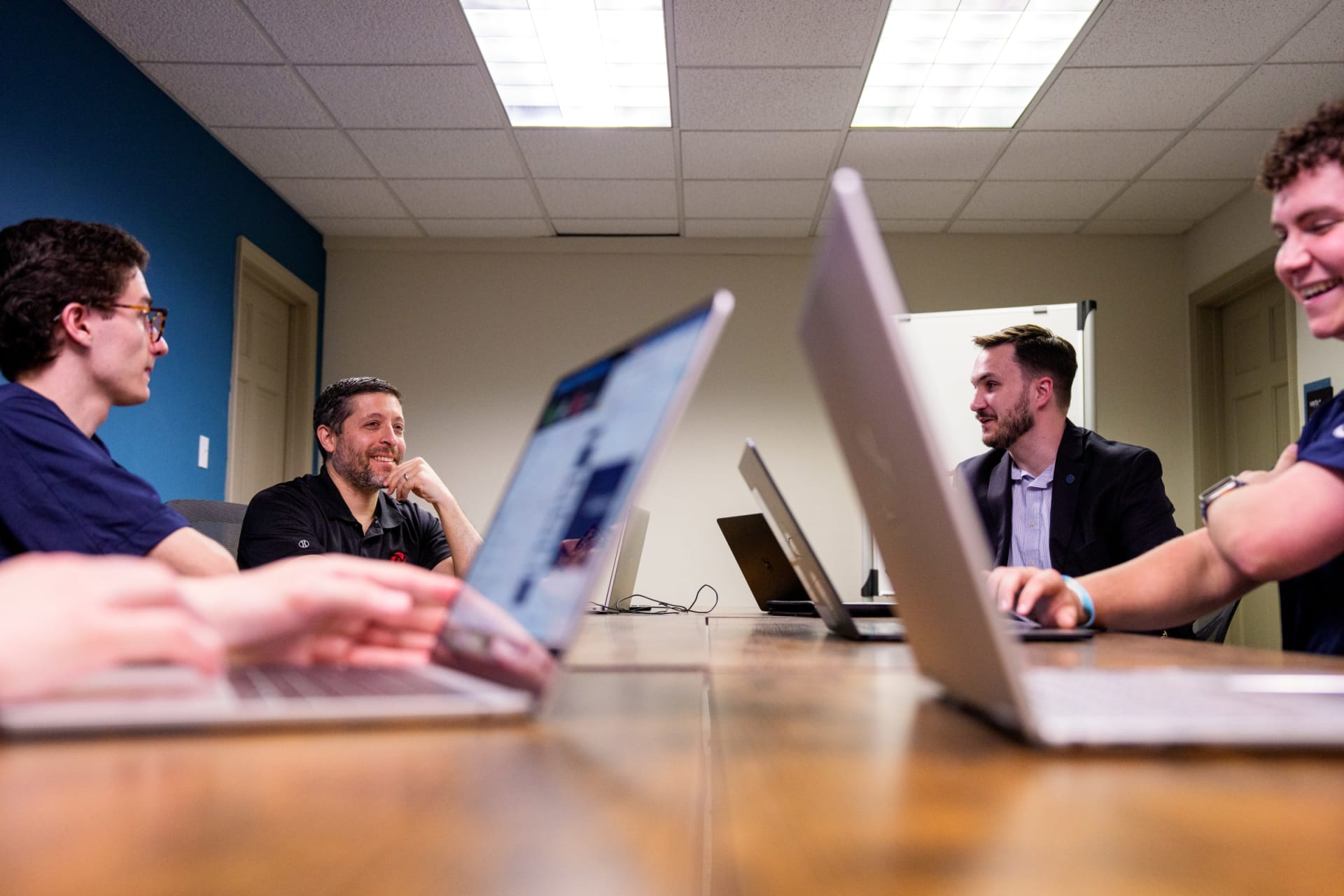
On the third floor of Reynolds Hall at West Virginia University, real-world challenges are the curriculum.
The problems arriving in the room are pressing and practical. A small business owner trying to stitch together three systems just to send an invoice. A nonprofit leader buried in operations with little time left for the mission. A state office racing a federal deadline and trying to get it right.
Students in Data Driven WV aren’t working through classroom hypotheticals. They’re solving complex problems, the kind most organizations don’t have the time, staff or resources to solve on their own.
![[FETC] [2025-08-23] Earn a CDL 1](https://res.cloudinary.com/mytown/image/upload/f_auto,q_auto,c_limit,w_540/spotlights/chkiaoujerahxlckcnql)
“The work we’re doing is what real jobs out there are made of,” said Joshua Meadows, executive director of Data Driven WV and service assistant professor in the WVU John Chambers College of Business and Economics. “I never want a student to have the knowledge and the skills and still struggle to land a job. I want them to have experiences they can talk about. Those are the kinds of experiences we’re creating with students every single day.”
That idea powers Data Driven WV, an outreach center housed in the Chambers College that’s part consulting arm, part talent pipeline. Students, guided by faculty and staff, take on applied analytics and technology projects for partners across the state and beyond and they leave the program with more than a line on a resume. They leave with real experience and stories — the kind that actually hold up in an interview.
A student-built idea that grew
Data Driven WV started with students in 2019. Meadows is quick to say that — not as a disclaimer, but because it speaks to the heart of the matter.
![[DHS] [2025-05-23] Kidney Care](https://res.cloudinary.com/mytown/image/upload/f_auto,q_auto,c_limit,w_540/spotlights/uothomsqrogfrkj1jlsn)
“It was founded by a group of students in the Business Data Analytics master’s program, recently rebranded as the Applied AI and Data Analytics master’s program, who saw the tech gap in West Virginia,” he said.
They had already been doing consulting-style work in their capstones since 2016. What they realized was that need wasn’t confined to semesters and didn’t stop at the classroom door.
“Small businesses often can’t afford these services,” Meadows said. “But they still need them.”
So, the idea took shape. What if WVU became a place where any organization could bring its real-world problems and students could help solve them? Early support focused on workforce development, backed in part by an investment from WesBanco to help close the skills gap while building student experience.
![[MYB] [2026-02-10] Job Listings Page](https://res.cloudinary.com/mytown/image/upload/f_auto,q_auto,c_limit,w_540/spotlights/qd9sdo6tvhl5jxea4z8u)
The scope just kept growing.
“COVID-19 hit,” Meadows said, “and Data Driven WV got pulled into some really important work like helping build the state’s vaccine rollout systems, forecasting hospitalizations and personal protective equipment needs, and more.”
Brad Price, Management Information Systems and Supply Chain Management Department chair and associate professor in the Chambers College, said the whole program activated the University’s land-grant mission and an all-hands effort from students and faculty.
“Everyone went to work on this problem that the state saw as important,” Price said. “It’s what we do as the flagship, land-grant University. It’s our job to attack problems like this head-on.”
Hannah Bailey, now Data Driven WV assistant director, was part of that effort as a graduate student.
“When I first started, we were building the applications and dashboards the state used for COVID-19 vaccine tracking,” Bailey said. “I created some of those apps. The work didn’t just support the state. It shaped the program and all of us in it.”
A sharper focus: West Virginia businesses
When Meadows stepped into the director role, he narrowed the focus, putting West Virginia businesses at the center, creating a system, not a one-off internship model. Today, the work is split between pro bono projects and contract work. And like many organizations in the state, its funding is built on relationships with alumni who Meadows considers “a huge source of support.”
![[AGING] [2024-12-13] In-Home Services](https://res.cloudinary.com/mytown/image/upload/f_auto,q_auto,c_limit,w_540/spotlights/ropbl44m1kd43zhrw1fu)
That support also fuels leadership opportunities. Through student fellowships — launched by a large philanthropic investment from the Lewis family — top-performing students move into paid roles and lead project teams. These roles empower students to oversee consulting teams, and they provide early exposure to professional responsibility and autonomy.
On the other side, contract work helps sustain the operation.
“Hannah and I act as consultants,” Meadows said. “We bring students into those projects and into grant work as well.”
It’s a balance Data Driven WV manages well — built to serve but structured to last.
![[FMG] [2026-02-02] Emergency Weather Repairs 2](https://res.cloudinary.com/mytown/image/upload/f_auto,q_auto,c_limit,w_540/spotlights/y2ocqu3yood0lor1cixh)
Projects that scale — and ones that don’t need to
Ask Bailey what stands out, and she goes in two directions.
One direction showcases enormous scale like the COVID-19 dashboards and a current endeavor that could directly translate to the expansion of high-speed internet access to more than 60,000 households across the Mountain State.
“We’ve been doing a lot of work on the Broadband Equity Access and Deployment project,” she said. “There’s $1.2 billion coming to West Virginia and we’ve done analytics work to support it. No one has ever used machine learning to plan the allocation of funding like this. We have a plan right now that I feel very confident in, and we have done absolutely everything to make sure this money gets every West Virginian access to broadband.”
![[STJ] [2026-05-18] MyChart](https://res.cloudinary.com/mytown/image/upload/f_auto,q_auto,c_limit,w_540/spotlights/fyqedj5nzgofelvtqbp3)
Then she shifts — to something smaller, but just as meaningful.
“The ones that feel best, though, are the ones that really change things for one person,” Bailey said.
She points to #500Rising, a nonprofit created to rethink how women’s self-defense is taught. The mission was strong, but the delivery method and operations weren’t.
“She was drowning in the day-to-day running of the organization,” Bailey said of the nonprofit owner. “Everything was patched together. Data Driven WV stepped in with a student team and rebuilt the system from the ground up. We did a full audit and moved everything onto one platform — automated and streamlined. It took about a year. The result — she’s now traveling the world with her program, and she credits Data Driven WV with helping make that possible.”
![[STJ] [2026-05-18] Same Day Appointments](https://res.cloudinary.com/mytown/image/upload/f_auto,q_auto,c_limit,w_540/spotlights/glc2vptrxpjje75iyedp)
Those wins don’t necessarily earn headlines, but they do change lives.
Where failure is part of the lesson
One of the most remarkable things about Data Driven WV is that participants aren’t limited to those just in the Chambers College.
“We take students from across campus,” Bailey said. “They learn theory in their programs — and apply it here. If a student is willing to learn and work, we’ll take them.”
![[STJ] [2026-05-18] Senior Life Solutions](https://res.cloudinary.com/mytown/image/upload/f_auto,q_auto,c_limit,w_540/spotlights/romuhizinufqlr2wlbis)
For Buckhannon native and rising senior Makenzi Cutright, that was a big draw.
Cutright is majoring in Management Information Systems and Neuroscience, but she didn’t come to WVU with a tech background and didn’t plan on developing one while on campus. She joined Data Driven WV as a sophomore and found something the classroom alone couldn’t offer.
“More than anything else I’ve done on campus, this translates directly to my resume,” she said. “Employers want to hear about real projects. Every interview comes back to project work, teamwork, experience with failure, problem-solving — I can tie all of that right back to my experience with Data Driven WV.”
Cutright is now a Denton Fellow in the program, leading other students on projects. She said she also appreciates that it’s a safe place to make mistakes.
![[DHS] [2025-05-23] Primary Care](https://res.cloudinary.com/mytown/image/upload/f_auto,q_auto,c_limit,w_540/spotlights/uxjgdvofnhnwtmbb9ap7)
“Students are encouraged to think outside of the box and try things. This program really helps them build confidence and it’s so exciting to watch,” said Maggie MacCarthy, Chambers College recruitment specialist.
Artificial intelligence, genuine change
The timing of Data Driven WV’s growth also lines up with something bigger happening inside the Chambers College — something University leadership hopes resonates with current and future Mountaineers in a big way.
WVU recently launched a new bachelor’s degree in Applied Artificial Intelligence and Data Analytics, a program built around the same idea that drives Data Driven WV — theory only goes so far if students don’t know how to use it.
![[HANK] [2026-01-23] Rate Lock](https://res.cloudinary.com/mytown/image/upload/f_auto,q_auto,c_limit,w_540/spotlights/dmqkcxthbuh8978vmbue)
In a lot of ways, the classroom and Data Driven WV are solving different sides of the same problem.
The degree builds the technical foundation — programming, data modeling, machine learning.
Data Driven WV puts that foundation under pressure. It’s where students take what they’ve learned and test it against real stakes, real clients and real constraints.
That connection isn’t accidental. The Applied AI and Data Analytics degree embeds Data Driven WV directly into the curriculum through two required project experiences.
![[STJ] [2026-06-11] Healthy Hero Hustle 5K](https://res.cloudinary.com/mytown/image/upload/f_auto,q_auto,c_limit,w_540/spotlights/loal8iauj2klyxn7yh6w)
In their junior year, students take an AI consulting course where they learn professional consulting frameworks while working on a live client project designed to prepare them for internships and external engagement.
Then, as seniors, they complete a capstone project in partnership with Data Driven WV — a culminating experience that demonstrates they are ready to step into practice, not just theory.
Connection with clients, colleagues and the work really matters, especially in a field moving as fast as AI.
Students working with Data Driven WV are already using machine learning to inform broadband deployment across the state. They’re building systems for organizations that don’t have the resources to do it themselves. For Meadows, the degree and the program reinforce each other in a way that’s hard to replicate.
![[KELLEY] [2019-11-16] Here For What Matters](https://res.cloudinary.com/mytown/image/upload/f_auto,q_auto,c_limit,w_540/spotlights/qbew6mqjimibs7d3pqe0)
“You can teach concepts in a classroom,” he said. “But until a student has to sit across from a client, understand a problem and deliver something that works, it doesn’t fully click.”
Together, the Applied AI and Data Analytics degree program and Data Driven WV create a pipeline that starts with fundamentals and ends with experience students can carry into the workforce.
Because in a field defined by rapid change, the advantage isn’t just knowing the technology. It’s knowing how and when to use it when it counts. And just as importantly, when not to.
“These developments are about getting students workforce ready,” Price said. “In a world where industry and technology are moving at a breakneck pace, our students are expected to keep up. Programs like Data Driven WV are what differentiate WVU, giving our students an advantage. It’s not just about creating a technological edge but teaching them to communicate what is happening and why it matters. At the end of the day, our students are problem-solvers, and technology is the tool they are using to helping organizations get to the solution. That skill set is going to set them up for the rest of their lives.”
What comes next
“AI seems like a buzzword right now,” MacCarthy said. “But we’re teaching students how to actually use it — and how to bring that into the workplace.”
Bailey agreed — with a note of caution.
“It’s not going away,” she said. “But students need to learn how to use it thoughtfully.”
![[KESLING] [2024-03-20] Bundle Home and Auto](https://res.cloudinary.com/mytown/image/upload/f_auto,q_auto,c_limit,w_540/spotlights/kh4xppxhrmj1pyfqzgv4)
She knows students who come through Data Driven WV leave with more than technical skills. They learn how to ask better questions, how to work through uncertainty, and how to take something messy and find a way forward. Most importantly, they’ve learned the importance of showing up.
One day, the people interviewing them for their dream jobs will inevitably ask: “Tell me about a time you solved a real problem?”
When that happens, the students won’t need to reach. The story will be theirs to tell.
![[DHS] [2025-05-23] Pain Free Living](https://res.cloudinary.com/mytown/image/upload/f_auto,q_auto,c_limit,w_540/spotlights/xswzc9oud10whhzr94hg)
![[TWIN] [2025-08-08] Meadowlands](https://res.cloudinary.com/mytown/image/upload/f_auto,q_auto,c_limit,w_540/spotlights/sueaeb3swu4g4qwmu3x2)