Community Bulletin
For more than 120 years, the Elkins hospital now known as Davis Medical Center has been where the Potomac Highlands turns for care. Today that includes expert kidney care close to home — sparing many patients a drive out of the region. Read more →
This story brought to you paywall-free, courtesy of the My Buckhannon team and our community partners
Because technology is a part of our everyday lives, it may be difficult to imagine what the future of technology will look like, let alone what it has the potential of accomplishing.
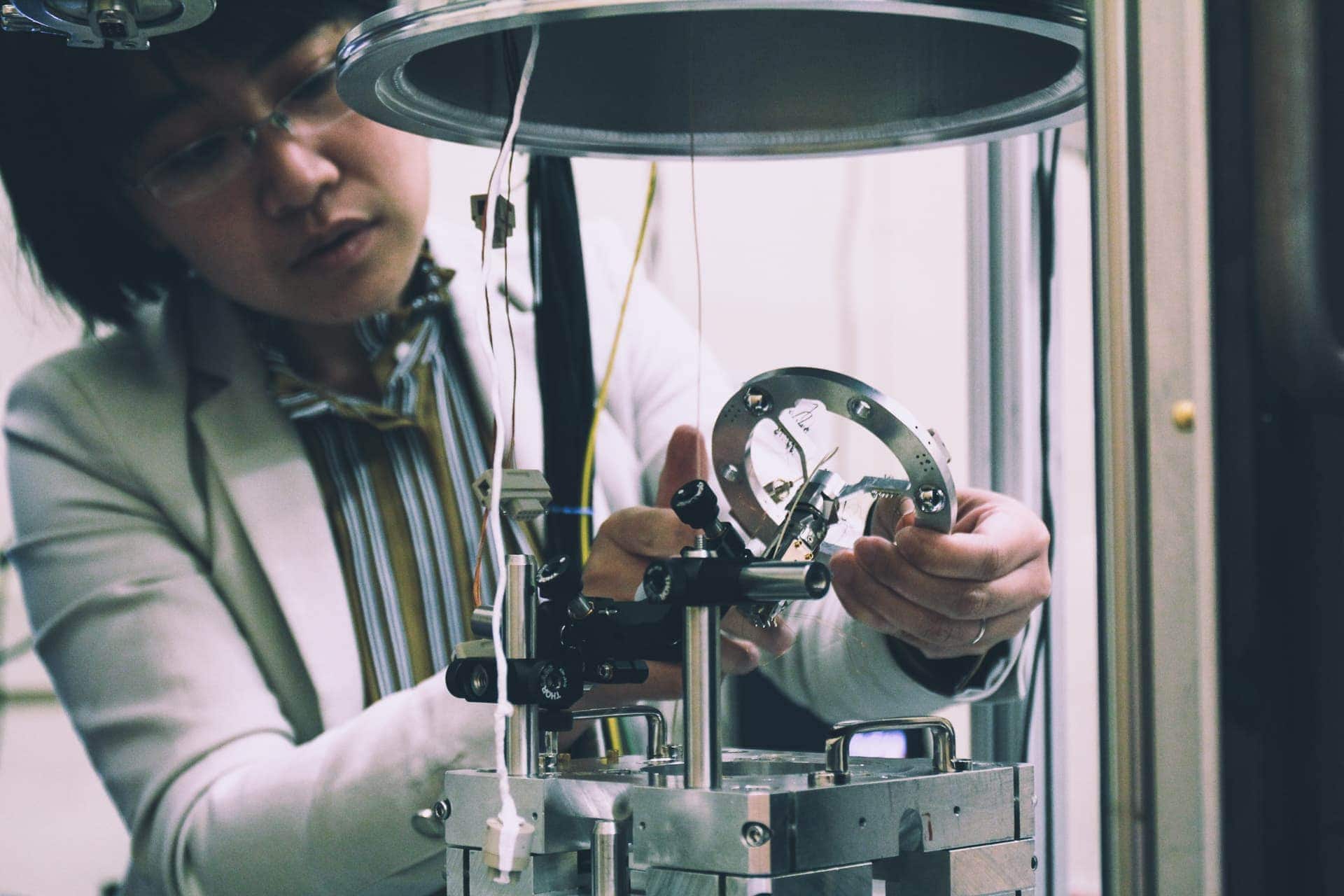
West Virginia University physicists Cheng Cen, Lian Li, Yanjun Ma, Ming Yang and Chenhui Yan are looking beyond the limits of classical computing used in our everyday devices and are working toward making quantum device applications widely accessible.
In a study published in Nature Communications, the researchers proved that superconductivity, which has a wide range of technological applications including being an integral component of quantum computing, can be manipulated by a weak, continuous ultraviolet light. This discovery has broad fundamental and applicational impacts, such as those in the development of quantum computation.
“This is why this is particularly significant,” said Cen, an associate professor in the Department of Physics and Astronomy. “We can control the superconducting state by using just a flashlight, instead of using a high energy laser or extreme conditions of pressure and temperature.”
The technology we are accustomed to today operates by storing information as binary zero and one and are limited to solving only one problem at a time. However, quantum computers perform differently to manipulate and store information by using a quantum bit, which has the ability to solve complex problems.

“The whole current fleet of devices was built by using a classic bit,” Cen said. “Now the question is, ‘How do we move forward?’”
According to Cen, a regular transistor can almost be as small as a single molecule and is used in modern technology to process information, but it cannot support a quantum bit. However, the superconducting material can.
Quantum computers have the potential to provide breakthroughs in materials and drug discovery, the optimization of complex systems and artificial intelligence.
“In the future, if we can understand these phenomena, we can very possibly use this light modulated superconductor commercially for devices,” Cen said.
By using a single atomic layer film of iron selenide grown by Yan, a postdoctoral associate of Li, the Robert L. Carrol Professor of Physics, the researchers could also switch its properties from a normal state to a superconducting state very quickly and reversibly by applying a voltage pulse. “Most remarkably, this effect is also nonvolatile, meaning that the light-induced superconducting state remains even after the UV light is turned off,” Li said.

This research was funded by the National Science Foundation and the Department of Energy.
“Drs. Cen, Li and Ma are an integral part of the Department of Physics and Astronomy’s development of a world-class condensed matter physics research program here at WVU,” said Earl Scime, chair of the Department of Physics and Astronomy. “This research highlights the cutting-edge research being done at WVU, and we are very excited to see their work appear in the very high-profile journal Nature Communications.”