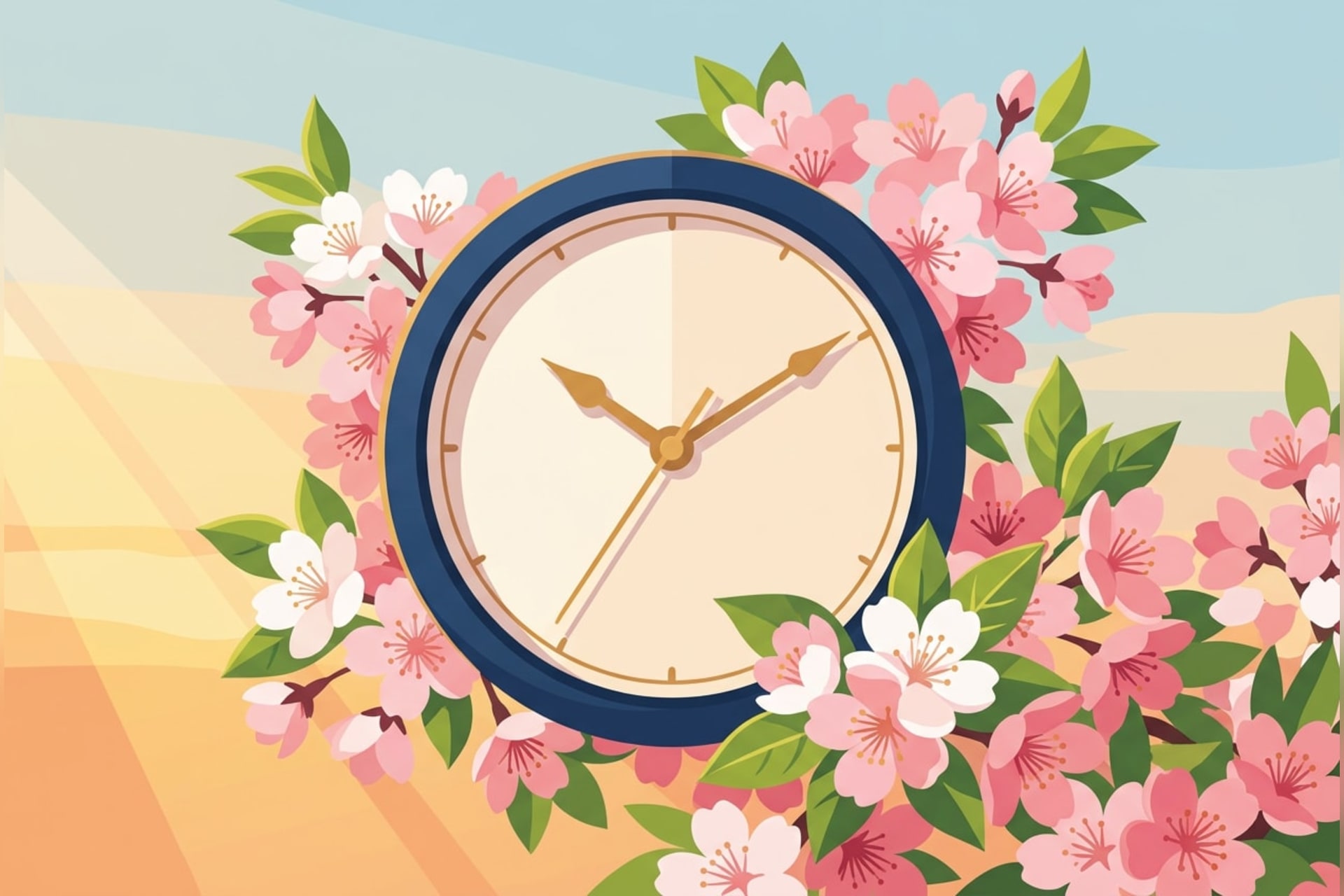
Set your clocks ahead before you go to bed Saturday night. Daylight Saving Time returns at 2 a.m. Sunday, March 8, which means most of the country will “spring forward,” losing an hour of sleep but gaining something many people have been waiting for all winter: evening daylight.
That extra hour of light after work or school is what most people associate with spring, and for good reason. When clocks jump ahead, sunsets push past 7 p.m. and the long, dark evenings of winter begin to feel like a distant memory.
But the tradition of shifting clocks twice a year has a longer, stranger history than most people realize — one that involves wartime energy rationing, decades of bureaucratic chaos and a debate that still hasn’t been settled.
Michael Downing covered much of the back-and-forth zaniness surrounding the time change in his book, Spring Forward: The Annual Madness of Daylight Saving Time, and other contemporary sources also tell the story of a world unsure of just what time it should wake up.

Benjamin Franklin is often credited with inventing Daylight Saving Time, but that’s a stretch. In 1784, while serving as American minister to France, Franklin wrote a satirical essay suggesting that Parisians were wasting money on candles by sleeping past sunrise. His tongue-in-cheek solution: fire cannons in the streets at dawn to wake everyone up.
He was joking. He never proposed changing the clocks.
The real push for modern DST came more than a century later. A New Zealand entomologist named George Vernon Hudson proposed it in 1895, when he wanted more evening daylight to collect insects after work. William Willett, a British builder, independently made a similar case in 1907, arguing that England was wasting sunlight every morning while people slept. Neither man lived to see it widely adopted.
Germany was the first nation to actually do it. On April 30, 1916, in the middle of World War I, Germany moved its clocks ahead to conserve coal. Britain followed weeks later. The United States adopted DST in 1918 with the Standard Time Act, but repealed it after the war ended — it was deeply unpopular with farmers, who found their schedules tied to the sun, not the clock.

During World War II, President Franklin Roosevelt imposed year-round “War Time” — essentially permanent DST — from February 1942 through September 1945, again as an energy conservation measure.
After the war, things got messy. With no federal requirement, states and even individual cities could observe DST however they chose. One stretch of highway might cross through multiple time zones depending on which counties had opted in. Bus and train schedules became a nightmare.
Congress finally stepped in with the Uniform Time Act of 1966, which standardized DST across the country: clocks went forward in April and back in October. States could opt out entirely, but they couldn’t set their own start and end dates.
The oil embargo of 1973 led to another experiment with year-round DST. Congress extended the time change through the winter, starting in January 1974, and the public hated it. Children were going to school in complete darkness, and the energy savings turned out to be modest. The experiment was quietly ended.

Through the 1980s and into the 2000s, DST gradually expanded. In 1986, the start was pushed earlier to the first Sunday in April. Then the Energy Policy Act of 2005 pushed it further — since 2007, DST has begun on the second Sunday in March and ended on the first Sunday in November, giving Americans about eight months of extended evening light each year.
Two states don’t observe DST at all. Arizona, which already deals with extreme summer heat, decided that extra evening sunlight in July wasn’t much of a selling point and has stayed on standard time year-round since 1968. Hawaii, close to the equator and with naturally consistent day lengths, has never observed it.
The bigger question — whether to get rid of the twice-yearly clock change entirely — has picked up real momentum in recent years. In March 2022, the U.S. Senate passed the Sunshine Protection Act by unanimous consent, which would have made DST permanent nationwide and eliminated the fall-back change. The bill stalled in the House and never became law.
The debate breaks down roughly into two camps: those who want permanent DST (keep the evening light year-round) and those who want permanent standard time (keep mornings lighter for health and safety reasons). Scientists and sleep researchers have largely sided with permanent standard time, arguing it aligns better with the body’s natural circadian rhythm. But permanent DST has more popular support — most people would rather have light at 6 p.m. than at 6 a.m.

For now, though, the twice-yearly ritual continues. Set your clocks ahead Saturday night, plan on a slightly groggy Monday, and enjoy what’s coming: longer days, warmer afternoons and the unmistakable feeling that spring has finally arrived.