Community Bulletin
For more than 120 years, the Elkins hospital now known as Davis Medical Center has been where the Potomac Highlands turns for care. Today that includes expert kidney care close to home — sparing many patients a drive out of the region. Read more →
This story brought to you paywall-free, courtesy of the My Buckhannon team and our community partners
It’s training day at the West Virginia University Police Department, and a new officer is making his way up to the exercise floor. Intimidated neither by the importance of his job nor the responsibility he bears for keeping the WVU community safe, he bolts out of the elevator before the doors are fully open and barrels across the room in a frenzy of energy, ready to get to work.
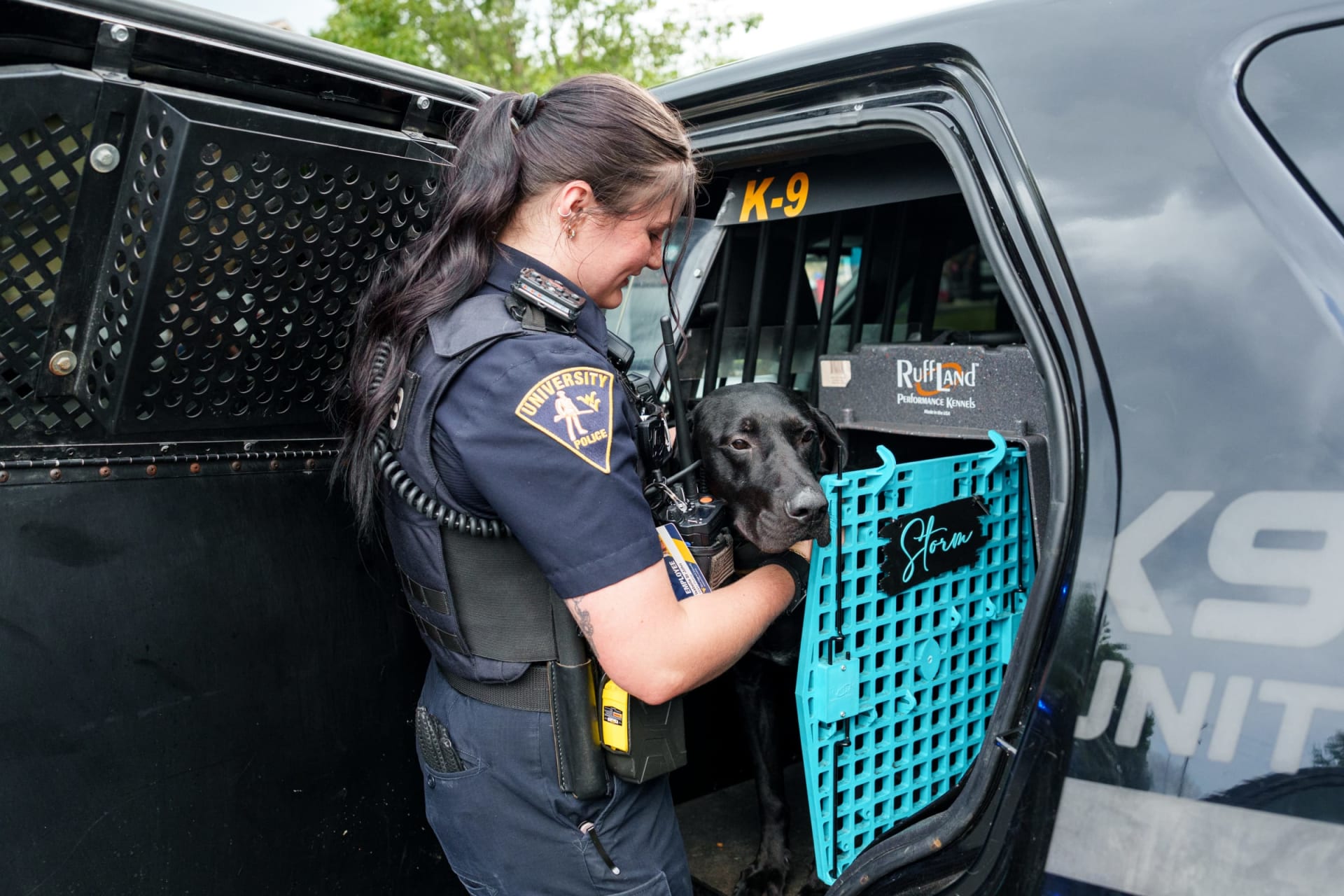
This frenetic and friendly officer is Storm, a 1-year-old black Labrador retriever and pointer mix who joined the department as a specially trained explosives detection K-9 in July 2025. Storm spends his on-duty days following his nose and patrolling the University for potential threats and he’s the most recent in a long line of hard-working, four-legged WVUPD officers with a license to sniff.
“We have had around 12 dogs since we started the unit,” Captain Zachary Camden of WVU Police Patrol Operations said. “We began with explosives dogs in the early 2000s, and then we also got the first of our narcotics dogs in 2008.”
Narcotics dogs focus on a select few odors — like marijuana or cocaine — whereas explosives dogs like Storm need to recognize around 25 different scents. And while that may seem like a mammoth task, a dog’s nose is up to the challenge. They have 300 million olfactory receptors, while humans have only six million. Moreover, they’re willing and easily motivated partners.
“At the end of the day, it’s a game for the dog,” Camden said. “We reward them with whatever they love.”

Indeed, the young K-9 does get compensated for his efforts, like everyone else. But Storm’s “paycheck,” as the officers call it, isn’t monetary — it’s his favorite toy, a squeaky rubber ball, thrown by his handler, Officer Isabella St. John.
Taking Morgantown by Storm
Every day, Storm goes to work with St. John, a 2023 WVU graduate from Hebron, Kentucky. While he’s still fairly new to the force, he’s a loyal partner who’s eager to learn.
“We train, exercise, and go on walks around campus,” she said. “And then he comes home with me.”
St. John knew she wanted to take a law enforcement career path when she transferred to WVU in her sophomore year.

“I was on the WVU competitive cheer team and finished the three years I had left of college here,” she said. “I majored in Criminology and minored in Forensic and Investigative Science.”
Her undergraduate experience left a lasting impression, especially a semester with Walter DeKeseredy, professor and Anna Deane Carlson Endowed Chair of Social Sciences and director of the WVU Research Center on Violence.
“He taught a class on violence against women,” St. John said. “The way he spoke about the topics and his passion for them — I can remember almost everything I was taught, and I use it when responding to calls that may involve domestic violence or sexual assault.”
Her time as a student gave a perspective she values and uses as a law enforcement officer.
“I can directly relate to students and the experiences they face while being here,” she said. “It helps me understand where they are coming from and how to help them.”

The fuzz
St. John’s K-9 partner is an essential part of what she does. Storm may be a young team member, but he’s always with her on their afternoon shifts.
“I love what I do for many different reasons,” she said. “There is a lot of help I can give to the community in my position as a police officer and a K-9 handler. I love my job because of Storm. I’m lucky to have such an amazing dog.”
K-9 Storm isn’t the only WVUPD officer who works for squeaky toys. K-9 Chuck, a yellow Lab who was born and bred in Holland, spends his days at the side of Officer Ethan Stepp, waiting for a chance to take his own bite out of crime.
Storm and Chuck are certified through the National Police Dog Association and learned the ropes in police dog school at Shallow Creek Kennels in Sharpsville, Pennsylvania, where their handlers underwent similar, rigorous instruction.

“When I got there, they had him trained and ready to go,” Stepp, a graduate of the WVU Wildlife and Fisheries Resources Program, said. “I took a six-week course, there, to learn how to work the dog. We trained with the dogs all day, Monday to Friday.”
Like Storm, Chuck is excited by his work. When he finds a suspicious substance, he sits and turns to look at Stepp. This is an alert, at which point Stepp determines what Chuck has found. And, like Storm, Chuck’s paycheck is his favorite ball — Stepp throws it immediately after the dog alerts as a reward for a job well done.
The work comes naturally to both Storm and Chuck.
“These dogs were selected from a young age and have a pretty high drive, and that’s what we like to see,” Stepp said. “He knows how to do his job. He knows what he’s smelling for. We do have a search command if we want to conduct a search in a specific area, but usually, when I get Chuck out at work, he’s already ready to go. He’s already looking for that odor, because he just enjoys it so much.”
Serving, protecting

St. John and Stepp need to be prepared, as their dogs may be requested for a search at any time. Big events — like games and large WVU community gatherings — require careful planning, prep work and a team effort. The night before a game, WVUPD works with agencies like Homeland Security, the FBI and the West Virginia State Police to sweep the stadiums. Once the human officers have conducted their searches, Storm and Chuck go to work with their handlers. The dogs can accomplish in a few moments what would take people and equipment hours.
“We’ll take care of the North Gate, the suites, and then the West Concourse,” Stepp said. “We’ll do a check of the vendors there and then the press box from the top down.”
On game day, the dogs have their work cut out for them, searching buses, bags and equipment for both teams and their bands. Some days are extra chaotic.
“Last year, Pittsburgh had their visiting team band come down — five or six buses,” Stepp recalled. “We had them line up, and then we ran the dogs along the buses, checked all the bags, and then once they were clear, we let the band come off the bus and do whatever they needed to do.”
On a busy weekend like Homecoming, Storm and Chuck have to search other events, like the annual parade route, too. Nevertheless, the K-9 officers don’t back down.

“It’s a lot of resources, a lot of effort, and a lot of work for the dogs,” Stepp said. “But they enjoy it.”
Long tail of the law
Many law enforcement agencies only have narcotics dogs, which makes Storm and Chuck even more important, not just to the University community but to the whole state. As explosives detection dogs, they’ve been called to other counties when necessary, including the Wheeling airport to prepare for a presidential visit. The dogs have also gone to federal buildings around the state and can respond to schools in all 55 counties if someone calls in a bomb threat.
It’s just another day for Storm and Chuck, tracking down trouble and doing what they love. For their handlers, however, the opportunity is a rare one, because not everyone is cut out to partner with an eager K-9.
“You need to have a strong desire to do this work,” Camden said of St. John and Stepp. “I’ve seen a lot of handlers, and you can’t just pull somebody in and make them a K-9 handler. It is such a different specialty in this line of work, and you either have it or you don’t. And we’re fortunate — we’ve got two great officers here in our department. They want to do this job they love and take care of the dogs.”

The K-9s, in turn, make the job worthwhile. St. John and Stepp have bonded with their dogs, who have become family. At home, Chuck plays with the other dogs and enjoys walks until it’s time to go to work.
And when they do go to work — protecting, serving and sniffing — the department’s bounciest officers are in good hands.
“The University takes care of our unit,” Camden said. “It provides any medical care that the dog needs while it’s in service. WVU makes sure we have all the food, all the treats, all the balls, all the beds — anything that you can think of. We’re very fortunate, because these dogs are a part of our family.”
Story by Laura Jackson.