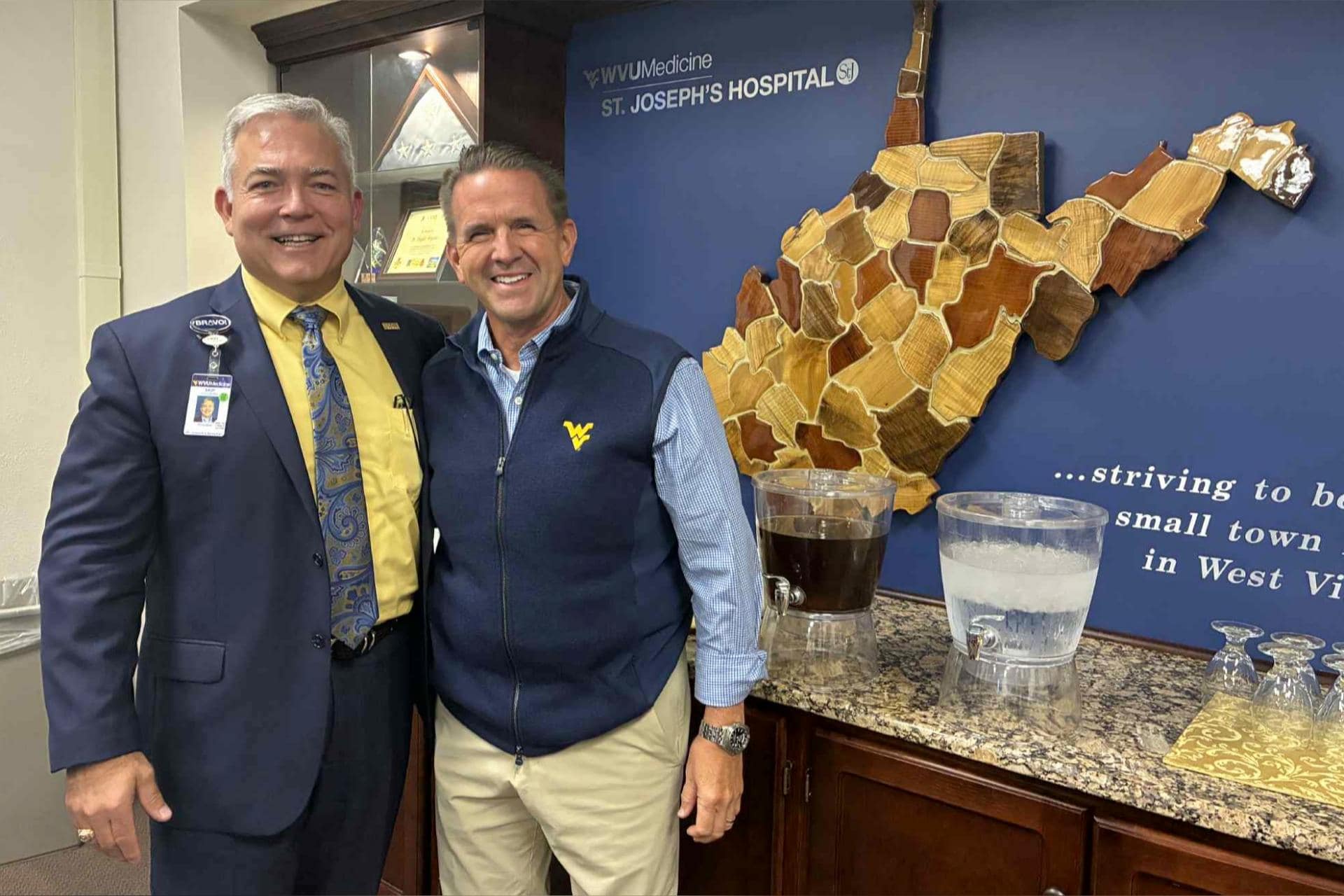
On a whirlwind tour of West Virginia, new WVU President Michael Benson stopped in Buckhannon this month to see firsthand how St. Joseph’s Hospital — part of WVU Medicine — delivers care close to home while serving as a vital link in the university’s statewide healthcare system.
On his 18-county swing through West Virginia, Benson offered a message of innovation and community connections — from preparing students for an AI-driven workforce to recognizing the lifesaving impact of facilities like St. Joseph’s Hospital.
“We started this tour in Hancock County and made our way south – 18 counties in five days,” Benson said of the tour, which kicked off just a few weeks after he officially started the job on July 15.
“It’s been really gratifying to meet people in different communities and hear from them how important the university is, whether it’s the Extension Service 4-H camp, the fact that a son or daughter went there, or the fact that WVU Medicine has a facility like we have here in Upshur County,” he said. “This is a state where you all know each other. I love hearing those stories. It makes it personal. It makes it real.”
Benson brings more than three decades of experience in higher education to Morgantown. Before coming to WVU, he served as president of Coastal Carolina University, where he secured a $10 million gift — the largest in the school’s history — and championed the renewal of a local-option penny sales tax that will support public and higher education for decades. His earlier presidencies included Eastern Kentucky University, Southern Utah University and Snow College in Utah, where he was appointed at age 36, becoming the youngest college president in the history of the Utah system.
In addition to his administrative leadership, Benson has maintained an active academic lifestyle, focusing on the role of the research university in American society. His book, “Daniel Coit Gilman and the Birth of the American Research University,” was named by Forbes as one of the Best Higher Education Books of 2023.
Benson said he was quickly learning to appreciate the role WVU serves across the Mountain State, from athletics to academic research to healthcare.
“It’s the only R1 land grant flagship university in the state,” Benson said. “There are 55 counties in West Virginia, and we’ve got a presence in every single one of them.”
Benson takes over WVU during a time of change for higher education, with demographic and technological shifts upending decades of tradition. A historian and author, Benson said the challenges ahead will require innovation as generative AI in particular becomes a daily part of life.
“I’ve been at this for 22 years as a college president,” Benson said, “so I’ve seen a lot of different trends. But I have never seen the pace at which AI has impacted learning and the dissemination of knowledge. We live in a technological age, but this is unlike anything anybody has ever seen.”
Benson said WVU is taking the challenge of adapting to an AI-future head-on by working to integrate it tightly into the academic curriculum.
“I don’t think you can ever get ahead of it, because it’s perpetually changing, but we want to teach our students and train our professional staff to use AI,” he said. “We’re looking at ways to embed it into our general education requirements — that classes must have an AI component so students can learn how to use it in a way that is appropriate.”
“Because when students get into the workforce – wherever they work — it’s almost guaranteed that AI is going to be a part of their daily routine.”
Benson also brings a global perspective to the job. He has lived and studied in Italy, England and Israel, and earned his doctorate in modern history from the University of Oxford as a Rotary Foundation Scholar. He also holds master’s degrees from the University of Notre Dame and Johns Hopkins University.
As part of Benson’s stop in Upshur County, he toured St. Joseph’s Hospital and learned about the healthcare facility’s role in local health from CEO and President Skip Gjolberg.
“We’re trying to provide the right care right here at home, and we have grown our services a lot in the 10 years since we became part of WVU Medicine,” Gjolberg said.
Gjolberg highlighted the expansion of services offered locally as part of the university’s healthcare system, from women’s health and cardiology to general surgery, podiatry and wound care. He also pointed to their achievements like the five-star Medicare rating, something awarded to only about 7 percent of hospitals nationwide.
“We improved our financial position quite a bit when we converted to critical access, and we’re following what we call our ‘culture of excellence,’” Gjolberg said. “Cleanliness is one thing that people always seem to speak about here at St Joe’s. It’s the cleanest hospital they’ve ever seen.”
WVU Medicine’s network extends across the state, with hospitals, clinics and outreach programs in all 55 counties. Facilities like St. Joseph’s Hospital not only provide essential care in their communities but also connect patients to the expertise and resources of a major health system. That integration, Benson noted, reflects the university’s land-grant mission of serving all West Virginians.
However, Gjolberg also outlined a number of challenges facing healthcare in general and St. Joseph’s Hospital in particular, from legislative and legal battles to the need to expand.
“We want to build,” he said. “We are expanding. We’re using every nook and cranny, and we need more room.”
Benson said his visit to Buckhannon reinforced what he’s seen across the state — that WVU Medicine’s reach is both broad and deeply personal.
“As a historian, I was so happy we got to start in Hancock County and go to Independence Hall, because it gives you a perspective on the courage, the temerity, the vision that people had back in 1862 to convince Abraham Lincoln to allow us to become the 35th state,” the new WVU president said. “I’ve met a lot of West Virginians, and what strikes me as a common denominator is that they’re very proud of their state.”
Benson also thanked his team at the university, many of whom accompanied him on his introductory tour of the state.
“I appreciate the vim and vigor and the pep and the grit that West Virginians have, and it’s been manifested everywhere we’ve gone,” Benson said. “I am going to be the face of the university, but West Virginia University belongs to the citizens of this state.”