Community Bulletin
For more than 120 years, the Elkins hospital now known as Davis Medical Center has been where the Potomac Highlands turns for care. Today that includes expert kidney care close to home — sparing many patients a drive out of the region. Read more →
This story brought to you paywall-free, courtesy of the My Buckhannon team and our community partners
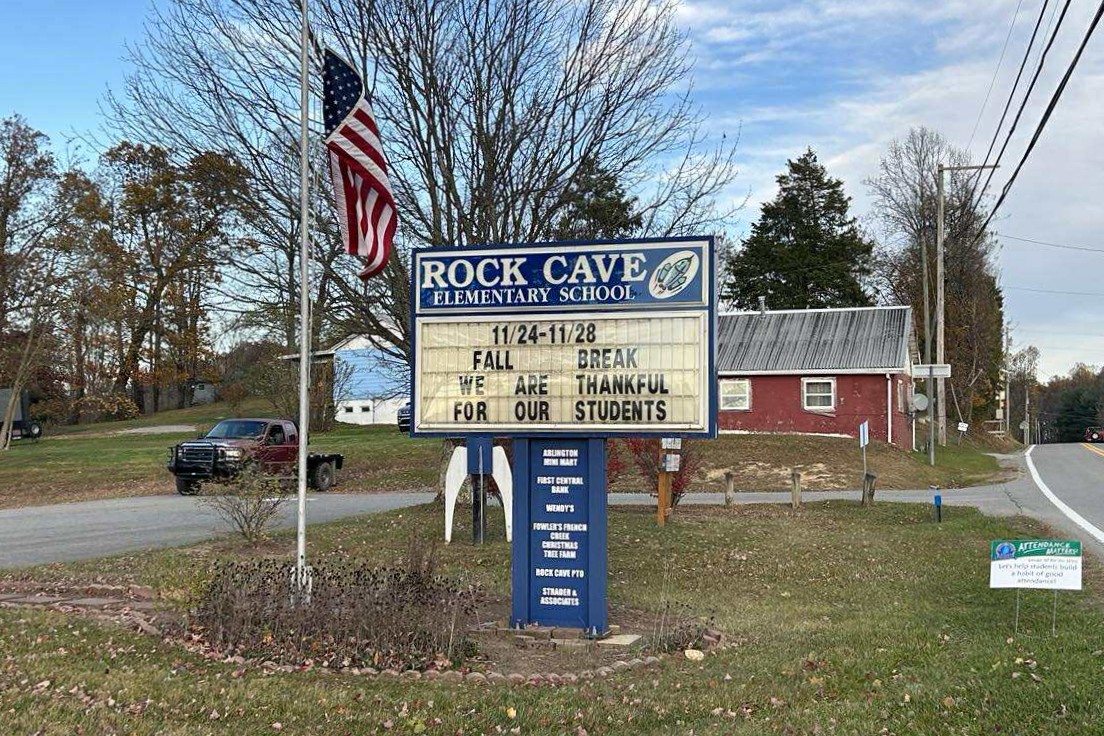
The West Virginia Board of Education approved the closure of Rock Cave Elementary School on Wednesday, ending months of community efforts to save the southern Upshur County school.
The board voted to close Rock Cave and consolidate its students into French Creek Elementary School at the end of the current school year. The board also granted a waiver allowing bus routes to exceed the recommended transportation time, meaning elementary students can be on buses more than 45 minutes each way.
Before the vote, two Upshur County residents addressed the board directly, making one final plea to keep the school open. Each was given two minutes to speak.
Abigail Jeffries urged the board to give the community more time, noting that legislators have indicated plans to address the school funding formula this session.
“I’m confident our elected officials will work with staff and stakeholders in the community to regain trust and find funding solutions to keep all of Upshur County schools operational and thriving,” Jeffries said.

She also pointed to a recent announcement that First Energy plans to build a natural gas plant in Harrison County, which she said could bring population growth to Upshur County due to its affordable living costs.
“Being heavy-handed with school closures will cause detriment, both known and unknown, not only to the communities, but also to the state’s growth,” Jeffries said.
Amber Anderson, a special education teacher at Rock Cave, spoke about the impact on students with disabilities.
“I am the special educator at Rock Cave. I currently serve eight students. French Creek has 25. Next year combined, we will have over 30 students with IEPs, many with high needs,” Anderson said. “Small class sizes at Rock Cave allow us to meet these needs. A larger school will stretch services to an unsustainable level and compromise the education of our most vulnerable students.”
Anderson also spoke to the school’s role in the community.

“Rock Cave is not just a school, it is a safe haven in the heart of our community,” she said. “We host events like the Easter egg hunt and the SUBA Christmas parade. We are a voting precinct and provide safe places for local children to play. Closing the school risks losing these traditions and a vital community connection that we have built.”
The decision was the final step in a process that began in August when Upshur County Superintendent Christy Miller initially proposed closing both Rock Cave and Tennerton elementary schools. The Tennerton closure was later abandoned when the county determined it could not fund renovations necessary to accommodate those students elsewhere.
Upshur County Schools remains under state control for problems that occurred during the COVID era, meaning a representative for State Superintendent Michele Blatt approved the closure at the Nov. 20 local board meeting. The five elected Upshur County Board of Education members — all of whom are new and were not in office during the financial issues that led to the state takeover — had no say in the decision.
Miller has said declining enrollment and reduced state funding make the current path unsustainable. This year alone, Upshur County Schools lost 183 students across all schools, translating to approximately $1.6 million in reduced funding.
Rock Cave Elementary was built for 154 students and now serves 71, she said.
The Upshur County closure was one of several the state board approved Wednesday as school systems across West Virginia grapple with declining enrollment and financial pressures.
Barbour County will close three middle schools — Belington Middle School, Philippi Middle School and grades 6-8 at Kasson Elementary/Middle School — and consolidate those students into Philip Barbour High School beginning with the 2026-2027 school year. Fifth-grade students from Philippi Middle will move to Philippi Elementary, and fifth-graders from Belington Middle will move to Belington Elementary.
Additionally, Junior Elementary School will close at the end of the 2026-2027 school year, with students from Junior Elementary and Belington Elementary moving into the vacated Belington Middle School building.
In Randolph County, the board voted to close two schools at the end of this school year. Harman K-12 School will close and its students will be distributed among Jennings Randolph Elementary School, Elkins Middle School and Elkins High School. North Elementary School will also close and merge into Jennings Randolph Elementary.
Unlike Upshur County, neighboring Barbour and Randolph counties remain under local control, and their elected boards voted on those closure decisions themselves.

The state board also approved closures in Logan, Roane and Wetzel counties.
After the delegations spoke, Board President L. Paul Hardesty addressed the crowd directly, thanking them for their respectful advocacy and acknowledging the difficulty of the situation.
“This is not easy for any one of you sitting here, and I understand that,” Hardesty said.
But he was blunt about the board’s limitations under current state law, pointing to three documents he keeps in front of his seat: the current West Virginia code, charter school requirements and homeschool requirements.
“There’s not much I can offer you in the way of a consolation and give you the outcome you desire based on what is currently housed in that book,” Hardesty said. “I want to be upfront and tell you that there’s not much that I personally can do.”

Hardesty said the core problem is West Virginia’s school funding formula, which was last addressed in 1982 and is based solely on student population.
“We continue to hemorrhage enrollment,” Hardesty said. “Somebody, somehow, some way, is going to have to factor in that we have rural counties with large square mileage but not a lot of kids. That has to become factored in somewhere in that formula, or these crowds will continue to grow as we continue to lose students.”
He noted that while the state’s population shrinks, the geographic challenges remain the same.
“This time it’s six counties. Next time, will it be nine? Will it be 10? I don’t know, but the mileage in our counties remains the same. Our population shrinks, but yet the way we’re counted by headcount for funding remains the same,” Hardesty said.
“We have to get a legislative fix with regards to the formula, or we’re going to continue to have tough conversations as we’re having today.”

Tiffany Raines, a teacher at Roane County High School and parent who spoke during the delegations, echoed the call for funding reform.
“West Virginia’s constitution promises a thorough and efficient system of free schools. Yet instead of fixing our outdated funding formula, the state continues expanding the Hope Scholarship and encouraging charter schools, moves that divert funding from public schools and further destabilize rural districts already struggling with declining enrollment,” Raines said.
She noted that West Virginia has seen more than 70 school closures since 2019.
“These closures have not stabilized finances, reversed enrollment loss or strengthened rural communities,” Raines said. “They have hollowed out our small towns and pushed families farther from opportunity.”
Raines called the closures “a predictable result of a funding formula that penalizes small and rural counties.”

“As long as enrollment and local share determine state aid, districts like ours will continue facing cuts and consolidations regardless of what is best for our children,” she said.
In Upshur County, 150 students receive the Hope Scholarship this year, decreasing the county’s budget by about $1 million annually, according to school officials.
“The Hope Scholarship is hurting us, and I know that next year it’s looking to skyrocket,” Jenny Davidson said at a November board meeting. “We’re taking West Virginia school money, we’re writing checks, and we’re sending them to states all over the place — anywhere but here.”
Upshur County also faces pressure from a failed excess levy that previously brought in $3.5 million annually. But Jeffries, one of the two Upshur County residents to address the board on Wednesday, noted that officials have indicated that the county will begin regaining local control incrementally in February 2026, which will be a chance to rebuild trust in the community.
“Time will also allow a future levy to pass,” she said. “Upshur County has traditionally supported students with a levy, and the reason for not doing so in the last election cycle was the misappropriation of funds by a past superintendent and the lack of transparency that has occurred since. We’re confident that a levy will again pass once the Upshur County Board of Education has regained control from the state.”

The West Virginia Board of Education voted to approve the closure without comment. Rock Cave Elementary will close its doors for the final time at the end of the 2025-2026 school year.