Community Bulletin
Bundling home and auto can lower your premiums — and at Jen Kesling State Farm in Buckhannon, a full-service agency with a 4.9-star Google rating across 300-plus reviews, a bundled quote is a phone call away. Read more →
This story brought to you paywall-free, courtesy of the My Buckhannon team and our community partners
Story by Micaela Morrissette
To the casual observer, the fish doesn’t look like much. It certainly doesn’t look like a zebra, despite its name. It’s an unassuming minnow, small, pale and darting.
But to Eric Horstick and his students at West Virginia University, it offers an incomparable, unobstructed view of the mysteries of human brains and behaviors.
An associate professor of biology at the WVU Eberly College of Arts and Sciences, Horstick studies the zebrafish, a freshwater fish native to South Asia but sold in pet stores around the world thanks to its hardiness and low cost of care.
Geneticists love zebrafish because they reproduce so quickly and share around 70% of their genes with humans.

For Horstick, however, it’s more than that. He believes zebrafish and similar species can help answer fundamental questions of neuroscience.
More precisely, he thinks their brains and behaviors may reveal why and how it happens that righties and lefties are found among not just people, but whales, pigeons, cats, octopuses and almost every animal species on Earth.
DARKNESS AND LIGHT
“Handedness” is how Horstick describes the quality of favoring one’s right or left hand (or eye, or claw or hoof). If an animal has a body with two distinct sides, he said, then it probably has handedness and is either a righty or a lefty.
Handedness looks different in different species. In humans, handedness might mean raising the right or left hand to protect the face from an incoming projectile. In fish, it might mean circling to the left or to the right when searching for prey in darkness.

These asymmetrical preferences or biases in behavior are nearly universal across different species — except they don’t happen in fish that have evolved over millennia to be genetically blind, such as a species of tetra found in the complete darkness of Mexican caves.
Horstick believes that’s because exposure to light early in a fish’s development may determine those biases.
“A really exciting early observation we made was that whether one particular fish tends to turn rightward or leftward isn’t an inherited preference, but a bias that’s created early in development by outside forces,” he said. “One of the first papers to come out of my lab here at WVU was about our study showing that whichever one of a fish’s eyes got light at a critical stage in its development led to changes in the brain directly correlating with whether the fish ended up being a lefty or righty.”
But because blind cave fish have no visual pathways, they don’t develop the same leftward or rightward circling behaviors as zebrafish or the sighted tetra fish that are their close relatives, he said.
“These two nearly identical species, one sighted and one blind, one developing left-right preferences and one not, give us a perfect opportunity to test asymmetrical biases that are driven by light. We can cross them, create hybrid offspring, and look at who’s handed, who’s not, and why. We can look at what about their brains is different. There are no other species on the planet that we could do that on.”

PREDATOR AND PREY
In humans, handedness is complex. We’re “weird,” according to Horstick, because as a population we’re predominantly right-handed. That makes us a massive outlier among animals.
Some studies suggest genetics plays a role in human handedness, but developmental — and cultural — factors are also at play, Horstick said.
“If handedness is nearly universal — what’s the benefit?” he asked. “Why did handedness develop in the first place, much less across nearly every species? After all, if I’m thinking about hunting or even just surviving, I probably want to use my left hand as much as my right hand. So it’s fundamentally strange that these preferences exist at all. Yet they exist everywhere.”
One speculative explanation for handedness has to do with behavioral efficiencies. Horstick’s research indicates that zebrafish may be searching or foraging when they move in circles — activities in which a predictable pattern like consistently circling leftward in search of food can be very effective.
But, he added, “In nature, predictable patterns are exploitable by predators. There are some really cool studies about the aquatic tentacle snake, which understands the behavior of its prey fish so well that it can move its body and elicit a startle response that will send a fish swimming directly into the snake’s open mouth.
“As an individual, you want efficient search patterns to find resources. As a population, those predictable behavioral patterns are exploitable. We need some degree of randomness across the population to ensure the species survives when individuals don’t. The split between lefties and righties introduces that randomness. In humans, we don’t have that.”
SOUTHPAW AND ORTHODOX
Horstick is a righty. So is his undergraduate research assistant Audrey DelGaudio, though the research group does include a couple lefties.
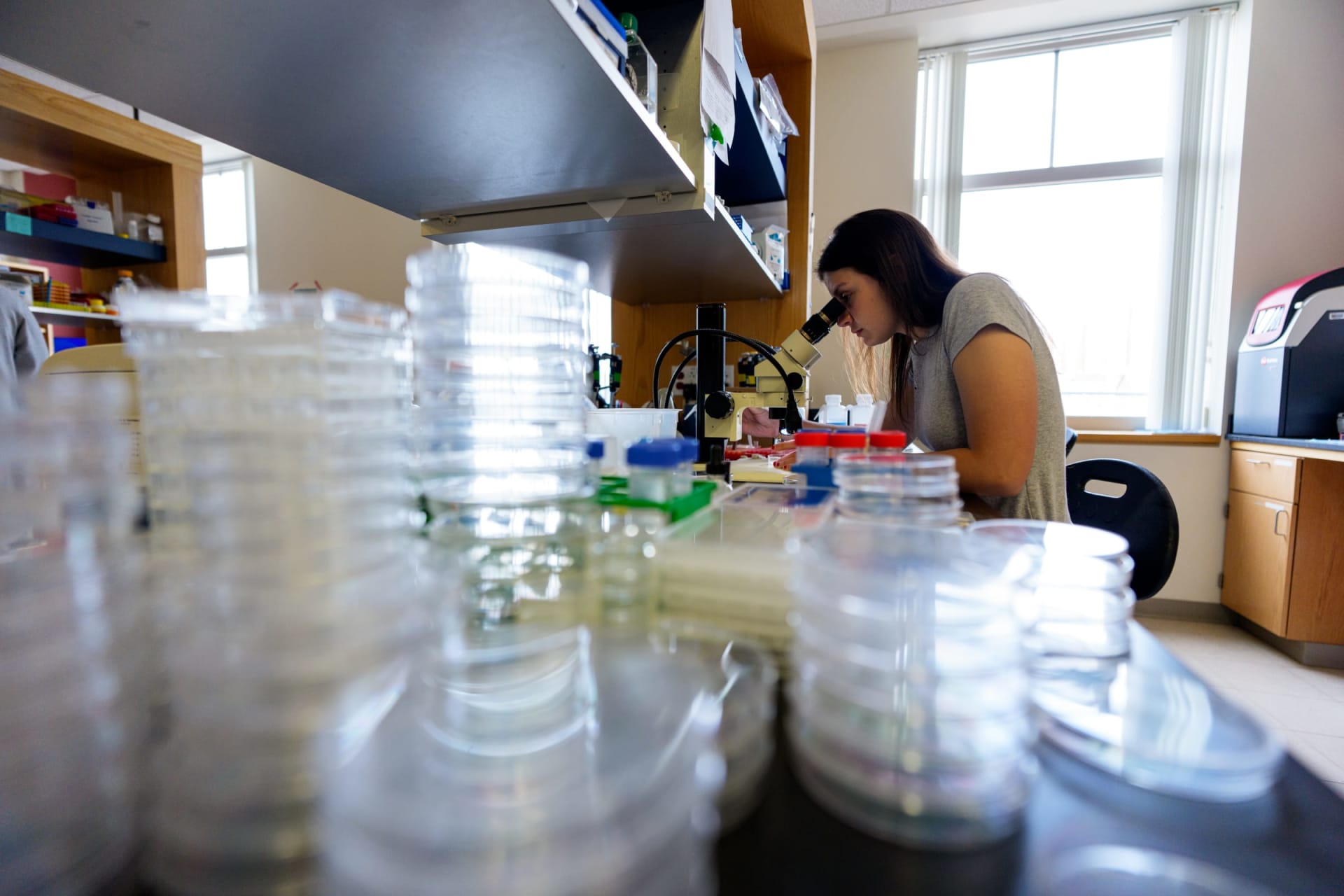
A double major in Forensic Examiner and Biology from Dallas, Pennsylvania, DelGaudio joined the Horstick Lab in her junior year and began working closely with graduate student mentor John Hageter.

“I’ve helped John with data collection and with running behavior in the ‘fish gym,’ which is what we call the behavior room,” she said.
“Zebrafish do this circling behavior when the light turns off, and just like different people are left- or right-handed, individual zebrafish have a bias to turn rightward or leftward. So John and I put the zebrafish in a tray with the lights out and tracked them to see whether they had a left- or rightward bias, and if so, whether that bias was the same over two separate tests.”
DelGaudio and Hageter were surprised to find that although each fish turned in one preferred direction every time, their preferences weren’t the same over both tests.
“I hope we’re going to get to look into that more,” she said. “We also want to start doing a little bit of social behavior with them, seeing what will happen if we put a big group of leftward turners in with rightward turners.”
Horstick said discoveries like theirs, which add wrinkles and new questions to the research, are how innovation happens.

“When we talk about science, we often convey a very disciplined approach to formulating and pursuing our hypotheses. The fun parts of science are the exact opposite of that. A thread comes up out of your shirt, and you start pulling and tugging on it, and we see what happens next.”
DelGaudio is one of over 20 undergraduate researchers to have passed through Horstick’s WVU lab, with about half of them coauthoring a paper for submission to peer-reviewed academic journals. He knows from personal experience what it’s like for these students to conduct original independent research.
“I always loved science and biology, and I got involved in a lab my sophomore year of college,” he said. “Doing research in the lab is what made the things in the textbooks tangible. I could see how knowledge is gained, and it gave me a profound respect for it. I learned that I can read in one second a sentence representing three lifetimes of work.”
Horstick began thinking about left-right behaviors when he was a postdoctoral researcher at the National Institutes of Health, but when he brought his observations to the principal investigator of his lab, “my boss was having none of it,” Horstick said.
“He didn’t buy it. But he did give me the room to go test it out. Bit by bit, experiment after experiment, evidence emerged that these asymmetrical behaviors are imposed in the brain. It shows how important it is to make sure people have space to explore their ideas.”

X AND Y
One of DelGaudio’s responsibilities includes maintaining the zebrafish that the lab breeds — and that’s true for Horstick as well.
“One of my principles is that to respect the research, you have to respect the animal and be part of that process,” he said. “We have about 2,500 adult fish right now, and everyone in the lab helps feed them and check the filters. It’s all hands on deck.”
The daily work of the lab focuses on creating different lines of fish, with each line carrying distinct mutations and genes of interest.
To some of those breeding lines, the researchers add “optogenetic” tools, allowing them to turn on a specific group of neurons in the fish’s brains that activates left-right turning behaviors on demand.

In others, they develop “transgenics” that express fluorescent green jellyfish proteins, which light up neurons in the brain. Horstick’s team can then see brain activity that’s significantly stronger on one side or the other, depending on whether the fish is a righty or lefty.
“Seeing those neurons glow is how we’re able to pop the hood on these fish and watch what’s happening. Even though we believe these bilateral asymmetries are universal, we focus on fish in part because we can watch their brains working in real time. We can see and study the entire brain, whole and intact,” Horstick said.
Within 13 or 14 hours from fertilization, the larvae the lab breeds start looking like fish, with identifiable eyes, heads and beating hearts.
Within four or five days, they’re swimming freely, exploring and interacting with their environments.
“That means we can make big genetic changes very, very fast,” Horstick said.

YOU AND ME
Horstick knows patterns of right- and left-handedness tug at students’ senses of curiosity and fun.
But his work extends beyond the basic question of what makes people righties or lefties. The zebrafish hold broader biomedical promise, Horstick said.
They could help scientists understand how the brain develops during critical periods early in life.
They might even help reveal how genetic mutations cause disease in humans.

For instance, in 2024, Horstick began collaborating with a group of biochemistry and molecular medicine researchers led by Visvanathan Ramamurthy, chair of Biochemistry and Molecular Medicine at the WVU School of Medicine on the Health Sciences campus.
Ramamurthy and his group study diseases of the retina, including a class of diseases caused by genetic mutations in proteins called “tubulins.”
When genetic defects occur in one specific tubulin, TUBB4B, the result is complete blindness and deafness from birth in humans.
Because scientists don’t understand how that happens, the Ramamurthy Lab created a mouse model to study the disease — but the missing gene that causes humans to be born completely blind and deaf caused deafness in the mice but left them with perfectly normal vision.
“That’s when they asked us to give it a whirl in zebrafish to see what might happen,” Horstick said.

Horstick’s group discovered immediately that removing the gene in zebrafish caused severe retinal defects, just as in humans.
“This is a unique case in which the animal model that seems like it should be the closer fit to humans, the warm, fuzzy mouse, doesn’t re-create the problem,” Horstick said. “And maybe that makes sense, because although mice are a cornerstone genetic model system, they’re nocturnal. The fish, like humans, are diurnal. Whatever the explanation, we have landed on this connection to a severe human disease in need of research-based tools.”
He added, “We started out wondering a decade ago, ‘Why do I do things with my right hand?’ or ‘Why is this fish circling left while that one always circles right?’ Now, we’re pulling at all these different threads.”
Editor’s note: The use of animals in this project was evaluated by the WVU Institutional Animal Care and Use Ethics Committee. WVU is voluntarily accredited by AAALAC International, a peer organization that establishes a global benchmark for animal well-being in science.