Community Bulletin
The Healthy Hero Hustle 5K Run/Walk in Buckhannon will return for its third year on Saturday, September 19, 2026, as WVU Medicine St. Joseph's Hospital and West Virginia Wesleyan College team up again to benefit nursing students. Read more →
This story brought to you paywall-free, courtesy of the My Buckhannon team and our community partners
When we look back over the record of last spring’s baseball playing, we should consider that West Virginia accomplished something extraordinary in the baseball world. By her almost incessant winning and her exhibition of high-class baseball she inevitably attracted the attention of a greater part of the sporting world.
That plaudit could sum up the 2026 WVU baseball season, which culminated in the team’s first appearance in the College World Series.
But it actually appeared almost a century ago, in 1908’s Monticola yearbook.
WVU baseball began all the way back in 1892. Prior to 2026, the program’s most celebrated streak was during Steve Harrick’s reign as head coach from 1948 to 1967, when the Mountaineers won six Southern Conference titles and earned seven NCAA district playoff berths.
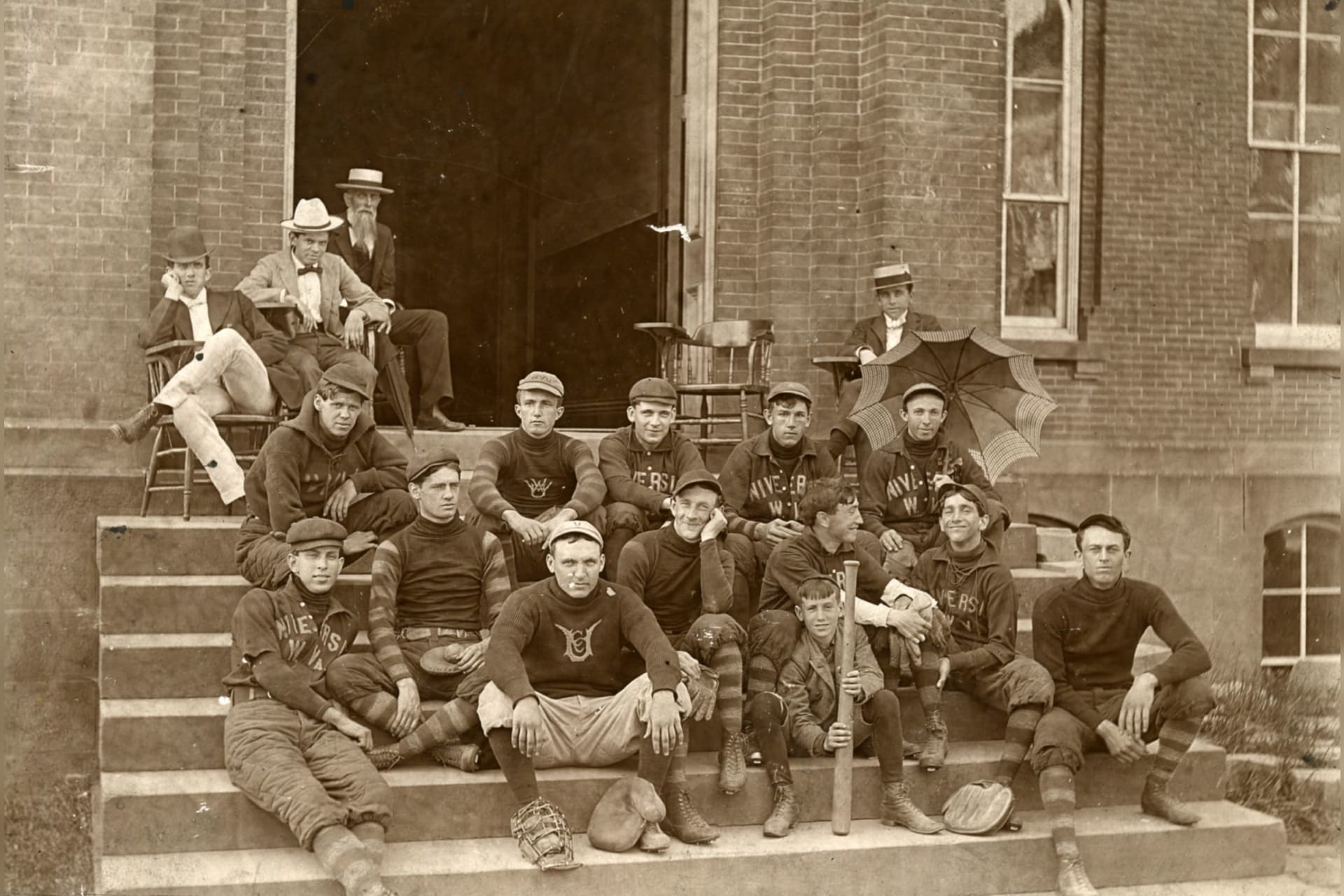
Lesser known, however, is the team’s success in the early 1900s, especially in the years leading up to World War I.

Instead of watching games from the comfort of the Kendrick Family Ballpark, early fans gathered at the Athletic Fields, where the Mountainlair now stands.
Rather than facing off against Big 12 opponents, the Mountaineers usually played traditional rivals such as Pitt, Marshall, Penn State and Waynesburg College. At that time, Waynesburg’s team included some professional players who worked in the local coal mines, and face-offs with WVU were often intense and heated.
Early WVU fans also had an especially strong antipathy for W&J — Washington & Jefferson College in Washington, Pennsylvania. And while “Country Roads” was still decades away, those fans did express themselves through song, such as this ditty sung to the tune of Yankee Doodle:
*W&J has come today
To play Old Gold and Blue — sir!
Poor Red and Black!
We’ll send you back,
With feelings black and blue — sir!*
Farmer boys who really knew how to play
During its third season in 1894, the baseball team played nine games against mostly independent teams. According to a retrospective in the 1928 Monticola, the season’s peak was a decisive victory over Rivesville Athletic Club:

Early teams were composed generally of farmer boys who really knew how to play baseball and the sport prospered, gaining the greatest part of the support from the student body and townspeople, until the team was playing schedules that included Yale and strong opponents on the Eastern seaboard, and Ohio State, Illinois and Notre Dame in the middle west.
Fans’ enthusiasm for the team became excessive at least once. As historians William T. Doherty Jr. and Festus P. Summers described it in their 1982 book on WVU:
After defeating Washington and Jefferson College in a baseball game and winning an oratorical contest at Bethany College in May, students rallied around a bonfire contrary to the order of a patrolman. When the officer attempted to make arrests, the students threw him down, broke his helmet, stole his mace, and ripped the brass buttons from his coat for souvenirs. Because of this episode, Thomas R. Horner, a law student, was arrested for assaulting an officer. Though defended by Dean Okey Johnson of the College of Law, Horner was fined $25 and costs.
In those days, W&J, not Pitt, was the archenemy of WVU, and the little-known first verse of official fight song “Hail, West Virginia” calls out W&J’s school colors:
*Let’s give a rah for West Virginia
And let us pledge to her anew,
Others may be black or crimson,
but for us it’s Gold and Blue.*

Bedlam reigned supreme
After the turn of the 20th century, the team’s success continued to rise in lockstep with the increasing popularity of baseball nationwide.
By 1902, the Mountaineers were playing mostly collegiate teams instead of independent ones and earning victories over Navy, Ohio State and the hated W&J. In those days, professional athletes often played for college teams from their local areas, sometimes under assumed names, and WVU baseball owed its growing success in part to pros from places like Wheeling and Pittsburgh.
The season grew, too — from nine games in 1894 to the 29 games the Mountaineers played in 1908, including a 15-game winning streak.
The years surrounding World War I were the high-water mark for early WVU baseball history. In 1916, the team achieved a 17–6 record, earning state championship honors by beating Marshall, as documented in the Monticola:
The fifth and deciding contest was played at Wheeling before a highly interested and enthusiastic crowd of people. This game was won by West Virginia, but not until a hard-fought game of twelve innings had been staged. It was a fitting climax for the championship.

The following year, the team had a less impressive 10-6 record, but two victories over Penn State consoled fans. The second one, coming at home, was a particular crowd-pleaser:
The Varsity’s brilliant and spectacular victory over Penn State was easily the greatest game of the season. Some old fans declare it to be the greatest game ever played on the home lot … For several minutes [after the winning run] bedlam reigned supreme.
Throughout most of the pivotal stretch between 1913 and 1917, the Mountaineers were led by Head Coach Charles “Piano Legs” Hickman, a former Mountaineer pitcher from Taylortown, Pennsylvania, who returned to his alma mater after a Major League career. He was one of many former players who came back to coach — among them, Ira “Rat” Rodgers, Charley Hockenberry, Steve Harrick, Dale Ramsburg and Greg Van Zant.
Hickman boasted many nicknames during his Major League days — not just Piano Legs, but Cheerful Charley, Handsome Charley and Happy Hick as well. And he continued to be a colorful character in his role as WVU coach, as evidenced by this Monticola excerpt:
Coach Hickman and his friend Jake are in a great measure responsible for the success that West Virginia has experienced during the early season of 1913 … Jake is the bear mascot whom Hickman purchased in Virginia during the Eastern trip.

In 1918, Piano Legs Hickman left WVU baseball to enter local politics. He would serve as Morgantown’s mayor for three terms and later as Monongalia County sheriff before succumbing to a heart attack on April 19, 1934.
The delight of all West Virginians
New Head Coach Kemper “Skeeter” Shelton took the helm from Hickman, and the team went 14–4 in his first year of leadership.
The squad included shortstop Rat Rodgers, from Bethany, who would go down as one of the best all-time WVU athletes and serve as head coach for over two decades, from 1921 to 1946. Like many early WVU baseball players, Rodgers competed in other sports as well. He was captain for the Mountaineer baseball, football and basketball teams and would become the University’s first All-American in 1919 for his electrifying gridiron performances. Rodgers famously turned down an offer from famed Philadelphia Athletics owner Connie Mack to play big-league baseball because of his distaste for professional sports, choosing to remain a collegiate coach at WVU instead.
After the 1918 season, with war raging in Europe, Coach Shelton joined the Army, serving with an engineering division in France. Until the opening day of the 1919 season, fans, and the team, were kept in suspense as to whether he’d make it back. The Monticola wrote:
It was doubtful at first whether or not Shelton would reach the states and obtain his discharge from the Army in sufficient time to handle the squad. Much to the delight of all West Virginians, he landed in the USA and received his discharge just as the baseball weather was opening. He handled the team in excellent style.

The same year, WVU baseball humiliated W&J twice, 15–0 and 23–0, capping a victorious decade.
A high place
In the years ahead, under Rodgers’ leadership, WVU baseball welcomed standout players such as Roy M. “Legs” Hawley, who would later become a WVU athletic director. Hawley Field, home to WVU baseball between 1970 and 2015, was named in his honor.
But after the 1920s, WVU football and basketball gained popularity, and baseball became less of a fan favorite. In the mid-1930s, struggling with cost overruns from the construction of Mountaineer Field, the University even considered dropping the baseball program.
The 1934 Monticola observed:
Baseball at West Virginia University seems to be suffering from the same lack of popular support that its football team has for the last couple of seasons. It seems that unless a coach can produce a team from a very small and inexperienced squad that will win the majority of its games, the student body and other usual WVU supporters will lose the greatest percentage of its proper interest and support.

The team would have resurgences, such as its Harrick-era success, and dozens of WVU alumni went on to play Major League Baseball.
Still, not until 2026 did the pride of a 1902 Monticola writer resound so boldly once again:
With such a promising lot of youngsters to depend upon, we are safe in predicting that from now on, West Virginia will occupy a high place in college baseball.