Help Wanted
Sam's Pizza, a family-owned fixture in Upshur County since 1991, is adding delivery drivers to its team of more than two dozen at its Buckhannon location. Applicants are asked to apply in person at 9 Southfork Plaza Drive. Read more →
This story brought to you paywall-free, courtesy of the My Buckhannon team and our community partners
Story by Micaela Morrissette. Photos by Scott Lituchy, Zak Issah and submitted by Aldo Romero.
If you’re Aldo Romero, then it’s a beautiful day.
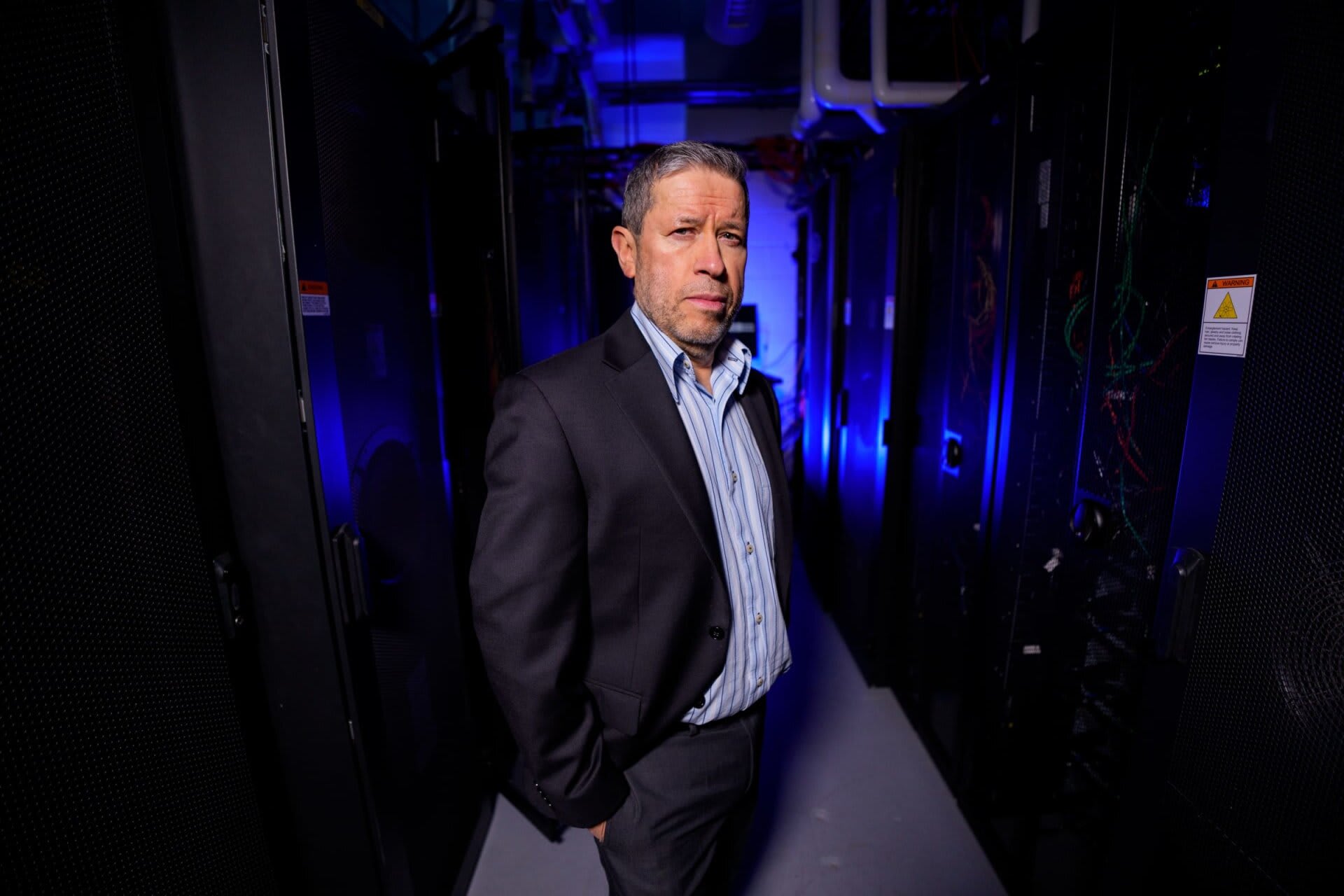
Romero is a quantum physicist at West Virginia University who uses math to look at the world at the atomic scale and has never stopped marveling at the wonders he sees there.
He may wake up in the everyday, humdrum universe, even eat breakfast here, but he spends most of his life as an explorer in the mysterious world of what he calls “weird materials.”
These materials take many forms, but it’s crystals that have most captured his interest. In particular, Romero’s research explores crystals that give him a view of unusual phenomenon like superconductivity and exotic forms of magnetism, driven by powerful interactions between electrons.

“The atoms decide what they want to do, they determine their own pattern, and because of that, all of a sudden, I discover something new,” Romero said.
“I’m scratching the surface of the secrets of nature, and it’s my job to make the math and the atoms sing the same song. One atom decides, ‘I don’t want to join with this other atom, I want to join with this guy instead.’ And it creates a beautiful pattern — a material with very beautiful properties. I just think, ‘Wow. I’m seeing something that nobody has seen before.’”
The puzzle box
What Romero is learning about “spintronics,” or how electrons spin, can help humans make the dream of quantum computing a reality — which in turn could give artificial intelligence superhuman capabilities.
He described quantum computing as an “entangled” version of classical computing in which “all the numbers, the bits of information, are holding hands with each other.”
It’s a model of Romero’s own mind.

“For me, science is friendship,” he said.
“My colleagues are friends. Our conversations about physics are also conversations about our lives. We are joined by science as a way of living. And this is also true of our students. When a kid comes in knowing almost nothing, and you see them grow and become an adult, they feel like family. I cried when my last doctoral student defended his thesis! Because I felt I was losing family.”
Romero’s family roots are in Pamplona, Colombia, “a place small enough to lack traffic lights,” he said.
“My mother was a pedagogy professor. She left home at 7 a.m. and often returned at 10 p.m., keeping the family afloat after his father lost his sight. Science wasn’t our family business — perseverance was.”
When Romero left Pamplona in 1989 for the University of the Andes in Bogota, it was for a practical degree in civil engineering, though he didn’t much care for engineering.

When he had to take a physics class, he found he cared for that even less.
At first, anyway.
“I never wanted to be a physicist ever,” he said. “Before college, I never thought about physics, except maybe to hate it. When I had to take physics at university, I didn’t like it. I thought, ‘Come on, this is not fun.’”
It was the irrepressible, contagious enthusiasm of the professor, Luis Quiroga, that eventually captivated Romero that semester.
“I could see the pleasure he took in his work every time he was at the blackboard, explaining the concepts with so much enjoyment, and I understood that I wanted to have that feeling in my work too,” he said.

“My curiosity detonated. Around the same time, I started to fall for computing — this was the era of floppy discs and punch cards — because every new constraint in computer science felt like a puzzle box that had just enough give for me to pry it open. So, I was able to be there for those earliest ‘click-whirr’ moments when machines began answering us back, and I have spent the decades since then trying to improve the conversation.”
The polymath
In those decades, Romero married and had a daughter and son. He moved back and forth between three continents and seven cities. He relished every flavor of life along the way, eating grasshoppers in Mexico and the notorious cheese “casa marzu,” which contains live insect larvae, in Italy.
Then, in 2013, he came to Morgantown, “a place like nowhere I have ever lived before,” he said, “where I open my window and I see deer walking by.”
At WVU, Romero found a new way to improve the conversation between human and machine.
In addition to his spintronics studies, he now works with the WVU Research Office to get researchers from disciplines across the University plugged into turbo-charged resources at the WVU High-Performance Computing facilities, which he directs.

It’s not quantum computing quite yet — but it’s powerful.
From forensic scientists who need to simulate gunshots to engineers creating new materials at nanoscale, researchers from across the University come to Romero and his team at the HPC with complicated tasks that require super-powered data processing.
“We want everyone to come to us and tell us what they need,” he said. “If the work is honest and the problem is interesting, we will learn their language.”
Alongside the advanced computing architectures that are rapidly expanding under Romero’s leadership, he is using the HPC to build community — especially around the question of artificial intelligence.
He has launched an AI discussion group that’s more than 80 faculty members strong, for instance. And he makes sure students and staff can join the conversation through resources like monthly talks and an AI newsletter.

“We’re learning what people are doing, and we’re seeing that, from health sciences to computer science, people are very interested in the ethics of AI,” Romero said.
The playground
The research Romero conducts at WVU could help build the first real-world quantum computer, massively accelerating the potential of artificial intelligence.
Quantum-powered AI could not only help humans find answers, but tell researchers which questions to ask, he said.
He admits he’s unsure what that will mean for “the human process of creating an idea.”
But it doesn’t leave Romero loving work — and life — any less.

“The reason I stay engaged and optimistic is that I get ideas from everything,” he said.
Recently, for instance, Romero’s daughter showed her father some experiments from her lab, where she creates puzzles that teach animals skills.
Suddenly, Romero’s mind “clicked,” he said, and he realized how to set up image analysis that would help her in her work.
Shortly after, his son told him about a political science paper he was writing. It wasn’t long until Romero was at the keyboard himself, creating a computer simulation that modeled the process his son needed to explore.
“I can find a problem that interests me in any corner,” Romero said. “That is why, every day in this job, I feel like I’m in kindergarten.”