In Louisville, tourists can follow the Mint Julep Art Trail.
In Santa Fe, visitors enjoy the Trail of Painted Ponies.
In Chicago, it’s all about Cow Parade.
San Francisco has hearts. Berlin has bears.
And now, thanks to an effort led by West Virginia University faculty member Terese Giobbia, the Monongahela National Forest has canoes.
The Mon Forest Network connects 12 West Virginia towns to the Monongahela National Forest.
In 2025, Giobbia began working with WVU alum Kelson Thorne, the South Branch Career and Technical Center in Petersburg, West Virginia, and 10 of the Mon Forest towns on a public art project that celebrates each community while providing hikers and other ecotourists with access to information about the local areas.
Giobbia found funding from the participating towns and the West Virginia Department of Tourism.
And she found partners, including the West Virginia Governor’s Honors Academy.
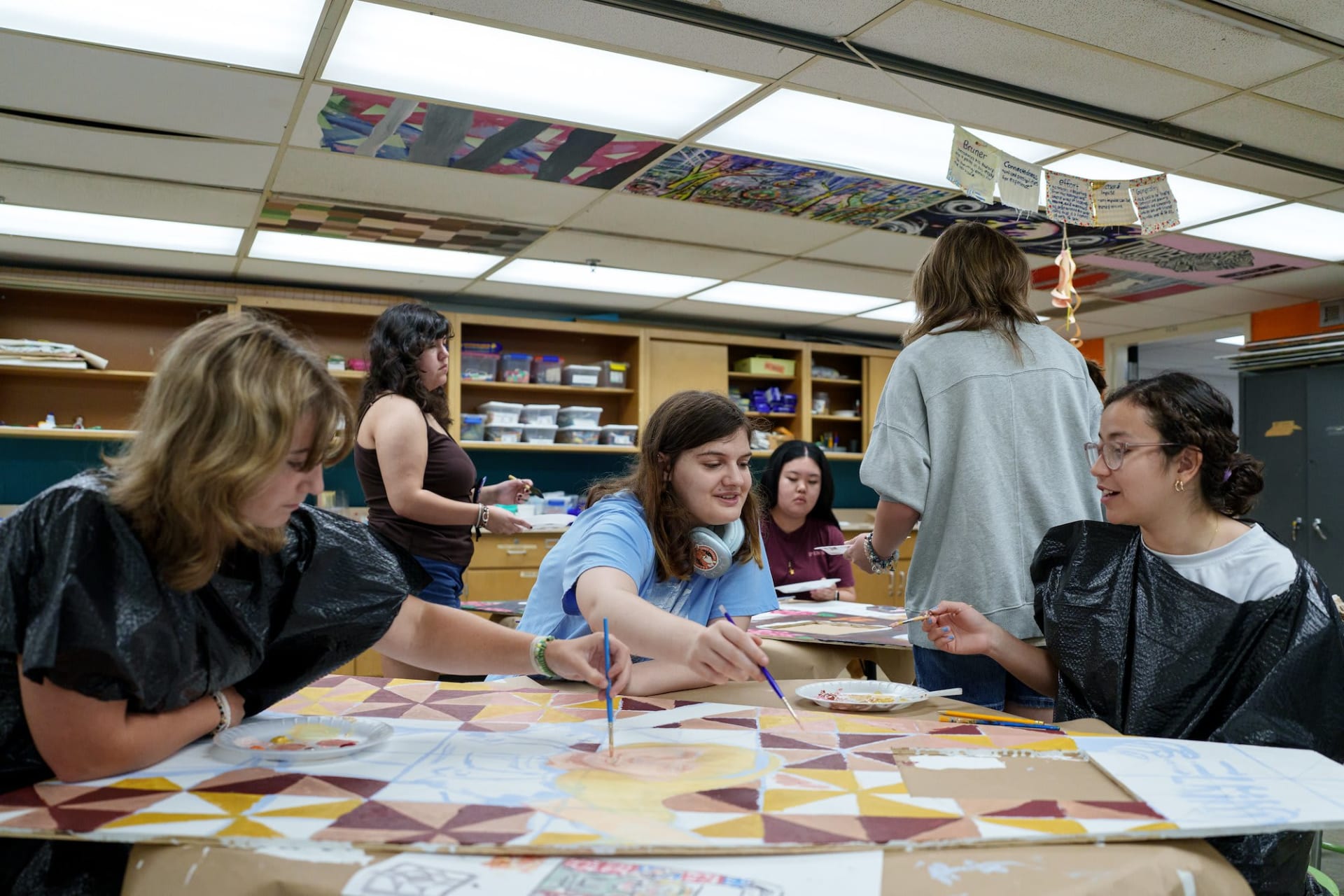
Giobbia, Thorne and WVU and high school students throughout the region then set to work creating canoes that would do double duty as information kiosks and canvases for paintings that capture the history, culture and landscape of each Mon Forest town.
Throughout the project, Giobbia’s WVU art education students worked side by side with high school art clubs to produce the imagery that decorated the canoes, sometimes rising at the crack of dawn to hit the road for collaborations with students and art teachers in far-flung counties like Pocahontas and Nicholas.
“Working in schools outside our own University setting broadens the students’ understanding of rural education and helps them recognize how community, place, available resources, and student experiences foster effective art instruction,” she said.
“Most of the WVU students working on this project are pre-service art education students who are eventually going into the K-12 classroom,” Giobbia said.
“It’s important they understand the value of doing projects that support their communities and allow them to build relationships with them. And this is also an opportunity for them to get experience working with high school students and to understand how to build trust and relationships with those students as future art educators.”
One of those high school students was Clara Weese.
Weese was introduced to the project through the South Branch Career and Technical Center program in tourism and hospitality, which pitched in to help build and decorate the canoes.
She worked on the canoes for Seneca Rocks and Franklin as well as the canoe for her hometown of Petersburg.
“The art represents the towns,” she said. “So the one that represents Petersburg has a fisherman in the water holding a rainbow trout, and then up top are rhododendrons.”
Because of her involvement in the project and Giobbia’s encouragement, Weese decided to launch her college career at WVU in 2027.
“Having Professor Giobbia tell me that I have skills and that I could be amazing and have a chance at a scholarship to WVU, that was the turning point,” Weese said.
“I’ve always loved to paint, and it’s really cool that my art is going to be displayed.”
Helping to produce the kiosks was Weese’s first time painting on such a large scale, so she had to learn some color theory and the “scribble grid method,” which involves projecting an outline of a design onto the surface to be painted.
“I poured a lot of time into the canoes, and I’m very proud,” she said.
Community Bulletin
Since joining Vandalia Health, the former Davis Health System has widened access across central West Virginia. Primary care remains the front door — now at five clinics, including Buckhannon Medical Care, backed by a 190-location network. Read more →
This story brought to you paywall-free, courtesy of the My Buckhannon team and our community partners