Written by Zakariah Issah
As a high school student in Glen Dale, West Virginia, Isabella Linton learned about Phineas Gage.
A railroad foreman in the 1800s, Gage entered the annals of history when an explosion while blasting rock drove an iron rod through his brain. Improbably, Gage survived, but his personality didn’t. The formerly temperate and focused man became crude and impulsive.
Nearly 200 years later, Linton’s science teacher told her, scientists still don’t have all the answers for Gage’s miraculous survival or for the transformation of his character.

At that moment, in Linton’s own head, something changed.
Curiosity detonated, Linton’s neurons responded and, from that moment on, her prefrontal cortex would never be the same.
“No one will ever figure the brain out completely,” she said. “It’s such a complex structure, so resilient and mysterious. That’s why I chose to study neuroscience at West Virginia University — because it’s still such a new and rapidly changing field.”
Now a senior in the WVU Eberly College of Arts and Sciences, Linton is a Mountaineer from way back. Her family has deep roots in West Virginia, and she grew up in the house her grandparents built. By the time she was 8 years old, she was already imagining herself as a WVU student.

“My stepdad went here, and so did his brothers and his parents. It’s a generational thing,” Linton said.
“During my senior year of high school, my stepdad gave me a tour of the campus so it didn’t feel so scary and big. Then I did New Student Orientation, and that was such an amazing time. I remember thinking, ‘This is my life that I’m building.’ It was so cool to be able to spread my wings.”
Linton didn’t take long to decide to pursue a double major in Neuroscience and Psychology, and by the time she hit her sophomore year, her schedule was chockablock with challenging classes.
Doubtful that she could balance her course load with a formal research apprenticeship, she decided “to volunteer in a lab — just to go in for fun and to learn,” she said.

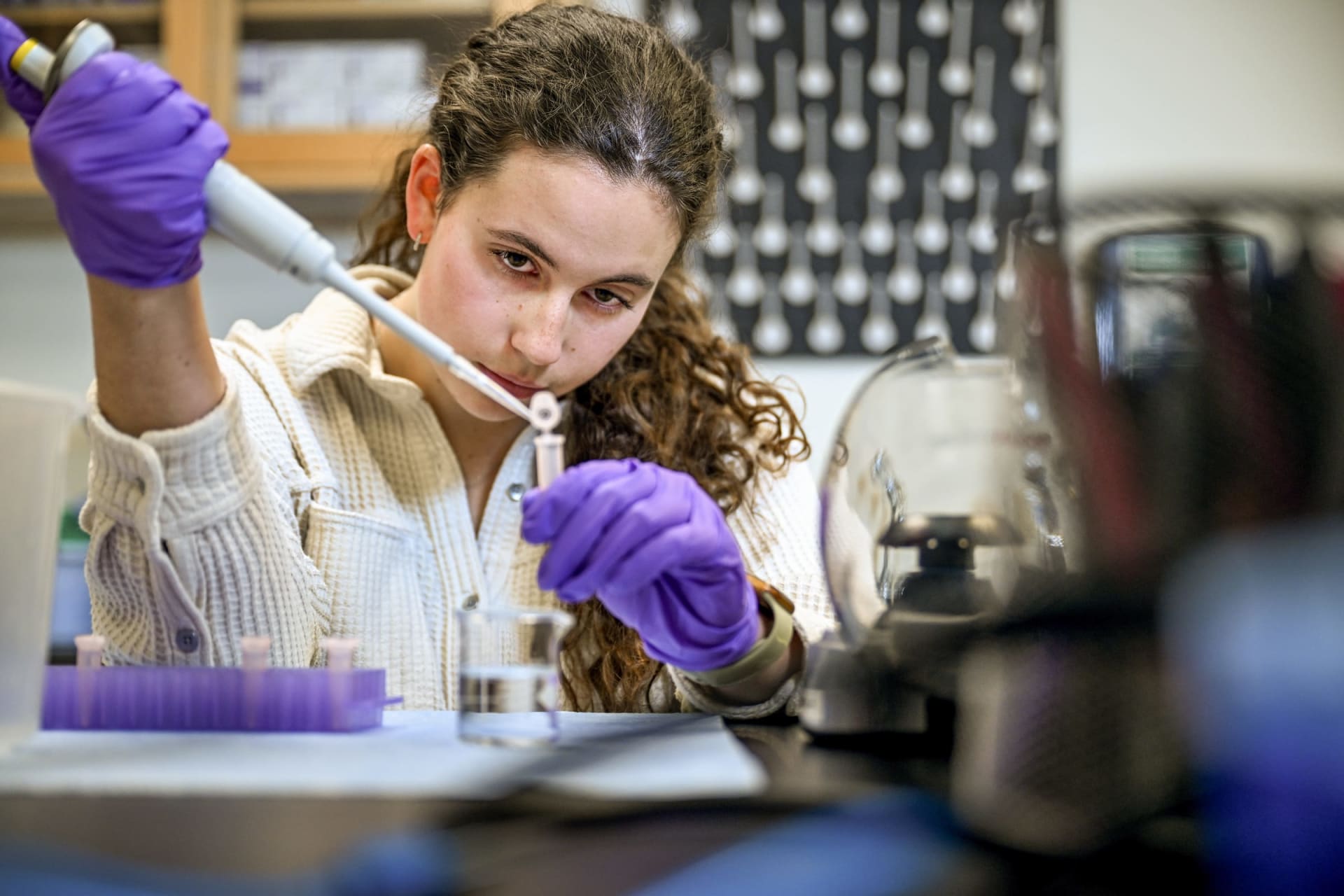
Linton joined Assistant Professor Kathleen Morrison’s Translational Neuroscience Lab, which investigates the effects of stress and adversity on the body, and especially on women’s bodies.
“In Dr. Katie’s lab, we want to know more about stress in women, because women have been overlooked in science — in part because there is a misconception that they are too complicated,” Linton said.
“But we know that a lot of different critical periods in a woman’s life affect her, and we know that women who are affected by adverse childhood experiences are more likely to experience anxiety disorder, for example, which can increase once they become pregnant. Yet there’s been no deep dive into that topic. I’m very happy to be in a lab that takes the time to look at this.”
At first, Linton observed Morrison’s graduate students and helped out with odd jobs. But by her junior year, lab life had sucked her in.

“In the fall of 2024, I started helping with a project that doctoral student Marissa Nicodemus was doing. Marissa was looking at risk-taking in the offspring of stressed mothers, and I was observing behaviors in the mice she was working with. I had never done anything like that before, and it was super exciting,” she said.
“Then going into the spring semester of my junior year, a grad student left, and her project fell into my lap. Dr. Katie wanted me to take it on, and I was kind of putting up a front, like ‘Okay, I’m confident.’ But internally, I’m like, ‘Oh my gosh, this is a graduate-level project, am I going to be able to handle it?’”
Linton took on the challenge. To address the big question of how mothers’ stress can be passed on to their offspring, she began trialing a new behavioral procedure that allows researchers to separate prenatal and postnatal maternal influences on offspring.
“I never realized how much stress even before pregnancy affects offspring, or how much the body is affected by stress in general,” she said. “Even the placentas of our stressed mice are different than the placentas of the control group.”

Linton attributed her own manageable stress levels throughout the study to her mentor, Nicodemus.
“It’s such a good relationship,” Linton said. “I cannot say enough good things about Marissa. She has helped me as a mentor, and I can ask her about more than lab stuff, like how to improve my CV.”
With Nicodemus’ support, Linton presented her findings at the Fall 2024 and Spring 2025 Undergraduate Research Symposia. Then, after participating in the intensive Summer Undergraduate Research Experience, she returned for the Summer 2025 Undergraduate Research Symposium. That time she won first place in the behavioral and social sciences category.
Soon after, she traveled to San Diego with Morrison and Nicodemus to present their work at the annual conference of the Society for Neuroscience — a pivotal experience for Linton.
“We talked to all different kinds of researchers in the field, all super intelligent. I even got to meet some of Dr. Katie’s original mentors,” Linton said.
She and Nicodemus will get at least one more chance to stand up together before Linton’s graduation, at WVU Research Week 2026. There, the two will offer a presentation about research collaborations between undergraduate and graduate students.
Linton has explored neuroscience outside the lab, too. For her capstone course in psychology, for example, she worked under Assistant Professor Alexandria Perle and Perle’s fellow, Moriah Splonskowski, at the WVU Rockefeller Neuroscience Institute.
“My time with Drs. Perle and Splonskowski helped me realize how much I enjoyed the clinical side of neuroscience, in addition to research,” Linton said. “Having that experience solidified my realization that I want to do this work in a way where I’m interacting with people and helping them. I got to observe patient interviews, patient testing and even how they prepare sometimes to tell patients very hard news.”

Linton had worked previously as a clinical associate at WVU Medicine Golisano Children’s Hospital, and she had assumed she’d most enjoy the pediatric patients at RNI.
“But it ended up that I really loved working with older adults,” she said. “They were very enjoyable to talk to, always cracking jokes, and I’m really interested in the neurodegenerative conditions that affect many of them, like Alzheimer’s disease.”
Linton’s exposure to hands-on work with patients at RNI convinced her to pursue a career in clinical psychology — just not immediately.
“I’m graduating in May 2026, and although I plan to go to graduate school for clinical psychology, I don’t want to get there right away. I want to take a year working in the field and making sure I know exactly what I want to do,” she said.

“I’ve done a bunch of different things at WVU, and I’m really glad that I have. Now I have a foundation for figuring out what happens next.”
An expert on the biological effects of stress on women, Linton is also well-informed when it comes to decompressing.
When she’s not in the lab or the classroom, she’s making mosaics and painting pottery at Morgantown’s WOW! Factory, playing intramural volleyball and pickleball, and volunteering as a coach for her little sisters’ sports teams in Glen Dale.
More than anything, she loves taking walks with Lottie, her standard poodle, who enjoys observing (but never barking at) the geese on the Mon River Rail-Trail.

“Reflecting back on all the opportunities and mentorship that I found at WVU and that I now have in front of me, I feel so immensely grateful. It has definitely taken a village to lead me to where I am today,” Linton said.
“Until Commencement, I’m living in the moment. I don’t want to focus too much on the future and lose out on the last couple months I have at WVU and my time with my friends here. Not that I can imagine those relationships and memories ever going away.”
Editor’s note: The use of animals in this project was evaluated by the WVU Institutional Animal Care and Use Ethics Committee. WVU is voluntarily accredited by AAALAC International, a peer organization that establishes a global benchmark for animal well-being in science.