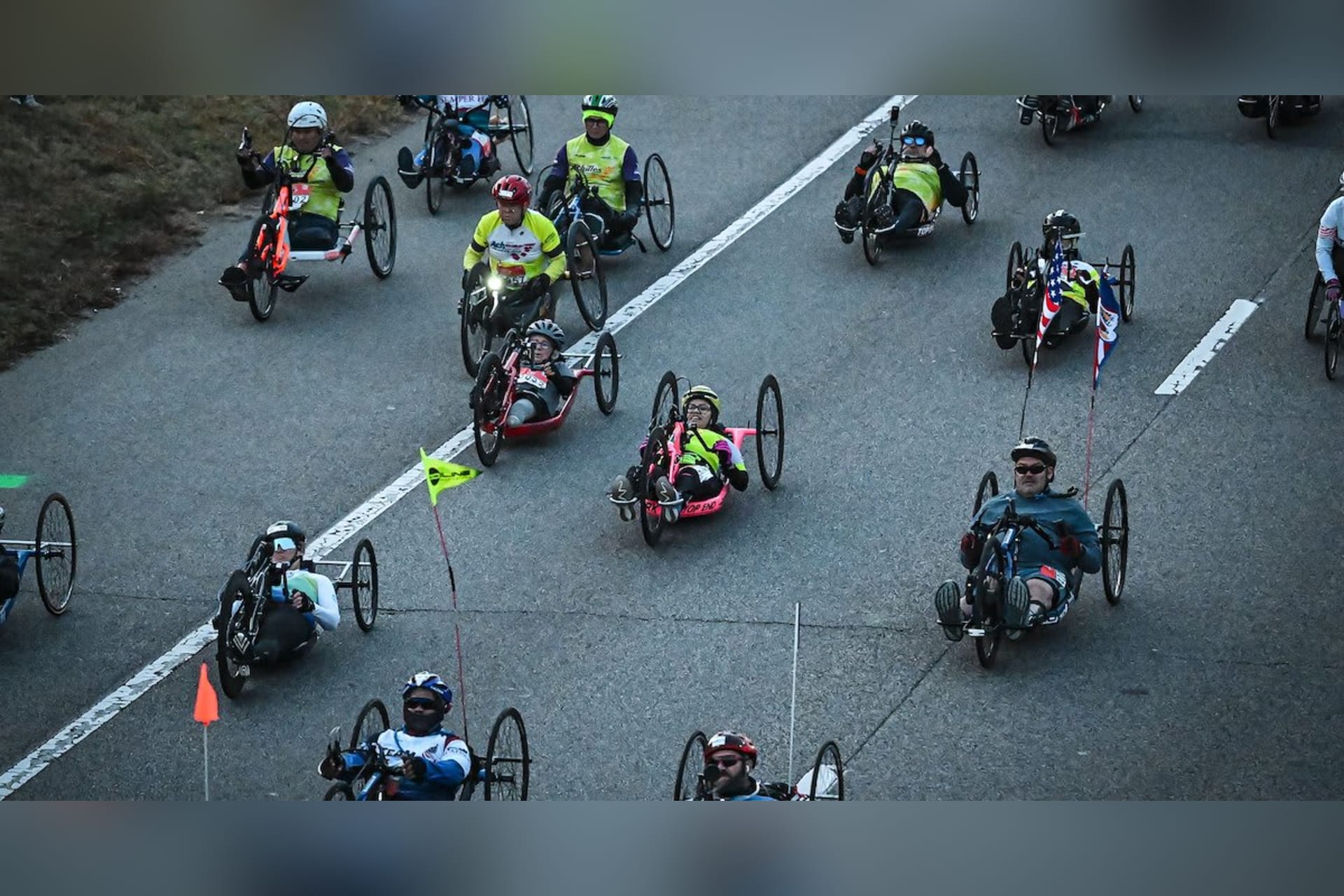
West Virginia University athletic training alum JoAnn Outten-Kenton had 200 yards left and a multi-time Boston Marathon champion close behind her. At 54, racing in only her second marathon ever, she was about to win or lose in a photo finish. The course turned uphill, then left toward the finish line.
Her competitor had been trailing for miles, conserving energy for this exact moment. Kenton’s internal monologue said, “Not today, sister.”
She won the Boston Marathon Handcycling Division in April 2025, propelling her handcycle across the finish line in first place. It was an improbable victory, making up just a single milestone in an even more incredible journey, one that began 16 years earlier on the sidelines of a football game, when a helmet to the shin during a Friday night game would eventually cost her leg, her career and nearly her life.
But Kenton didn’t lose anything in the end. She gained everything back, and then some.
The early years
Kenton’s story begins on a small 30-acre farm in Harrington, Delaware, where hard work was a way of life. At 7, she and her older brother were allocated plots to grow bell peppers and learn life skills. The same farm-forged discipline would shape her approach to life.
In the athletic world, Kenton was a force — one of the first inductees into her high school’s athletic hall of fame, racking up 13 varsity letters across field hockey, swimming, diving, track, cross country and softball. Yet hidden behind the competitive fire was a shy redhead navigating the world.
“I was so shy. I realized that in high school, I never looked down the hall with my head up. I looked at the floor. I was trying to hide,” Kenton said.
At 13, she volunteered as a candy striper at the local hospital, initially drawn to nursing. In high school, when an athletic trainer started visiting two days a week, her calling became clear.

“I didn’t even know what an athletic trainer was, but I would see him looking at and treating, taping and bracing injuries. That’s really what started it for me. I knew that that was something I wanted to do,” she said.
She earned her undergraduate degree from Wesley College in Dover, Delaware, then came to WVU for her master’s degree in athletic training. As a graduate assistant, she juggled teaching 21 credits per semester while taking 21 credits of her own coursework.
“When I was in the midst of it, I said to my parents, ‘If I can do this, I’m going to be able to do anything,’” Kenton said.
After graduation, she returned to Delaware and built a career in high school athletic training. Then came a November night in 2008.
The accident
At her alma mater, it was a city rival game, final series, fourth down. Kenton stood along the line of scrimmage as players piled out of bounds, and a helmet slammed into her leg.
“I thought my leg was going to be broken. I thought I was going to look down and my shin was going to be at a right angle,” she said.
What seemed like a bone bruise spiraled into a medical nightmare. Over the next 14 years, Kenton underwent multiple surgeries — none of which restored function. She lived with crutches, a hip brace and constant pain. On disability and financially strained, she grew dangerously thin. Her marriage ended in divorce.
Her youngest had no memory of his mother walking on her own. There were moments when she questioned whether life was worth living.

“If it were not for my faith, I wouldn’t be on this side. Just as sure as I’m sitting here, I would not be where I am if it were not for the grace of God,” she said.
The turn
Then she saw a video. A former doctor had posted footage of a woman walking on a beach with an above-the-knee amputation and prosthetic. Kenton had spent years sitting out beach trips with her family.
“I kept playing it over and over and over. I kept saying there’s someone without their leg walking on the beach. I can’t go on the beach. My kids love the beach,” she said.
She wrote to Dr. Rob Rozbruch, one of the surgeons who had tried to save her hip years earlier. He hadn’t forgotten her and invited her for a consult.

The resulting procedure — an osseointegration surgery with a metal rod inserted through bone allowing prosthetics to attach directly — had never been attempted in her specific case before.
“It was one of one. I looked at it as a medical professional, as I often did through this whole process. I thought, ‘Wow, this is really cool.’ Then I was scared,” Kenton said.
The surgery in August 2022 lasted over 10 hours. The surgeons had to cut her femoral artery, costing her four units of blood. She needed emergency blood transfusions.
“God spared my life. That feels like a great purpose,” she said.

By January 2023, she had her first official walking leg. With a full prosthetics team in Silver Spring, Maryland providing custom care and expert guidance, Kenton began a new chapter. She’s since logged 3 million steps, walking 10,000-15,000 steps daily.
The return — and the race
In August 2024, Kenton stepped back onto the sidelines as an athletic trainer, standing on the same field where her life changed 16 years earlier.
Unbeknownst to her, her daughter and mother had come to watch. When she turned around, she saw them both crying at the sight of her standing on her own two feet.
“Fully restored. Missing a leg, but fully restored,” she said.

For years, Kenton had dreamed of doing something without her crutches. After her amputation, she discovered she could finally pedal a handcycle independently. She describes the first ride as a weepy moment.
“It was the first time doing something, going somewhere, not being dependent,” she said.
She found a used racing cycle online, fundraised through the IM ABLE Foundation and came up $1,000 short. An anonymous donor paid the difference. She got the racing cycle in March 2024. By May, she had hired a coach.
“Go big or go home. I want to make the U.S. national team and the 2028 Olympics,” she said.
She entered the Marine Corps Marathon in October 2024 as her first marathon and finished second. Six months into training, she placed third in U.S.A. Cycling time trials, behind two Olympic athletes half her age. Then came the Boston Marathon — and a first-place finish.
In May 2025, Kenton returned to West Virginia for her third time trial, earning her U.S.A. Cycling jersey in Charleston.
“Best state in the world to get a national championship,” she said.
She’s racing a secondhand bike against competitors with $20,000-$25,000 equipment, and winning despite the disadvantages. The 2028 Olympics remains the goal.

“I don’t know what the future holds, but God knows. I’ll do my part to be the best I can be. If I die today, I’m good — I am good to my soul,” she said.
When people ask where she went to school for athletic training, she proudly points to WVU. Over the years, she’s sent many Delaware students to the University, paying forward what WVU gave her.
Story by Katie Short, WVU Storytelling.