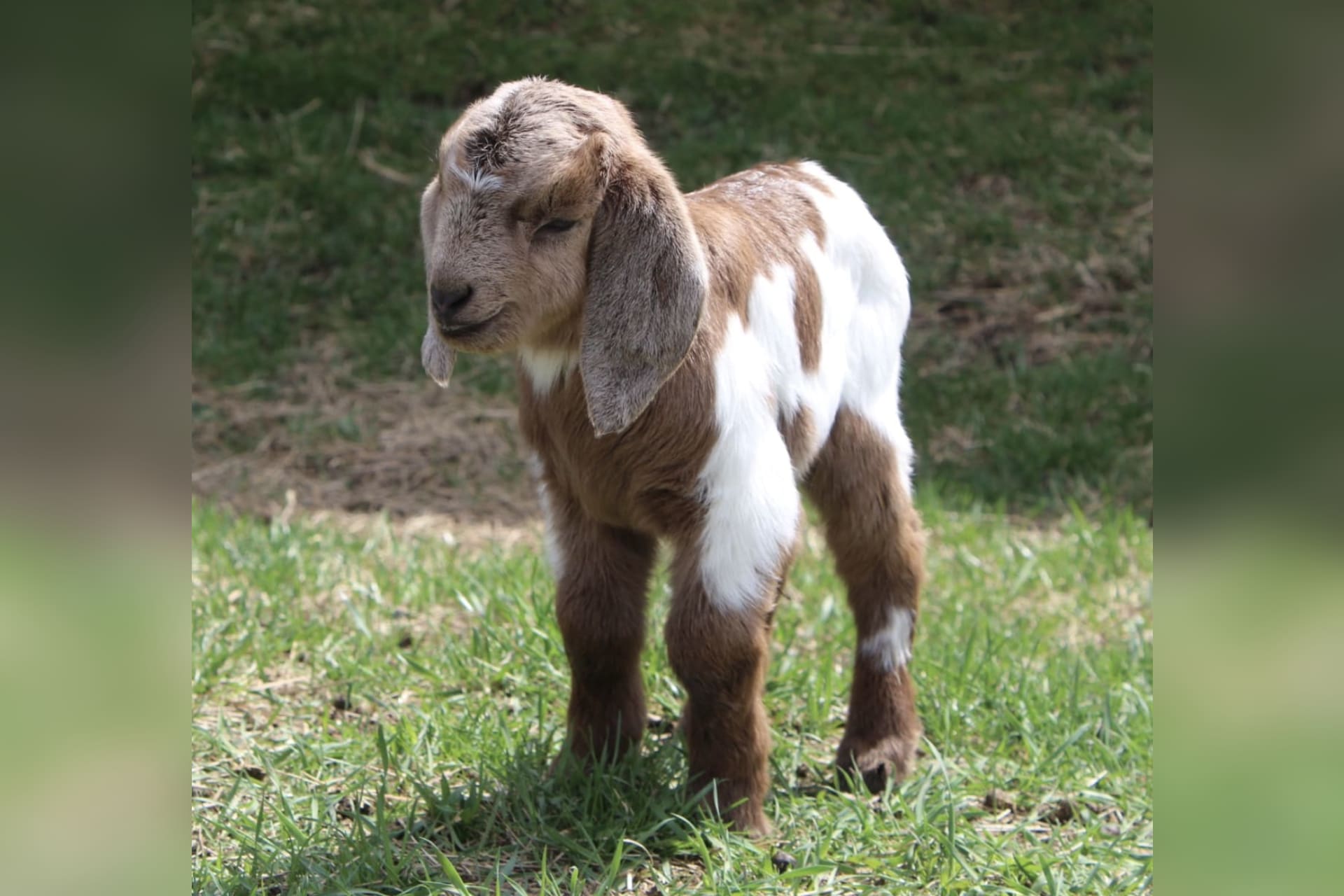
If it’s spring, it means there are plenty of newborns arriving on the farms at WVU Potomac State College.
The college’s two livestock farms are experiencing a baby boom this season, with 20 calves born at the Malone Farm in Fort Ashby and 25 kids born at the Gustafson Farm near the Keyser campus. Ethel had twins on March 5. Her sister Thelma had a baby the next day. Loretta went into labor on March 7. And Reba is due any day now.
More are still coming. The cows and goats that haven’t yet given birth are expected to deliver between now and April 11.
“It’s one big maternity ward right now on the farms,” said Tyler Rohrbaugh, Malone Farm manager. “Welcome to spring. It’s time for the babies!”

The simultaneous arrivals aren’t coincidence — they’re family planning. Potential mothers of both cattle at Malone and goats at Gustafson are timed so every female has a chance to give birth around the same time, temporarily doubling the livestock population. The typical birth window runs early March through mid-April, though some babies arrive early and others late.
“In the morning, it isn’t uncommon to arrive at one of the farms this time of year and find out at least one more mother has given birth,” said Natasha Henry, Gustafson Farm manager. “We have a newborn born nearly every day for about two weeks. Sometimes we have multiple births in one day.”
Cattle births at Malone Farm are assisted by both a stud bull and artificial insemination — AI accounts for about 60% of calves. The goats at Gustafson take a more traditional approach, with one Billy Goat named Rocky doing all the work. Fertility rates run about 95% for both cattle and goats.
The baby animals draw visitors along with social media attention, with neighbors and community partners keeping watch year-round.
“We have really good neighbors and community partners who keep an eye on the property too,” Henry said. “People are always asking me in the spring how many babies we have had and when they can come and see them.”
Occasionally, nature needs a hand. When one of the goats went into labor on March 9 with the kid in an awkward position, Henry had to manually reposition the baby to ensure a safe delivery. Most births, though, happen with only Mother Nature as midwife.
“There was one morning I stepped away for a short meeting, and when I came back, there was a new birth just like that,” Henry said. “She literally gave birth 15 minutes after I left, and the baby was there when I got back.”
Some newborns need extra attention — bottle-feeding until they’re strong enough to manage on their own. Henry has taken goats home for around-the-clock care more than once.

“Ethel, for instance, who just had a baby, I raised her,” Henry said. “I call her Ethel Jean, the drama queen. She was my house goat before she was strong enough to come back to the farm and live. She used to actually hop inside the truck with me and go for rides. And she just had two babies, so yeah, I guess in a way, that makes me a grandma.”
Students shoulder most of the work on both farms, which together are home to 41 adult cattle and 32 mature goats.
“Students do about 99% of everything here,” said Rohrbaugh. “They make the feed, and they do the feeding and cleaning up and even herding them from one field to the other.”
That herding happens the old-fashioned way — on horseback, without machinery or vehicles that would stress the animals.
“Vehicles moving in the field tend to stress the livestock out,” Henry said. “So, we still do it by getting on horses. It could look a lot like the TV show Yellowstone around here at times.”
Rohrbaugh views the cows as employees, each with one job: reproduce, every year. Their continued place on the farm depends on it.
“I do look at the cows as employees,” he said. “And it’s good to get along with your employees, but they all know what they need to do. Everyone works on a farm. And this is a true working farm.”
Cows and goats take different approaches to parenthood. Cows are protective and territorial; goats are more relaxed.

“The cows are very territorial when it comes to their own babies,” said Rohrbaugh. “They will call out to their young if they get separated.”
“Goats are people-friendly and will let you pick up and hold their babies right after the babies are born,” said Henry. “They care, but they don’t care. Or maybe they just trust the people at the farm.”
Henry recalls a mother goat two years ago whose kid was stillborn. Grieving, she took in one of a neighbor’s twins — and the biological mother allowed it.
“She was grieving, and goats do grieve, not just the loss of their young but other goats in their herd,” Henry said. “And one of the other mothers had twins. So, the mother who had the stillborn baby just went up to one of the twins and kidnapped one and just took it in as her own. And the biological mother let her do it because I think she knew that the only way she would get over that grief was to have one of her own.”

Malone Farm spans more than 300 acres and is one of the largest self-sustaining farms in the county. Hay and straw are produced on site; manure goes back into the soil as fertilizer on both the farm and the Keyser campus.
“The farms as a whole are very efficient,” Henry said. “And right now, we are right in that window of time when it’s early spring and all of the babies are being born. I mean, who doesn’t love a baby animal?”
March is National Agriculture Month in the United States. WVU Potomac State College is celebrating its 125th anniversary year.