If the early bird catches the worm, how early do you have to be to catch the bird?
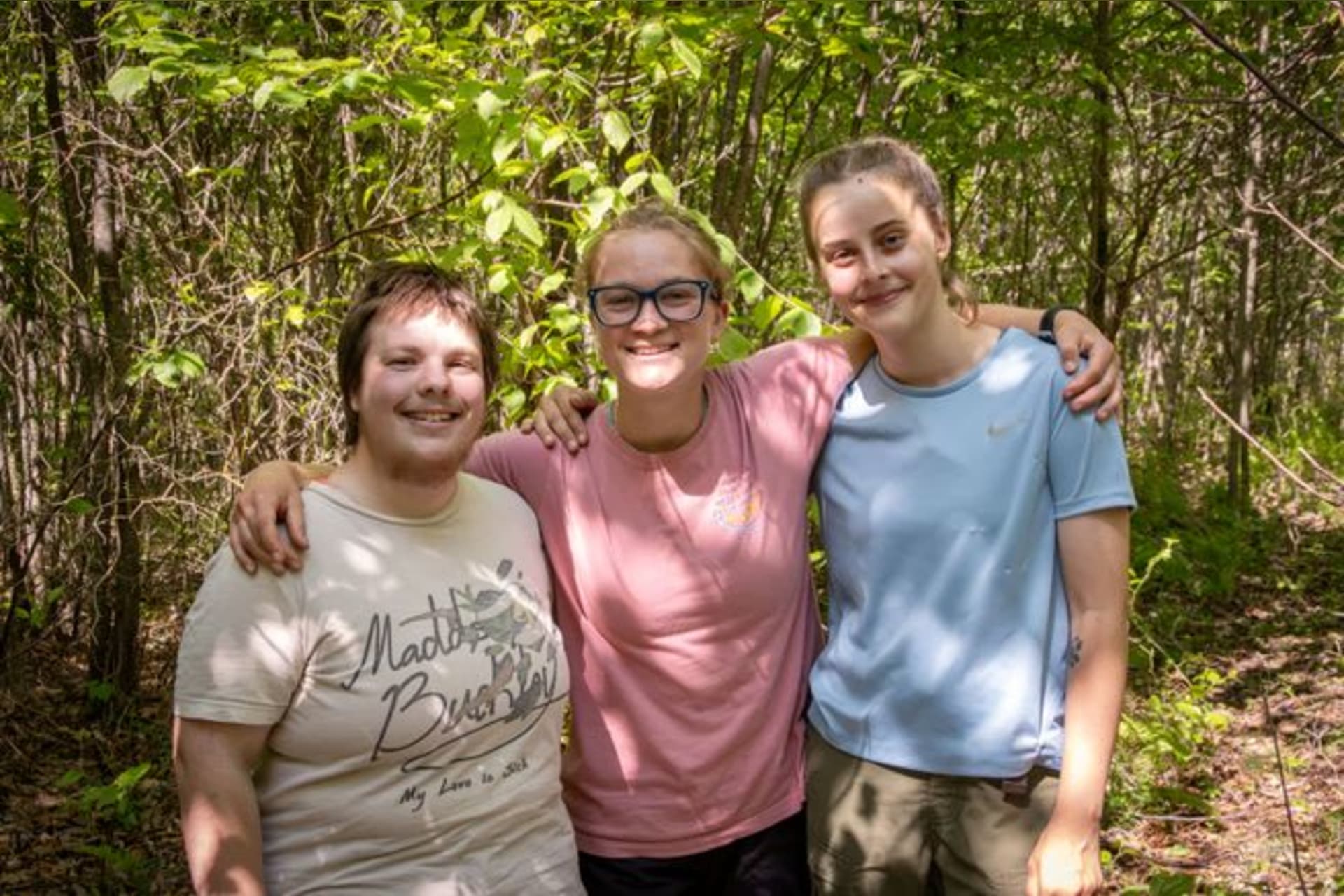
For West Virginia University Davis College of Agriculture and Natural Resources graduate researchers Ava Craven, Samantha Grimes and Audrey Longenecker, the answer is about 4 a.m. Before the sun was up, these three wildlife and fisheries resources students were trekking through the forests of Greenbrier County, looking for the migratory birds who spent their mating season in the woods of West Virginia.
“We have to wake up early because that’s when the birds wake up, and we’re kind of on their schedule during the field season,” Craven said. “Birds start calling and moving around about 30 minutes before sunrise, so we want to match that.”
In the absence of proper trails, the trio moves through dense underbrush toward their makeshift camp. Along the way, Craven explains how local birdwatchers help make her research possible.
Apps like eBird are popular among birdwatchers to keep track of the species they find in the wild. As part of the Cornell Bird Lab, eBird data can also be used by scientists and researchers to create population models for bird habitats. Finding out how accurate these predictions are is at the heart of Craven’s project.
A key detail of the model, Craven says, is how birds are using privately owned and managed land. Because most eBird sightings are on public land or in backyards, Craven’s research requires boots-on-the-ground observation to confirm how accurate the model really is.
“One interesting pattern this model shows is songbirds, especially during migration, are using private lands like the timber harvesting properties,” Craven said. “We decided to specifically focus on early successional forests because we know they are used during fall songbird migration, even by species that spend time breeding and overwintering in more mature forests.”
Early successional forests, or forests aged 15 years old or younger, grow on land after a disturbance such as forest fires, severe storms or even timber harvesting. These young forests have certain features that make them favorable for birds and insects, like an abundance of food and shrubs that offer protection from predators. Through her research, Craven wants to help paint a clearer picture of how this type of forest influences bird migratory patterns in the area.
“Right now, there’s not a lot of research on the role of early successional forests during spring migration because it’s really hard to predict where songbirds will actually be,” Craven said. “The fact that we have a model has been really valuable in helping us understand the role these types of forests play for birds.”
Parts of this forest, managed by the timber company Weyerhaeuser, are classified as early successional, and it’s exactly why Craven, Grimes and Longenecker are here in the first place.
Because of several factors like early European settlement, development and fire suppression, Craven points out that early successional forests have seen a decline of roughly 30% to 50% on the East Coast since the 1950s. Craven’s goal is to find out how often birds are using manmade early successional forests like this one and expand the eBird model to more accurately predict the kind of birds that live there.
“While there are certainly pros and cons to timber harvesting when it comes to wildlife, it might be possible that regenerating forests through timber harvesting and prescribed burns could be a substitute for natural disturbances like wildfires,” Craven said. “This is a great opportunity to learn more about potential areas of compromise between wildlife conservationists and private industry.”
Thanks to funding from the National Council for Air and Stream Improvement, Weyerhaeuser lands can be used by researchers like Craven to find out more about this unique environment and how songbirds are using it to their advantage.
A common way to find out more about birds in a particular area is to use a mist net. Mist nets are a straightforward and reliable way to capture birds that risk minimal harm to the animal. They resemble a net you might see on a volleyball court, but for catching small songbirds, the net uses an extremely thin mesh that is practically invisible to birds.
The goal is to place mist nets in relatively open spaces where birds are likely to fly through. Once they become entangled in the net, they can be safely removed and examined. Each of the six nets used by Craven, Grimes and Longenecker is checked every 30 minutes to prevent captured birds from overheating in the sun.
“The squares in the net are specifically made for the size of songbirds. They’re not big enough for them to fly completely through the net, but they’re not too small that they could put the bird in danger,” Craven said. “It also prevents bigger birds like hawks from staying in the net if they fly into it.”
Once a bird has been captured, Craven, Grimes and Longenecker record the bird’s species, weight, wing chord, sex, approximate age and more. This data can be useful for future research, but it can also give more information about the bird’s overall health and behavior.
For example, the condition of a bird’s feathers can be an indicator for how far the bird has flown during migration. Alternatively, the presence of a “brood patch” under a bird’s feathers can show whether it is breeding or not.
Once a bird has been catalogued, a small band is placed around the bird’s leg. Each band is engraved with a unique serial number; if the bird is ever captured again, whether by Craven or any other researcher, the bird’s condition can be compared to previous observations in the U.S. Geological Survey database.
“Banding is a super useful and widely adopted method for tracking and learning more about birds,” Craven explains. “All of us have banded over a hundred birds, and we’re all working together to make sure that the bird isn’t being stressed.”
Originally from Delafield, Wisconsin, Craven earned her undergraduate degree in environmental studies at St. Olaf College in Minnesota, but her appreciation for birds started in high school. Although Craven didn’t intend to pursue a master’s degree at first, she realized West Virginia University was a place she could continue focusing on her personal interests while still furthering her education.
“It’s been cool to be part of a community that really focuses on wildlife and specifically on birds. That’s something I’ve never gotten to be a part of before,” Craven said. “West Virginia is almost entirely forested — it’s so different from the Midwest. I grew up mostly around prairies and farmland, so it’s been cool to mix things up.”
As both a conservation advocate and bird enthusiast, Craven wants to do what she can to help sustainable forest management through her research. While many conservation efforts might be imperfect, Craven says researchers are finding new ways to protect what remains. Part of that effort includes working with companies like Weyerhaeuser, which adheres to Sustainable Forestry Initiative standards.
“Since 1970, there has been a 30% decline in global bird populations including songbird species. This means, alarms are blaring that global natural ecosystems are in trouble,” Craven said. “Our research hopes to guide future conservation practices and encourage people to work as part of the natural ecosystem, not detached from it.”
Christopher Lituma, associate professor of wildlife and fisheries resources at the Davis College of Agriculture and Natural Resources, said Craven’s research is particularly compelling because of how it brings together multiple stakeholders toward a single, shared goal.
“An exciting component of this research is the partnerships between a private landowner like Weyerhaeuser, researchers at West Virginia University, and non-governmental organizations like the National Council for Air and Stream Improvement and National Alliance of Forest Owners,” Lituma said. “For conservation to be effective, it must be collaborative and include the inputs of private landowners, including those from industry.”
All research was conducted under WVDNR Permits, USGS Federal Bird Banding Permits and IACUC Protocol #2602090650.
Community Bulletin
Due to ongoing renovations, Precinct 18 has been temporarily relocated to a new polling location at the Vo-Tech School. Read more →
This story brought to you paywall-free, courtesy of the My Buckhannon team and our community partners