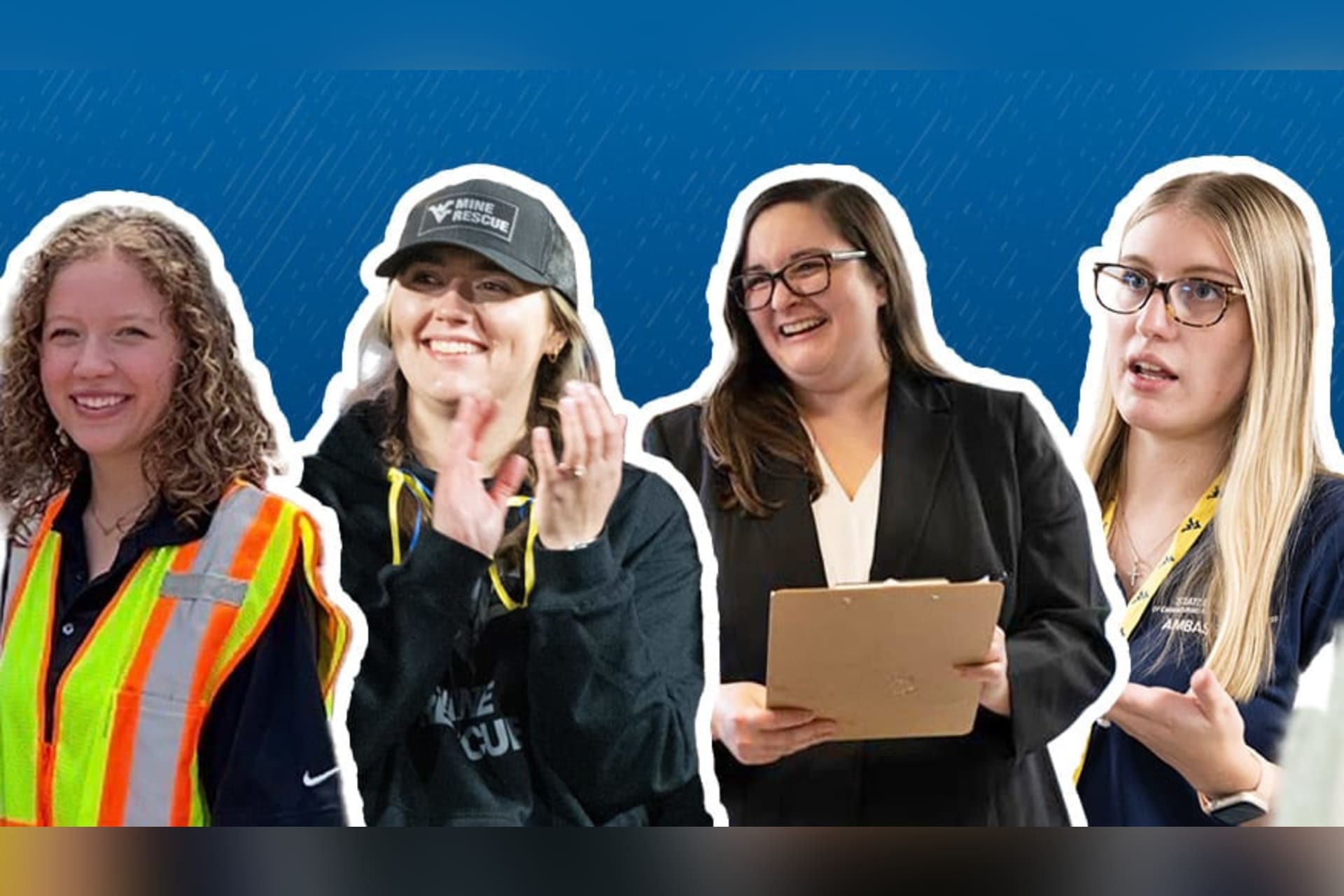
The world often celebrates engineering breakthroughs — the towering bridges, life-saving technologies and infrastructure that transform communities. Behind many of these achievements are women whose innovation, resilience and leadership have shaped the field and paved the way for future generations.
At the Statler College of Engineering and Mineral Resources, a new generation of women is continuing that legacy. Through mine rescue training, improving infrastructure, leadership and real-world experience, these students are not only navigating the path forged before them — they are rewriting it, engineering solutions that will define a better future.
Though their disciplines vary, their experiences reflect a common theme: At Statler, women are supported not only to succeed but to lead.
When Samantha Roark arrived on campus, she was unsure whether she belonged in engineering. Now a senior mining engineering major, Roark has become one of the most engaged student leaders in her department. She serves as president of the Women in Mining chapter, briefing officer for the WVU Mine Rescue Team and leader of a nationally competitive aggregate design team.

Her academic experience has extended beyond the classroom to fieldwork, competitions and industry engagement. Roark has competed nationally in mine design, conducted undergraduate research incorporating LiDAR scans into virtual reality mine rescue training and completed internships that led to a full-time engineering position after graduation.
Her long-term goal is to advance safety innovation within the mining industry, working toward zero fatalities and more sustainable site design.
For Madalynn Clayton, civil engineering has always been rooted in service. Raised in West Virginia, Clayton grew up watching infrastructure projects shape local communities. That early exposure instilled an appreciation for the responsibility engineers carry.
“I want to help improve infrastructure in a way that enhances quality of life and supports communities, particularly in West Virginia,” Clayton said. “From highways to bridges, I am motivated by the role civil engineering plays in creating safe, efficient and sustainable infrastructure that serves the public.”
Leadership roles in Chi Epsilon strengthened her professional skills, emphasizing communication, accountability and collaboration. She plans to pursue a career as a project engineer, overseeing infrastructure projects that improve safety and quality of life, especially in West Virginia communities.
For Kaley Worley, industrial engineering focuses on improving systems while keeping people at the center of solutions. Worley aims to improve safety, ergonomics and efficiency in manufacturing environments.
“Statler College has helped me prepare for the future by equipping me with the technical knowledge, problem-solving skills and hands-on experience needed to enter the workforce and succeed in my field,” Worley said.
Inspired by early exposure to programs such as WVU’s Engineering Challenge Camp and Girls STEM Academy, Worley chose Statler for its sense of community and opportunity. She has served as president of the Institute of Industrial and Systems Engineers student chapter.
“As a woman in industrial engineering at Statler College, I’ve never felt limited by the challenges in front of me. Instead, I’ve been motivated by them. Whether leading IISE, competing in case competitions, or mentoring younger students, I’ve learned that growth happens when you’re willing to step outside your comfort zone and say yes to new opportunities,” Worley said.
Evie Harper’s path in mechanical and aerospace engineering reflects expanding opportunities for women in STEM fields. Drawn to engineering through physics and hands-on experiences, Harper pursued a dual degree combining mathematics and space systems. An internship with the Air Force Research Laboratory and NASA University Nanosatellite Program introduced her to satellite mission development and solidified her interest in spacecraft guidance and control.
As president of the Society of Women Engineers, Harper has led outreach initiatives, mentored younger students, coordinated professional development programs and connected aspiring engineers with alumni networks.
“I get the honor of being the President of the Society of Women Engineers club here at WVU. Just this year we had the largest general meeting to date with over 120 members in attendance. Being a part of this organization makes the female presence of engineering feel big and impactful. It is truly so inspiring to lead such a passionate group of women through the challenges and successes that come with being an engineer,” Harper said.

What unites these four women is not only their academic focus but the environment that supported their growth. At Statler, women are encouraged not just to adapt to engineering but to shape it. They design safer mines, oversee infrastructure projects and develop structural systems built to last.
“I want incoming students to know that you don’t have to change who you are to succeed in engineering. Your perspective is valuable — and it makes the profession stronger,” Clayton said.