Community Bulletin
General surgeon Avian Pham, MD, has joined WVU Medicine St. Joseph's Hospital, expanding the General Surgery team alongside Dr. Long at the clinic at 10 Amalia Drive in Buckhannon. Appointments: 304-473-2303. Read more →
This story brought to you paywall-free, courtesy of the My Buckhannon team and our community partners
By Chelsi Baker
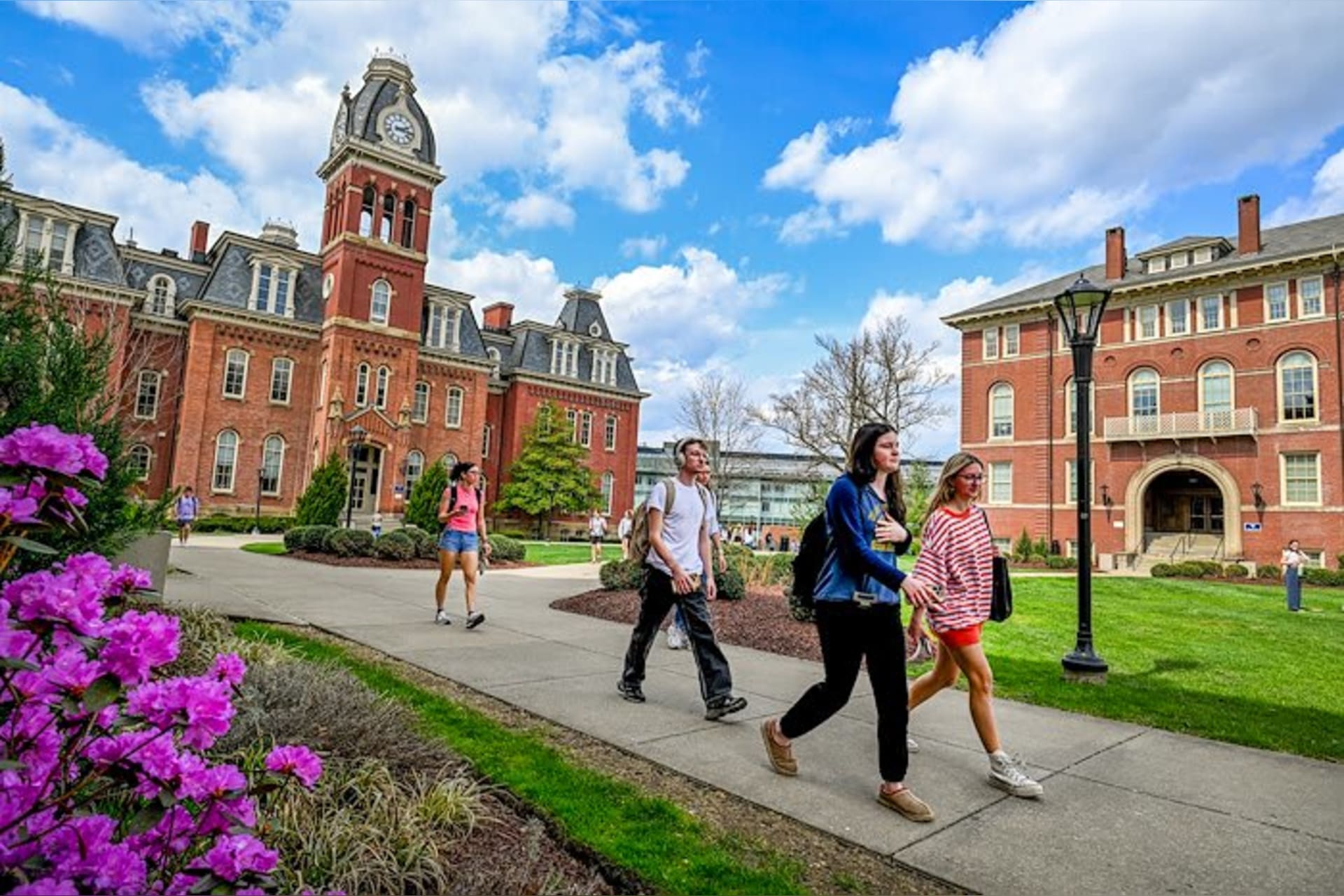
For 150 years, Woodburn Hall has stood at the center of West Virginia University.
Since Woodburn’s construction was completed in 1876, it has welcomed thousands of students into its classrooms, served as the backdrop for countless photos and events and housed endless academic discoveries.
As the campus and the culture have grown and changed around Woodburn, the historic red-brick structure with its iconic belltower has reminded the community of the University’s beginnings.
Yet three-quarters of a century ago, Woodburn Hall was very nearly demolished.

When Armstrong Hall opened in 1950, the University considered tearing down Woodburn Hall and replacing it with a new building on the same site.
Armstrong Hall was slated to become the new hub for the College of Arts and Sciences, while aging Woodburn had fallen into disrepair and was out of synch with plans for a “modern” campus.
But sanity prevailed, and leadership did an about-face. Discussions of demolition were abandoned and instead, Woodburn Hall underwent a careful restoration.
In 1973, it became the first building on the WVU campus to be added to the National Register of Historic Places.
Its origin story goes back even farther than WVU itself.

In 1858, the Woodburn Female Seminary opened in a house built by Thomas P. Ray, on the site where Woodburn Hall now stands.
The name “Woodburn” meant “streamlet in a shady glen” and was inspired by nearby Falling Run and the forests that surrounded the property.
When Woodburn Female Seminary closed its doors in 1866, the property was purchased by the Monongalia Academy, a private men’s school.
The Academy’s trustees immediately offered the property to the State in a bid to situate a land-grant university in Morgantown.
The deal went through, and the Agricultural College of West Virginia was established at the Woodburn site in 1867.

A year later, the Agricultural College was renamed as West Virginia University.
And just like that, the former seminary building became the University’s first home — literally. The building served as a boarding house for students and faculty.
On the front lawn, students tended a small farm with varying degrees of success. WVU Professor Emeritus of History Barbara Howe wrote of their efforts in her 1997 book, “Tales from the Tower: If Woodburn Hall Could Speak”:
In the spring of 1868, superintendent of grounds and buildings, George M. Hagans, organized the Volunteer Labor Corps. Some sixty students tended a twenty-acre plot on Woodburn Circle and divided it into plots which were one-sixth of an acre in size “for agricultural operations.” Some planted potatoes and corn. Others tended lettuce, beans, radishes, and tomatoes. One student recalled:
“Some planted seeds so deep that if they sprouted they could not reach the surface during the season, others so shallow that they might sunburn … The rain fell in torrents. It was a regular gully washer. The early morning light revealed a scene of havoc. All our beautiful beds were in one common ruin.”

The student Howe quotes is Marmaduke Dent, the first-ever graduate of WVU.
In 1870, the University’s first permanent academic building, University Hall, was completed next to the boarding house, creating the footprint for what would eventually become Woodburn Circle. University Hall was later called Preparatory Hall, then renamed Martin Hall in 1889 to honor inaugural WVU President Alexander Martin.
Martin’s home was the boarding house, by the way. He lived there alongside students and faculty during the first two years of his presidency.
On January 25, 1873, disaster struck when the boarding house was destroyed by a fire. The West Virginia Legislature authorized a special tax of five cents on every $100 of taxable property to build a replacement. That’s when construction started on the building modern-day Mountaineers recognize as Woodburn Hall.
Wheeling architect Charles C. Kemble set to work designing the new building, at that time aptly named New Hall, and construction was completed in June 1876 at a cost of around $41,500.
In 1878, New Hall was renamed University Hall to reflect its new role as the University’s academic hub. That same year, the College of Law, the first professional school at WVU, opened in the hall.
Even before the College of Arts and Sciences was formally created in 1895, some core disciplines like biology, English, history, political science, mathematics and languages were taught in University Hall.
The building also contained the University’s first science labs, and according to Howe, University Hall housed the dissection labs for anatomy courses until the legislature appropriated funding for the first medical school building in 1890.
The med school’s new home was called “The Hick House” after the epitaphic Latin phrase “Hic iacet,” meaning “Here lies.” According to historian Howe, Hick House was constructed because the anatomical dissections were taking place in “an exposed and therefore odorous” room in University Hall.
In its early years, University Hall also served as home base for the WVU library, student organizations, the student newspaper and even WVU Commencement exercises.

It was also the digs for the Cadet Corps in the late 1880s. The Cadet Corps was one means for WVU to fulfill its land-grant mission, paving the way for today’s Reserve Officers Training Corps program, or ROTC.
Anticipating growth, the architect had designed the original masonry so additions could connect directly to the existing structure. So, as enrollment increased and the University grew, University Hall expanded. The North Wing was completed in 1900, and by 1901, the building housed classrooms, botanical and zoological labs, the herbarium and the School of Music.
In 1902, University Hall returned to its roots and was named “Woodburn” once again, honoring the former seminary school.
After 150 years and two major additions, including construction of the south wing in 1911, Woodburn Hall has not strayed far from its academic traditions. To this day, it’s the hub of the WVU Eberly College of Arts and Sciences.
An incubator for knowledge, a repository of history and a Morgantown landmark, Woodburn Hall is also, for many generations of Mountaineers, a symbol of home.