Community Bulletin
Twin Oaks Home Sales is now renting newly set-up manufactured homes at its Meadowlands community near Buckhannon — a quiet country setting close to town and schools. Good credit and references required; no homes are currently for sale at Meadowlands. Read more →
This story brought to you paywall-free, courtesy of the My Buckhannon team and our community partners
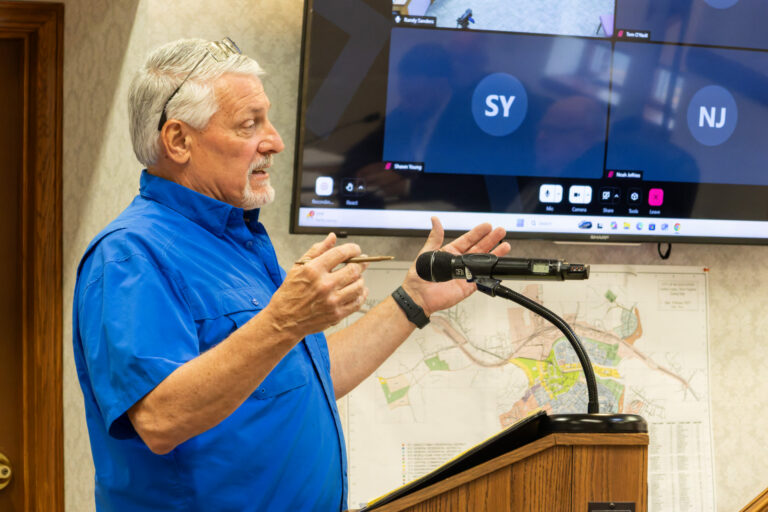
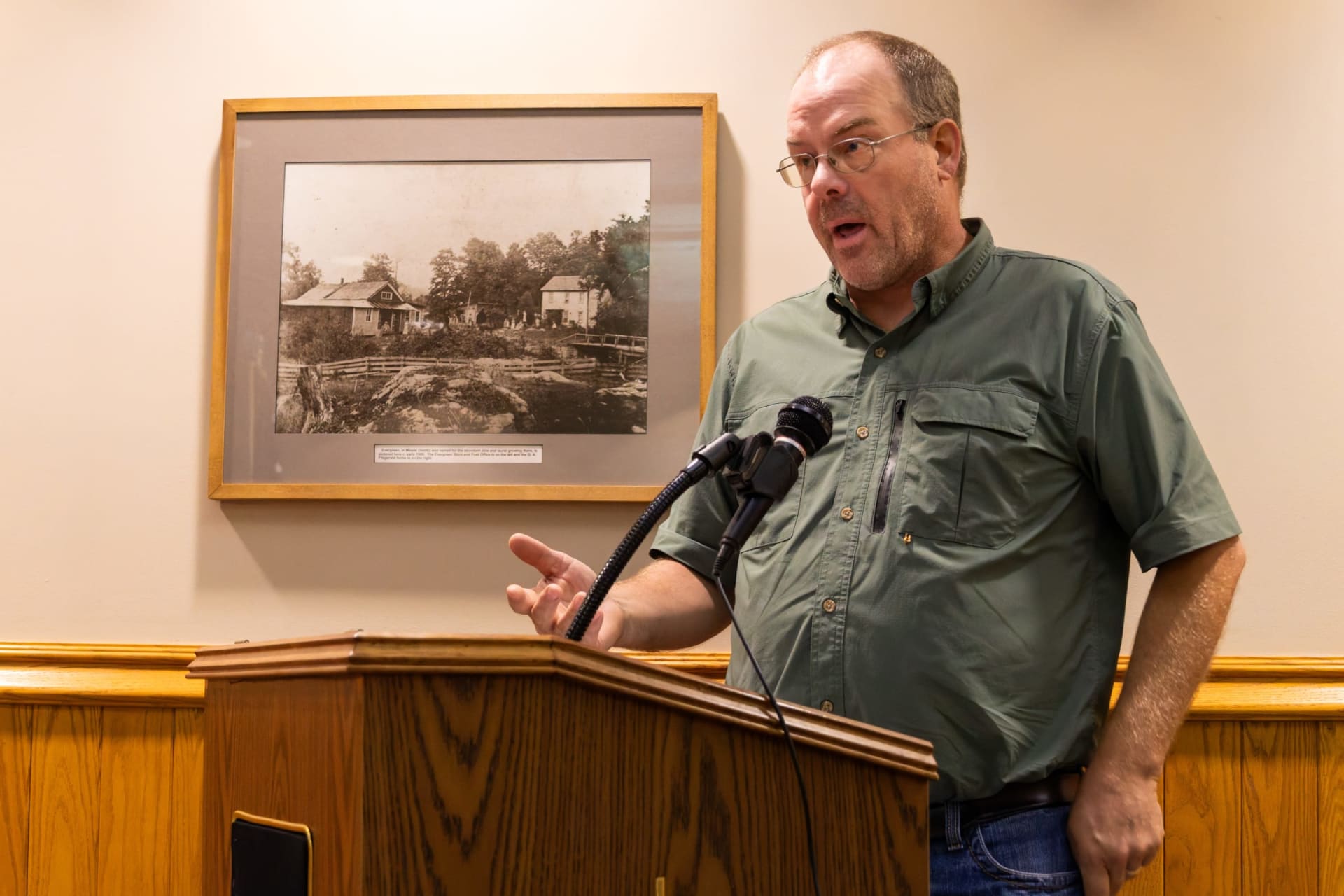
The Upshur County Commission agreed Thursday to draft a resolution opposing the Valley Link transmission project, after a succession of residents packed the commission room and, one after another, told the three commissioners the same thing: a 765,000-volt power line proposed to cross the county would bring West Virginia every burden and no benefit.
Not one person spoke in favor of it. The commission will consider the formal resolution at its meeting next week.
The project is a joint venture of Transource, Dominion Energy and FirstEnergy Transmission operating under the name Valley Link. The northern segment planned through Upshur County is called Valley North. According to the company’s website, the line would run about 260 miles from Putnam County, West Virginia, to Frederick County, Maryland, at 765 kilovolts — one of the highest transmission voltages in use in the country — with new substations in Hardy County and in Frederick County, Maryland.
No representatives from Valley Link attended Thursday’s meeting. On its website, the company says the region’s electricity demand is “expected to double over the next decade” and that the line would deliver “more reliable, affordable electricity” while strengthening the grid. The company’s Valley North page does not mention data centers.
The residents who filled the room described the project very differently. They said the line exists to move power generated in Putnam County hundreds of miles east to feed data centers in Northern Virginia, consuming more than 6,300 acres of private West Virginia land through eminent domain along the way.

Patricia McCarron and her husband bought 39 acres in Rock Cave three years ago to build what she called their forever home.
“We fell in love with Buckhannon and Upshur County,” she said. “We searched far and wide, and we fell in love with this community. The people are amazing. The scenic views are beautiful. It offers great amenities, but complete privacy. And then we learned, in the beginning of June, that we will potentially have these monstrosities right next to our land.”
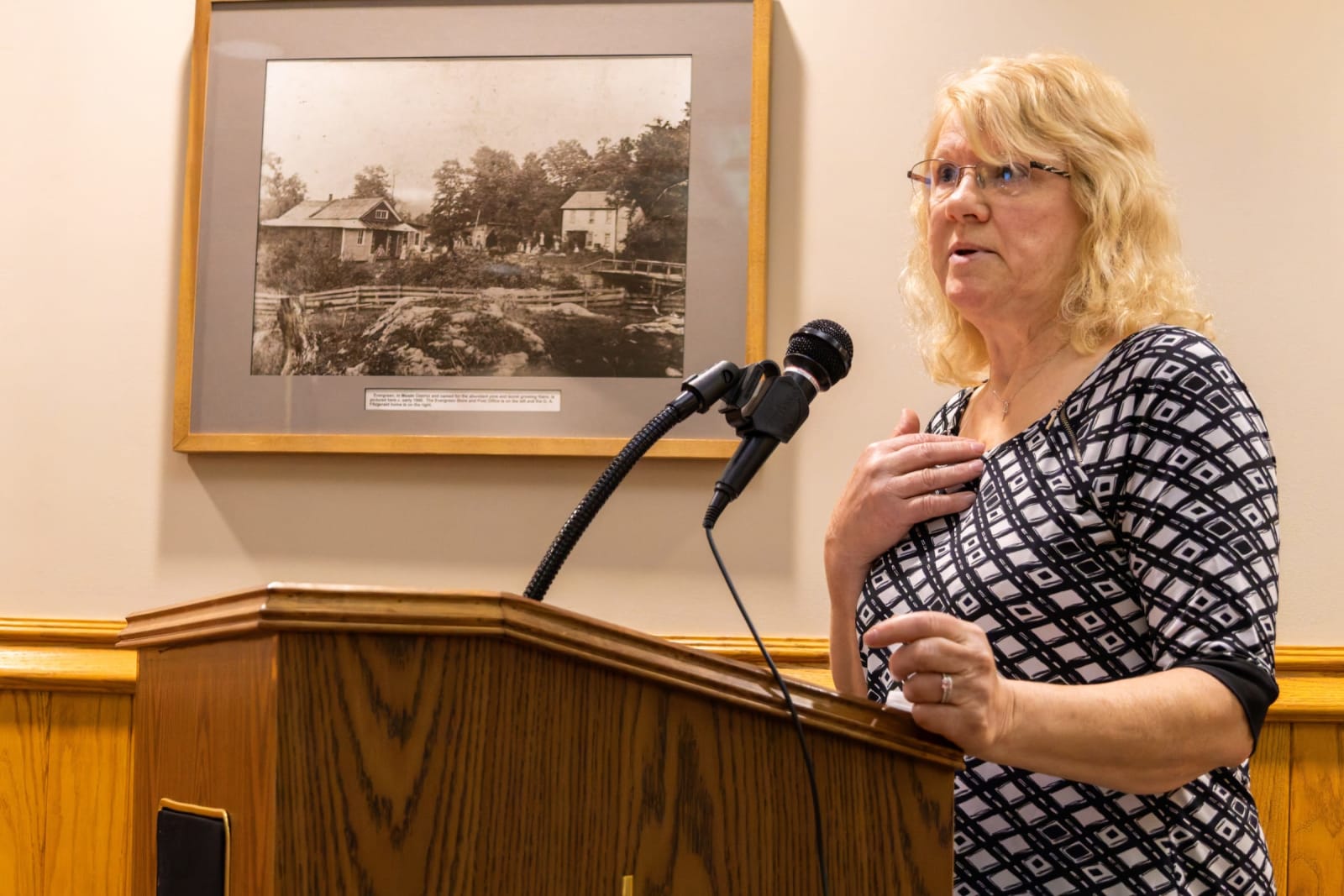
She said their plan is in peril because of the ‘hideous 190-foot towers’ that would loom over the tree line.
“The average electrical pole is 35 feet,” she said. “This is 190 feet. These are going to tower over our trees … I’m not going to build if I’m going to have a 765-kilovolt monster over my home. I don’t want to see that from my back porch. I don’t want to see that from my hunting ground. I don’t want to see that from my garden. I don’t want to see that from my orchard. I don’t want to see that.”
McCarron said the dangers posed by the line are not theoretical.

“There are videos of people walking under towers, and they’re not even 765; they’re 500. They get shocked,” she said. “You can take a light bulb and walk under the towers, a fluorescent bulb. It’ll light up because it’s shooting out that power. Is that what we want in our community?”
Tim Bryan, a Rock Cave resident and mechanical engineer whose family has owned a farm there since the early 1940s, told the commission he had spent 20 years as an industrial engineer rebuilding transformers and working inside high-voltage switchgear. He said he has felt the power of a 765,000-volt line himself.
“We stopped under one down at the West Virginia-Virginia border,” he said. “It makes your hair stand up. I mean, it’s wild how powerful it is. It is just an enormous amount of energy right there that can’t be contained.”
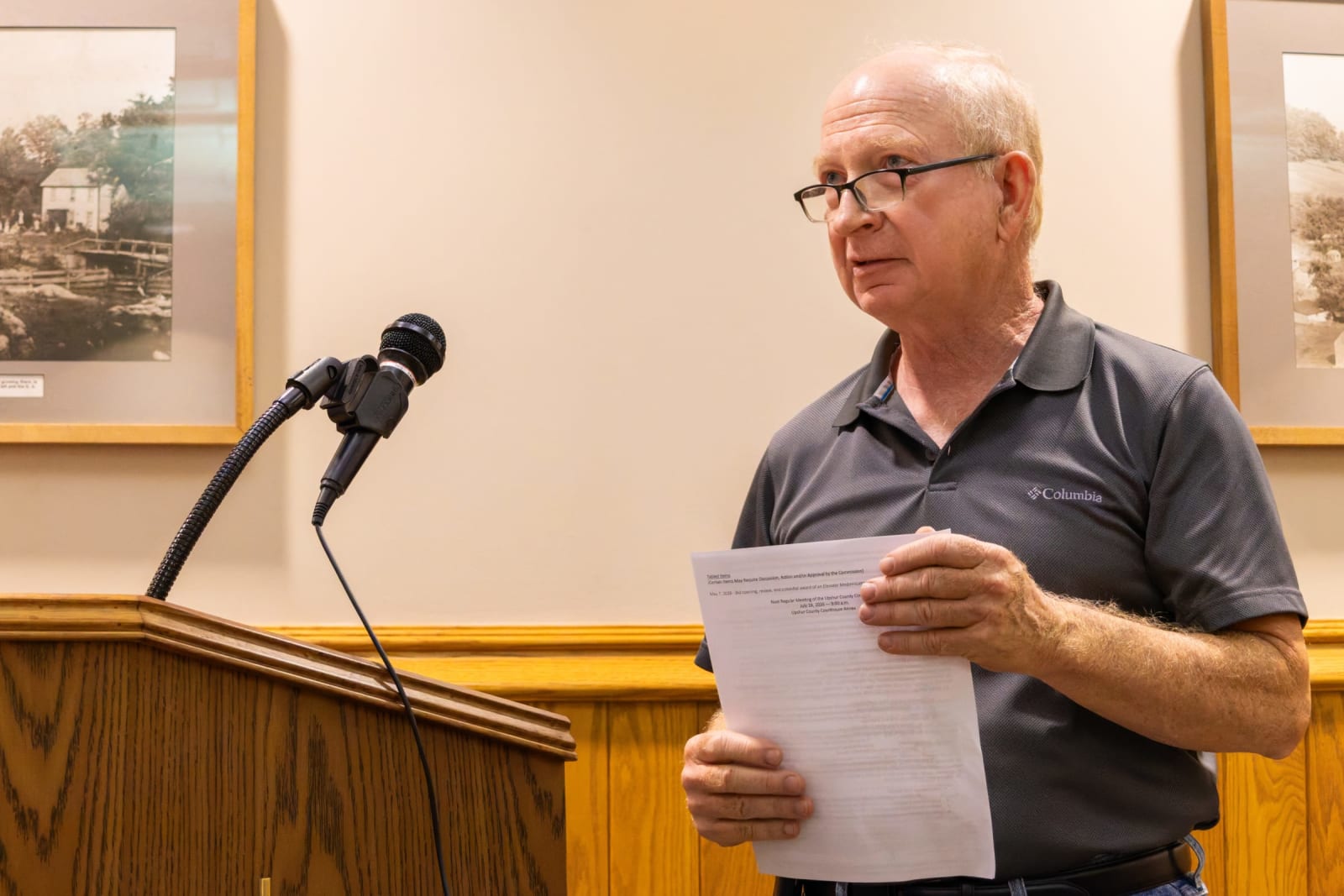
Tom Mullen, a retired professional engineer who said he worked for gas companies, went further. He had been through the John Amos plant and hunted near a 500-kilovolt line in Mason County.
“Those things are just absolutely scary,” he said. “You go under them on a misty day, and it’s crackling and popping — it’s bad.”

Where such a line runs alongside a buried pipeline or other metal for any distance, he said, crews had to lay grounding mats because the current it throws off can be lethal: “They could actually get killed by the induced current on those pipelines. I mean, this is big stuff.”
Bryan said the same effect can charge a fence or a piece of farm equipment sitting in the right-of-way.
“It can become electrified and shock a person,” he said, “not a deadly shock, but not a comfortable thing either. Similar to holding onto an electric fence.”
For Bryan’s family, the risk is personal. His wife’s father received a pacemaker last year, and the documentation that came with it warns that the wearer cannot be near high-voltage equipment.
“It calls it out in the documents that he was handed,” Bryan said.

The farm is the one the older man was raised on and still works on, Bryan said, and the line would put a large part of it off-limits to him.
One of the proposed routes runs right up against a school.
“It literally clips the corner of the property at Washington District Elementary School,” Bryan said. “These aren’t the kind of things we want next to an elementary school.”
That proximity alarmed several speakers, who pointed to research linking transmission lines and childhood cancer. McCarron was careful to say she could not prove the towers would make anyone sick — but she said that was exactly the problem.
“I’m not here to say that transmission towers are definitely going to cause health risks,” she said. “But what we do know is there is an absolute correlation between transmission lines and childhood leukemia. The World Health Organization said that they’re concerned enough to say they’re carcinogenic, so we deserve transparency.”

She compared the industry’s assurances to others West Virginians have heard before. Asbestos and lead paint were once considered harmless, she noted, and coal miners were told not to worry about black lung “until it started killing people.”
“What are these transmission lines going to do?” she asked. “We don’t know.”
For many in the room, the objection ran deeper than any single tower. Donna Ours told the commission her great-great-great-great grandmother came across the mountains in 1852 in a covered wagon and settled the part of Upshur County where Ours still lives.
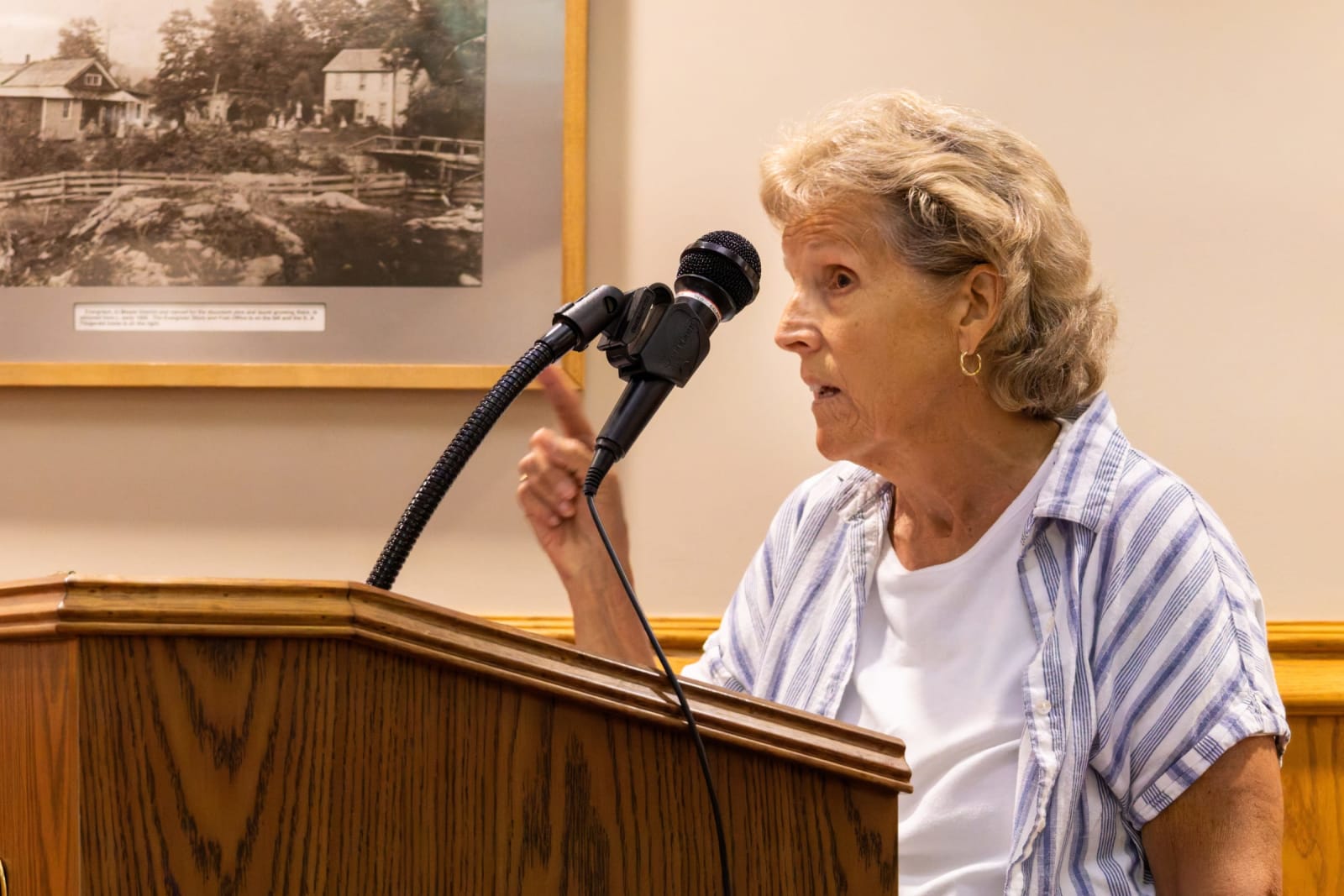
One of the proposed lines would pass within about 100 yards of her front porch, she said, close enough to affect her view, her health and even her hearing aids, which she was told the line could disrupt.
“West Virginia has given so much in its history — gas and oil, coal, timber — and the vast majority of that went out of state,” Ours said, calling the project one more in a long line of outside interests taking the state’s resources “and just hoping we’ll just be silent and say nothing.”

She framed it as a moral test.
“God calls us to be good stewards of what we’ve been blessed with, and we’ve been blessed with a lot here in West Virginia,” she said, then turned the question on the commissioners: “Would any of you want to put your children or grandchildren at risk for developing a childhood cancer, which could be prevented by just saying no?”
Another Rock Cave-area landowner, whose property sits between two of the proposed forks, put it more bluntly.
“I’m kind of tired of West Virginia always being like somebody’s colony,” she said, “and we are often the losers.”
McCarron returned to the same theme, pointing to the well-known Buckhannon mural and its motto, “the promise of tomorrow,” and asking whether a line of steel towers was the promise the county wanted.

“West Virginia has given so much, and what do we get back in return? We get everything ruined,” she said. “A scar across West Virginia? … We get penalized while these billion-dollar corporations get the profit. It’s not right. It’s not fair.”
McCarron rejected the company’s promise of local benefit outright.
“There is no truth to that whatsoever,” she said, arguing the data centers driving the demand could generate their own electricity instead of putting the cost of the line on West Virginia ratepayers — a price tag analysts put in the hundreds of millions of dollars, spread across customers’ bills.
McCarron set that against the county’s economics. Upshur is listed as an economically at-risk area, she noted, with a median household income of $53,400 and a poverty rate of 15.5 percent.
“People can’t pay their electric bills as it is,” she said. “How are we supposed to support increased electric bills?”

Yet FirstEnergy paid its top five executives $28.5 million in 2024, she said, and Dominion paid $38.7 million — together, those 10 people earn as much as 1,250 average households in Upshur County combined. She said she did not begrudge the executives their pay, only the idea of Upshur County ratepayers financing new power lines that will not serve a single local resident.
The promised jobs, she said, were another illusion.
“‘Oh, your electric bill is going to go down.’ That’s a lie. ‘Oh, we’re going to have jobs.’ That’s a lie,” she said. “Do you know how they bring the towers in? Helicopters.”
Bryan said his family had already learned what such a bargain is worth. The 138-kilovolt line that crosses the farm was run in the early 1940s, and the family was paid a grand total of $60 for it.
“Think about that in today’s standards,” he said, warning that whatever Valley Link offers now will look just as paltry in another 80 years.

He had asked a right-of-way attorney who handles such cases nationally how the payments work. The starting point, he was told, is the raw appraised value of the land taken — perhaps $1,000 or $2,000 an acre — with nothing added for lost timber, restricted use or the long-term drop in value. Ten acres might bring a $20,000 check, Bryan said, the same range PATH offered landowners 15 years ago before that project collapsed.
And that one-time check buys a permanent 200-foot easement, with no lease payment, no ongoing income and no new jobs once the line is built. The line would also erode what the land is worth, he said, which in turn drags down the county’s tax base for everyone.
“If the line goes through your land, automatic 50 percent deduction in property values,” Bryan said. “If you’re in sight of it, then you’re looking at maybe a 30 percent reduction in value.”
His own estimate put the cost of the line at nearly $1 billion across West Virginia — a cost he said the companies would spread across everyone on their network. And for all that, Bryan said, the power is not even needed here. He noted that the 54-year-old John Amos plant in Putnam County runs at only about 38 percent of capacity, and its owners are hunting for somewhere to send the rest.
“That’s not Upshur County’s problem,” he said.

Commissioner Doug Bush asked whether the line could be buried instead. Bryan, drawing on his engineering background, said a 765-kilovolt line is a different animal from the smaller lines that run through a neighborhood: at that voltage the cables throw off too much heat to shed underground. Denmark has buried high-voltage lines only by running cooling systems through the conduits, but at a cost that would be unfeasible over any real distance.
The residents offered an alternative they said would make the whole project unnecessary: microgrids. Rather than move power hundreds of miles, Bryan said data centers could generate electricity where they operate, eliminating the need to take 6,000 acres of private land just to string an “extension cord” across the state.
His wife, Kathy Lipps Bryan, said the distributed generation offered by microgrids is also sturdier.
“If something goes down, you lost 5 percent — you don’t lose the whole thing,” she said, recalling how companies with their own microgrids in Texas fed power back to the grid when hurricanes knocked out the main plants.
That approach has backing in Charleston. The West Virginia Legislature passed a law in 2025 authorizing microgrid construction, and Governor Patrick Morrisey called the measure his “landmark policy proposal for the 2025 legislative session.”

McCarron called on the three Upshur County Commissioners to take a stand.
“People respect what you have to say,” she said. “We are asking you to join your constituents. Support us. Fight for us.”
The commissioners unanimously said they wouldn’t want the lines on their own land. Sam Nolte said he had heard the same objections during the PATH fight years ago and had never met anyone who supported that project either.
“You’ve got a tough path,” he recalled telling a Valley Link representative who pitched the line to the commission. “People don’t want that in their backyard. I wouldn’t want it.”
When Ours spoke about the state’s resources leaving, Nolte answered plainly: “I agree with you, because we have been taken advantage of multiple times here with our natural resources.”
He supported putting the county on record against the power line: “I don’t have a problem doing a resolution.”
Bush said he agreed with the residents’ concerns but wanted to make sure he was well educated on the matter.
“I don’t want to risk my children’s lives with leukemia. That’s a no-brainer,” he said. “I agree with everybody in here, and I haven’t heard anything I disagree with, but I want to look at the other side.”
Commission President Kristie Tenney said she and her family also live on a farm close to the proposed route.
“I wouldn’t want that on our farm,” she said, asking county administrator Tabatha Perry to place a resolution opposing the line on next week’s agenda using Preston County’s version as a model.

“I think it’s well written, simple, to the point,” Tenney said.
Several speakers said that many of the people in the line’s path do not even know yet. Bryan said that of his four or five direct neighbors, two had no idea the line might cross their land until he told them in person.
“It comes in a very nondescript letter,” he said, one that Nolte agreed looks like junk mail, something that people might throw away without realizing what it is.
Moving forward, Mullen urged the commission to take its objection to the right place. The project will first go to the West Virginia Public Service Commission, but because the line crosses a state boundary, he said it could also require a federal certificate of public need. If that happens, it would open another public comment period.
“If they have to go to FERC, FERC is going to open a public comment period,” he said. “So if you’re going to object, it would be good for the commission to object directly.”

He also warned residents about the land agents who will come knocking.
“They’re hired guns,” he said. “They’ll tell you what you want to hear, and don’t count on anything else.”
Tenney said the current public comment period closes August 14 and urged residents to file comment cards before then; the commission had copies printed and available Thursday.
Upshur County Assessor Dusty Zickefoose offered to have the county’s mapping vendor overlay the proposed route so residents could click on a parcel and see whose land is affected. The update was completed by Thursday afternoon. Residents can visit the county’s GIS mapping tool, click the layers button in the menu at the top-right, and select “powerline” to see the route overlay.
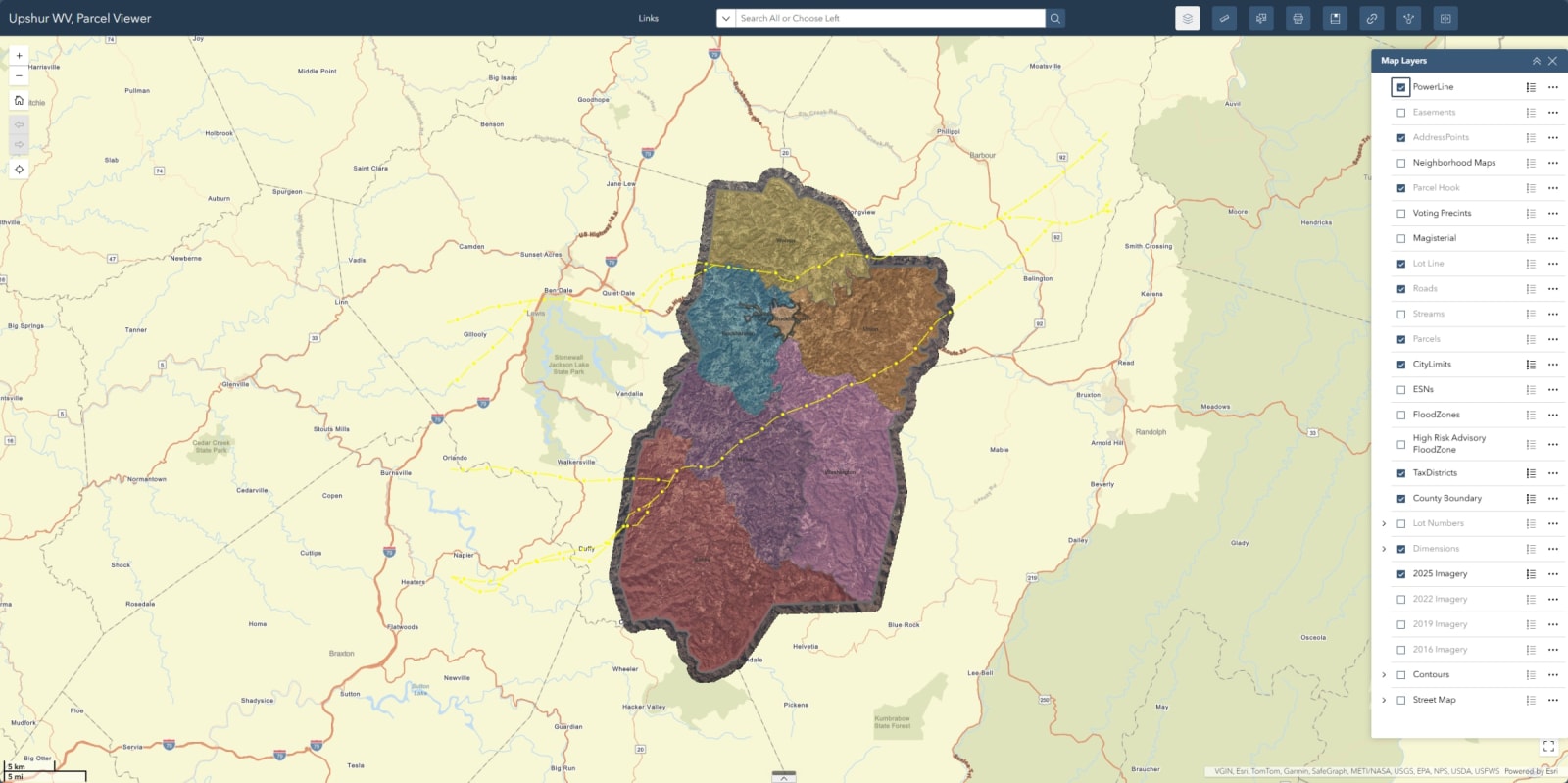
The formal resolution is expected to come before the commission next week. Barbour County has already adopted one opposing the project, and residents noted that Preston and Monongalia counties have hired outside counsel to fight a related line before the state Public Service Commission.

McCarron closed the public comment with a warning about property rights. Valley Link is not a public utility, she said, and its agents have no right to set foot on private land without permission or a court order. She said she had already sent the company a certified letter ordering its representatives to stay off her property, and she expected the sheriff to enforce trespassing laws if they ignored it.
She promised to fight to the end: “I will take my last breath,” she said. “I will spend my last cent.”
Bryan left the commissioners with a picture of what he called the power company’s ‘laughable’ commitment to local infrastructure. When a storm rolled through a few weeks earlier, he said, his family’s power was out for two days, and the crew that restored it fixed the line by lashing a two-by-four to the top of a broken pole rather than replacing it.
“At the same time, they’re going, ‘Hey, can we have some land for a big power line to help everything?’”