Community Bulletin
WVU Medicine St. Joseph’s Hospital and Buckhannon Upshur Rotary will offer $35 blood screenings by appointment Oct. 10-31 in Buckhannon and Nov. 7 in Rock Cave. Optional tests are available, and participants must fast for 12 hours. Read more →
This story brought to you paywall-free, courtesy of the My Buckhannon team and our community partners
A Buckhannon boy was a year and a half old when his mother noticed his eye was not doing quite what the other one did. She took him to the doctor. At the children’s hospital at Ruby Memorial, doctors found a cancerous mass growing behind the eye.
Ruby did not have the equipment to treat it, so he was sent to Philadelphia. Not many years ago, the operation would have taken the mass and the eye along with it. Instead, treatment removed the mass and left his sight intact. He is 3 1/2 now.
“You wouldn’t know a thing was wrong with him — that’s the advancement that cancer research has given us,” said Robin Oldaker, chairperson of Upshur County Relay for Life.
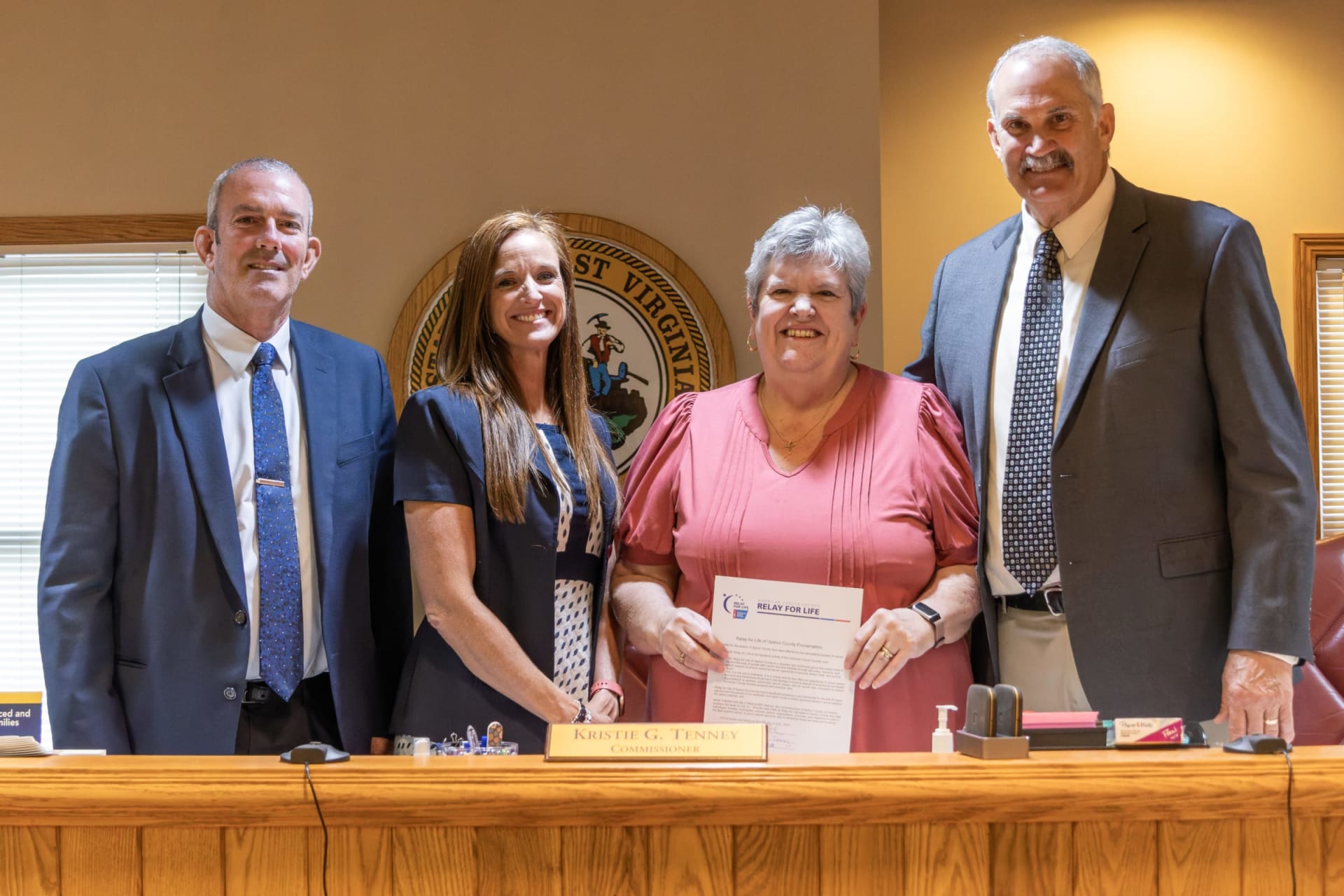
Oldaker told that story to the Upshur County Commission at its July 9 meeting, where commissioners adopted a proclamation declaring the week of July 12 through 18 as Relay for Life week in Upshur County.
“These are Buckhannon people,” she told commissioners.

More than nine of every 10 American children with a specific type of eye cancer that strikes almost entirely in kids under 5 are now cured, the American Cancer Society reports, and most keep both eyes.
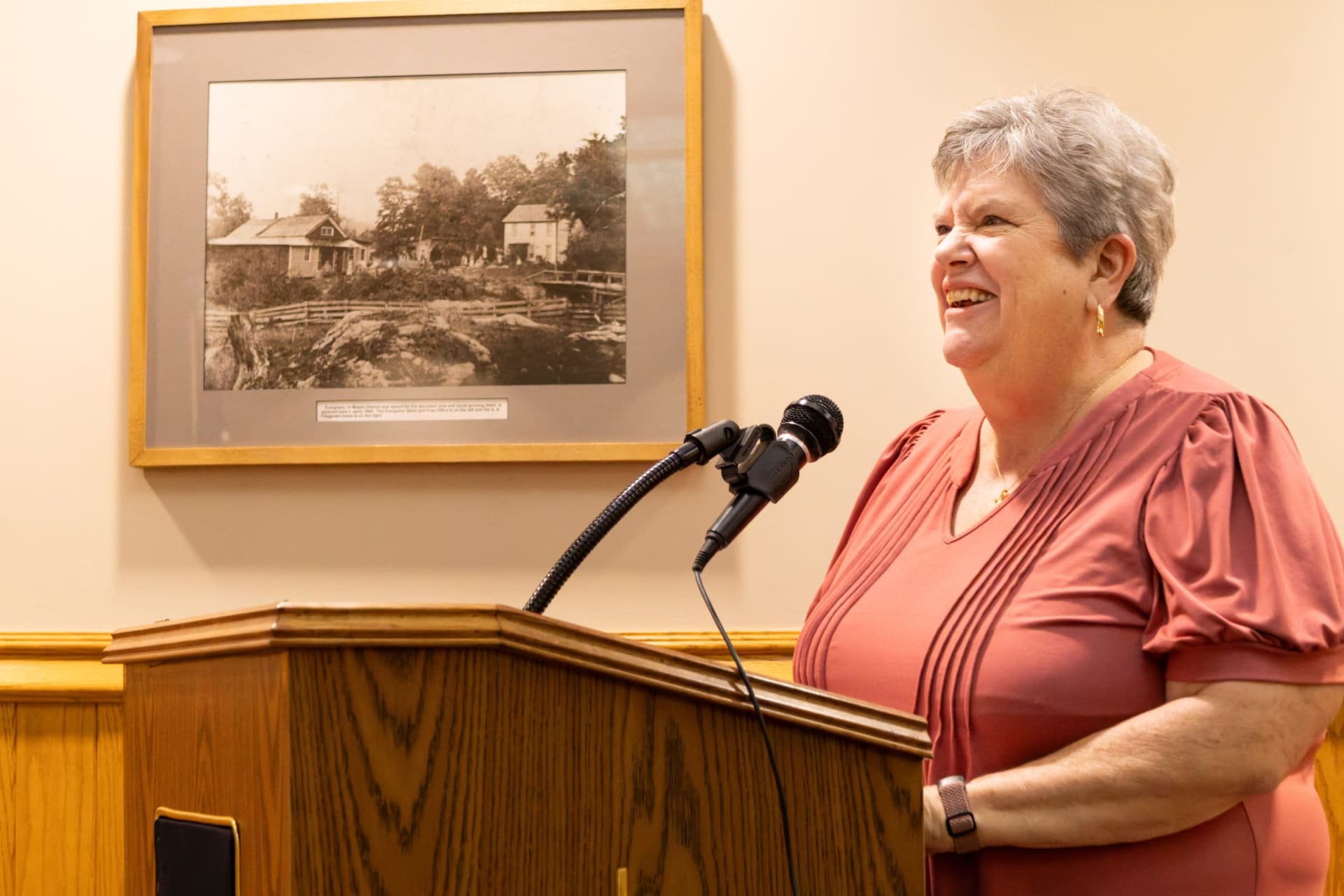
Oldaker said she has stood before the commissioners many times and presented a proclamation for Relay for Life.
“I’ve already told you about statistics. I’ve told you about how the money’s used. I’ve told you about survival rates, early detection,” she said.
So this year she took up a different question, one the American Cancer Society poses on its own website: why do we relay?
Her answer starts more than 20 years ago with her father, who died of colon cancer. She walked in his honor, stepped away for a time and came back after her first cancer diagnosis.

“I wanted to get word out that things are changing,” she said.
She learned that in a treatment waiting room, among a group she came to call her cancer family. One woman there was 80 years old, back for treatment because her breast cancer had returned after 15 years.
“Her comment was, ‘If I’d been treated the first time the way I’ve been treated now, it would have never come back,’” Oldaker said.
But despite the improvements, living with cancer or as a survivor is a lifelong battle.
She read commissioners a passage written by another cancer survivor. It asks the reader to imagine going about an ordinary day when someone steps up behind you and presses something against the back of your head.

“I’m holding a gun against the back of your head. I’m going to keep it there. I’m going to follow you around like this every day for the rest of your life,” the passage reads. “I’m going to press a bit harder every so often, just to remind you I’m here. But you need to try to ignore me, to move on with your life. Act like I’m not here, but don’t you ever forget, one day I might pull the trigger, or maybe I won’t.”
Remission does not end it, the passage says. “It never truly goes away. It is always in the back of your mind.”
Oldaker, a survivor herself, said people have told her she does not look sick.
“I may not look sick on the outside, but there are lots of things going on on the inside,” she said. “And then sometimes that trigger gets pulled, and you face it again, and you change again. You fight harder, and that’s why I’m relaying.”
Oldaker gave commissioners two more examples of how the fight against the disease continues to evolve.

A man decided when he turned 40 that he needed to take better care of himself, she said, so he went in for a routine physical — bloodwork, a PSA test, the whole panel. It came back showing prostate cancer caught so early that doctors could not assign it a stage.
“In past years, prostate cancer wouldn’t have been detected until it was probably stage three or stage four,” Oldaker said. “Look at the advancement there.”
The man needs no treatment yet, only monitoring, with blood draws and biopsies to catch any change.
That approach has a name. Under National Comprehensive Cancer Network guidelines, active surveillance — watching a low-risk prostate cancer closely rather than treating it right away — is now the preferred first option for most men whose disease is small and slow-growing. Roughly 69% of prostate cancers are now caught while still confined to the prostate, and five-year survival at that stage is essentially 100%, according to the National Cancer Institute.
Oldaker also pointed to the cooling caps offered to chemotherapy patients, which she called ice caps.

“It goes on your head, and somehow — I don’t know how it works — it works with your hair follicles, and you don’t lose your hair during cancer treatments,” she said. “Isn’t it amazing, the research that has come along?”
The caps chill the scalp during an infusion, narrowing blood vessels so less of the drug reaches the hair follicles and slowing the follicles down so the chemotherapy is less likely to target them. The first use was cleared by the Food and Drug Administration in 2015.
Her mother is 96, Oldaker said, which gives her a long view of what has changed.
“I think of during that time, so many people died, and they never knew what was wrong,” she said. “Even 10 years ago, 15 years ago, treatment was totally different.”
The cancer death rate in the United States has fallen 34% from its 1991 peak, an estimated 4.8 million deaths averted, according to the American Cancer Society’s Cancer Statistics, 2026 report, released in January. Five-year survival across all cancers combined has reached 70%, up from 63% in the mid-1990s. The society credits declines in smoking, earlier detection and better treatment.

West Virginia has not kept pace. The state’s cancer death rate stands at 177.9 per 100,000 people against a national rate of 145.4, among the highest in the country, according to the National Cancer Institute’s State Cancer Profiles. The American Cancer Society projects 13,590 new cancer diagnoses and 4,710 cancer deaths in West Virginia this year.
Relay for Life, which pays for a share of that research, began in 1985, when a Tacoma, Washington, colorectal surgeon named Gordy Klatt circled a track for 24 hours, covered more than 83 miles and raised $27,000 for the American Cancer Society. Friends paid $25 to walk a stretch with him. In the four decades since, Relay has raised nearly $7 billion for the society, which has put more than $5 billion into research grants since 1946 and funded more than 50 eventual Nobel Prize winners.
The Upshur County event runs on volunteers, Oldaker said.
“Did you apply for this job?” she said, repeating a question she gets. “I was kind of volun-told that I was going to do this.”
Asked whether she is paid: “Absolutely not.”

The group starts every year with nothing.
“Our budget is zero,” she said. “As of August 30, our account clears, and we start all over again.”
Every dollar raised goes to the American Cancer Society, Oldaker said. Local businesses cover the event’s own costs in kind — paper products, food, gift certificates — and none of that is counted in the total.
Eleven teams raise money year-round, and they take the work where they find it. Jody Light, who organizes the Almost Heaven BBQ Bash, told commissioners she needed someone to handle trash pickup at this year’s festival after her usual crew fell through, so she called Relay.
“We gave them a fairly nice donation, and they pulled through and did a great job,” Light said. “It really was a win-win for both.”

Upshur County Relay raised $38,000 last year. The goal this year is $40,000. As of Thursday’s meeting, the total stood at $28,000.
“With the economy, I’m not sure we’re going to make it,” Oldaker said. “But it doesn’t matter, because what we’re doing is something that’s near and dear to my heart.”
This year’s Relay is Saturday, July 18, from 5:30 to 10:30 p.m. at Jawbone Park. The theme is “Stars and Stripes for a Cure.”
Survivors are recognized first and served dinner, as they are every year.
“They are our heroes,” Oldaker said.
This year, the event will also honor veterans — any veteran, Oldaker said, not only those who have had cancer. There will be games, music and the return of the Jail Birds, local figures who must raise money to be sprung from a mock jail.
The night closes, as it always does, with the luminaria service, the bags lit along the walkway in memory of those lost and in honor of those still fighting. This year, it will end with Taps.
Upshur County Relay for Life has been at this for 29 years.
“So I fight, and I fight for those, because I don’t want anyone to ever hear or get that phone call: ‘You have cancer,’” Oldaker said. “I want cancer to be treated like your common cold.”