Community Bulletin
A run of power outages across central West Virginia in recent months has homeowners weighing backup options. Crites Electric, a Buckhannon Generac dealer of more than 45 years, installs automatic standby generators that restore power within seconds — no cords, no switches. Read more →
This story brought to you paywall-free, courtesy of the My Buckhannon team and our community partners
For every faculty member at West Virginia University, work is personal. Their research, teaching and mentorship are driven by a sense of purpose that doesn’t turn off when the clock strikes five.
But for some faculty members, the lines between “me time” and Mountaineer time are even blurrier. These WVU power couples are colleagues by day and spouses after hours. They bring their work home with them, literally.
The faculty couples celebrated here have made their relationships work thanks to their willingness to embrace each other’s passions.
When one partner has asked, “What if?” the other has answered, “Let’s go!”
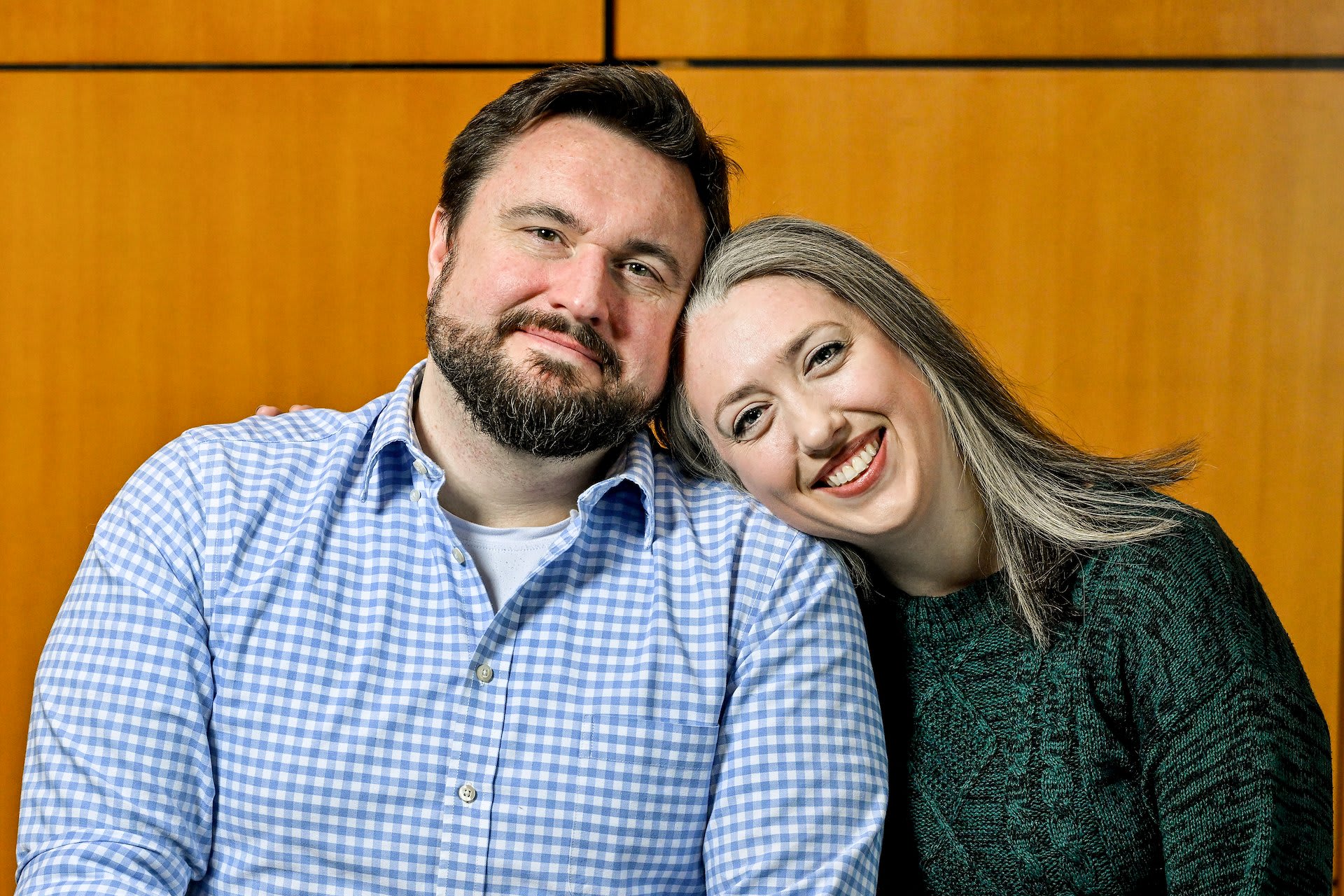
Katelyn and Ryan Best
In 2009, at a bar in Tallahassee, Florida, Ryan Best introduced himself. Katelyn had a hard time believing his introduction wasn’t a cheesy pick-up line.

“I’m Ryan Best,” he said.
“Oh yeah, I’m Katelyn Awesome,” she said back.
But it wasn’t a line. It was his name, and he pulled out his driver’s license to prove it.
A few months later, they started dating. Ryan was a graduate student in cognitive psychology. Katelyn was in a grad program for musicology.
Both were musicians — she performed in an intercultural jazz ensemble, while Ryan played bass guitar in a reggae band.

They’d camp out at coffee shops with their laptops, working side by side through long days of reading and research.
But when the demands of Katelyn’s program grew, she told Ryan, “I don’t have time for a relationship.”
“Well, you have to eat,” he parried. “I’ll cook dinner.”
And that fixed that. In 2011, Ryan proposed, and they married in 2012.
Like many academic couples, they faced what’s known in higher education as “the two-body problem.”

Finding two faculty positions in the same location can be notoriously difficult, so for years, they followed each other’s opportunities. When Ryan landed a postdoctoral fellowship at the University of Zurich in Switzerland, Katelyn turned down job offers to join him there, pursuing her own research independently. Later, Ryan’s work brought them to Santa Monica, California. They took three weeks to drive across the country together.
When Katelyn got a job at WVU, everything finally clicked. The university’s Dual Career Program worked with Ryan to identify the perfect teaching role for him.
Across the country they drove again. This time, they seized the chance to record their songs at national parks they visited along the way.
“We were trying to come up with melodies and arrangements in the car, hiking to a certain spot in the park, setting up phones and recording,” Katelyn said. “That was quite the adventure.”
Now in their fifth year at WVU, Ryan is an assistant professor of psychology in the WVU Eberly College of Arts and Sciences, and Katelyn is a teaching assistant professor in the School of Music at the WVU College of Creative Arts and Media.

For Ryan, who grew up in a college town as the son of a professor, the community felt familiar.
“This is a perfect town. We have that ‘university town’ feel here in spades. I love it here — it’s home,” Ryan said.
Katelyn, who’s not far from her hometown of Pittsburgh, agrees.
“Because my colleagues at WVU are all very collaborative, it’s a fantastic environment to grow as an academic. I’m able to thrive and feel supported.”
They perform together as the acoustic duo Park and Franklin, seeking out open mics wherever they go. The project started as a cover band. Then they made it personal, setting Katelyn’s father’s poems to music.

“Ryan and I have very different compositional styles, so our songs sound very, very different,” said Katelyn. “The thread that connects them is ‘Tapestry of Love and Loss,’ a book of poetry written by my dad.”
They have different styles in life, as in music.
Ryan depends on Katelyn’s compassion and generous spirit, while she sees him as “the bamboo” — patient, thoughtful and mindful.
To her ears, she said, their shared last name no longer sounds too good to be true.
Yoav and Maureen Kaddar
The front room of Yoav and Maureen Kaddar’s home in Morgantown has never been furnished and never will be.

“We need somewhere to move,” Maureen said.
Both choreographers, they use the space to plan and dance, working through sequences together.
The room looks empty, but the Kaddars say it’s full — full of artistry, possibility and partnership.
They met while performing together for a New York City dance company. Over four years touring the country and the world together, they became friends, then a couple.
“In dance, you work so closely,” Yoav said. “It’s not like you’re going to the office, you do your work and I’ll do my work. We’re always together, especially in a smaller company where you tour and travel together.”
In 1998, they married — and life immediately separated them, as Yoav headed to the West Coast for graduate school while Maureen continued touring.
But the two dancers found a way to reach across the space.
“If I couldn’t get to Seattle, and he couldn’t get to New York, we’d meet somewhere in between,” Maureen said. “Sometimes, we would meet in Chicago.”
The Kaddars settled for a time in the Hudson Valley of New York State and started a family. As their two children grew, however, they began looking for stability.
WVU offered that — and excitement, too.

Yoav and Maureen joined the WVU Dance Program at a pivotal moment, helping transform the popular dance minor into the first dance major ever offered in West Virginia.
With colleagues such as Associate Professor General MacArthur Hambrick, the Kaddars built the dance major on foundations that had been laid not only by the passionate dance educator Kathryne “Kacy” Wiedebusch, but also by the student organization Orchesis Dance Ensemble.
“In 2028, we’re going to celebrate 100 years of dance at WVU,” Yoav said. “The character of dance is to pass the torch from mentor, teacher, performer and then on to the next generation. That’s the story that happened here.”
Neither Kaddar makes much distinction between the bonds that unite them as artists and partners.
“You’re supporting me. I’m supporting you,” Yoav said.

Maureen agreed.
“Dance gave me a partner,” she said. “I’m very grateful for that.”
Alyssa Beall and Alex Snow
Alex Snow had just started his doctoral program at Syracuse, and he was nervous.
“It was the fall of 2000, and our cohort of new PhD students was meeting for the first time in a little room, the day before classes started,” he recalled.
“I’m perpetually the early guy to everything. I got there early, surveyed the room and found the space where I wanted to sit down in. I said to myself, ‘The room is mine.’ Then she walked in.”

While Alex was always early, Alyssa Beall had arrived a little late — and was running even later by the time she entered Alex’s life.
Anxious about an email miscommunication that had delayed her, she said she “stood outside the door for about five minutes, deciding whether or not to walk in late.”
“I’m glad you walked in,” Alex said.
Alyssa smiled.
“I decided that if I was going to walk in, I was going to own the room,” she said.

The two clicked, as much at the dart board and the pool table as in the halls of academe.
According to Alex, their relationship quickly found the form it takes today, “competitive, sometimes playful, sometimes combative.”
“Stop saying that we’re combative,” Alyssa interjected. “We’re not that combative!”
In 2005, they married, and in 2011, they left New York for West Virginia. Both were used to pulling up stakes. Alyssa had already lived in Pennsylvania, Washington and California. Alex’s stomping grounds had included North Carolina, Ohio and Missouri.
Once they made it to Morgantown, they were able to travel farther than ever before.

As members of the religious studies faculty at the WVU Eberly College of Arts and Sciences, Alyssa and Alex have led WVU students on study abroad trips to countries including Israel, Spain, Greece, Japan, Vietnam, Cambodia and Thailand.
“Study abroad is basically teaching on steroids,” Beall said. “You’re with the students and each other for three or four weeks.”
Far from home, they have faced crushing heat and missed trains, ending up convinced that a couple who can run a study abroad program together can get through anything.
When it comes to their scholarship, Beall enjoys the “strange stuff” within Western theology, like magic and witchcraft. Snow, on the other hand, specializes in the religious and philosophical traditions of India, China and Japan.
That diversity keeps conversations at their dinner table interesting, they agree. But they also have hobbies in common. When they cook together, she is the head chef, and he is the vegetable-chopping sous chef. They play backgammon and throw darts together almost every evening. And they share their 100-year-old house near campus with two cats, Fizzgig and Tucker.

Next, they might want to go to Greece.
Or to Malta.
Or to Thailand.
Wherever it is, they’re going together.
Story by Amy Quigley and Katie Short. Photos by Jennifer Shephard. Published by WVU Stories.