Help Wanted
My Buckhannon is looking for freelance writers who love their town and want to help share the stories that make Upshur County special. Read more →
This story brought to you paywall-free, courtesy of the My Buckhannon team and our community partners
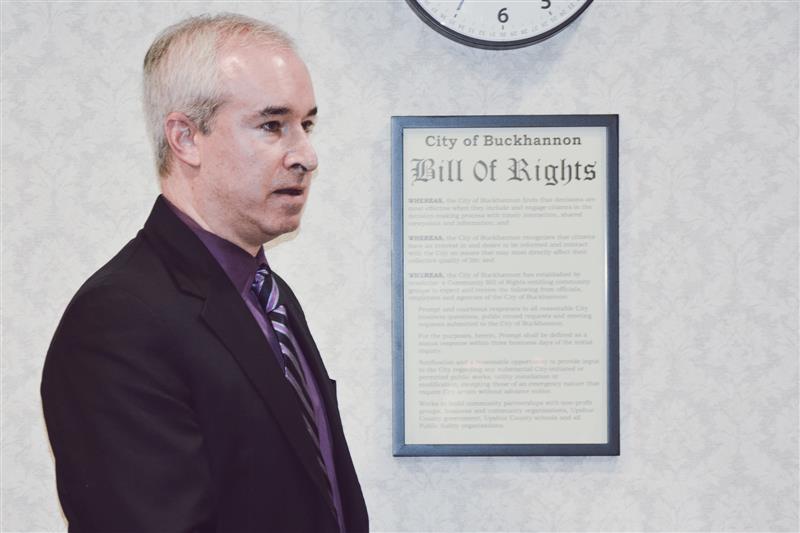
BUCKHANNON – Buckhannon City Council will consider an ordinance that would outlaw discrimination based on sexuality in public accommodations – including housing, employment and places of business – in December or January.
Andrew Schneider, the executive director of Fairness West Virginia, urged council to elevate their 2013 resolution opposing discrimination against people based on sexuality or gender identity to an actual law at council’s Oct. 18 meeting.
However, on Sunday, mayor David McCauley said the council likely won’t take up the ordinance until a meeting in December or in early 2019, allowing Schneider time to work with city attorney Tom O’Neill.
Fairness West Virginia is a statewide civil rights advocacy group that lobbies for fair treatment and basic civil rights for lesbian, gay, bisexual and transgender West Virginians, according to its website.
Since Buckhannon adopted its LGBTQ nondiscrimination resolution in 2013, 11 communities in the Mountain State have actually gone one step further – converting their resolutions to ordinances or laws.
The point of a nondiscrimination ordinance is to give people who believe they’ve experienced discrimination based on sexuality “cause of action,” or a legal justification to sue.
“Since [2013], a number of communities have come forward and decided it was long past time to adopt municipal laws that protect our LGBTQ citizens from discrimination,” Schneider said. “That includes everyone from Charleston, the largest city and our capital, to Thurmond, West Virginia, the smallest town in America.”
Schneider said although the most common attacks on LGBTQ nondiscrimination laws typically come from religious organizations, he’s realized mobilizing religious leaders of varying denominations across the state could help bolster the case for the exact same laws.
“When we gave it some thought, we recognized that religion actually provides us with the strongest argument for LGBTQ nondiscrimination and inclusivity, mainly the Golden Rule, and that’s in Christianity, of course, but that same principle – one of God’s highest commandments – treating each other as you would want to be treated – exists in all major religions,” Schneider said.
Fairness W.Va. has since recruited 55 religious leaders from across the state – that number represents West Virginia’s 55 counties – to public speak about why their religion mandates that they support LGBTQ nondiscrimination.

“We got everyone from Catholic priests to Methodist ministers, the largest denomination in our state, to Presbyterians, Episcopalians, we got all the rabbis in the state,” Schneider said. “We’ve got Quakers, we have a Muslim, a person of Lakota faith. And they all say the very same thing – that nondiscrimination is a religious value.
“LGBTQ nondiscrimination is in keeping with religious principles,” he added.
So, why do cities need to pass laws?
The answer, Schneider said, is because the state and federal governments haven’t.
“State and federal government have both so far failed to adopt a law that provides for nondiscrimination in employment, housing and public accommodations,” Schneider said, “so even though we have marriage equality now – that was decided by the courts three years ago – you essentially can get married on Sunday, get fired on Monday and get evicted on Tuesday because the very basic laws that so many of us take for granted that protect us from discrimination still elude the LGBTQ community in very serious ways.”

Schneider said that in addition to the moral argument for nondiscrimination, there’s also a strong economic case for it.
“Our state is losing population, our communities are losing population because people in West Virginia – particularly our young and talented citizens – are moving to communities out of state that they deem to be more tolerant and more inclusive and more livable for an LGBTQ minority like themselves,” he said.
Now, nearly all Fortune 500 companies – about 96 percent – have implemented LGBTQ nondiscrimination policies, Schneider said. And whether or not a town has a nondiscrimination law on the books can influence critical decisions about where they set up shop.
“They make their decisions [about] where to base their company on where they can attract the best and brightest employees, so they’re going to think twice about moving their headquarters or moving an office to a place that doesn’t have any nondiscrimination protections because they’re going to have trouble recruiting employees to work there,” he said. “So it’s important, from an economic standpoint to replicate what Charleston, what Lewisburg, what Martinsburg are doing because … they want to attract [and] compete for these companies, for this economic development.”
Schneider said the classic example (and lawsuit that wound up in the U.S. Supreme Court) involving a baker refusing to bake a cake for a same-sex couple is used to trivialize how important nondiscrimination laws can be to basic survival.
For instance, without an ordinance in place, a medical provider might refuse to render services to someone who’s gay – something that would be “unconscionable” to most people, he said.
Because West Virginia is rural with doctors’ offices and hospitals fewer and farther between than urban areas, having a nondiscrimination ordinance in place could literally be a matter of life or death, he said.
Schneider said the ordinances haven’t led to an increase in frivolous lawsuits in other towns and don’t place a burden on the city. A plaintiff is charged with finding her or his own lawyer; all the ordinance does is gave that plaintiff a “cause of action.”
“Laws are important because they make people feel safe, and they act as deterrents for bad actors,” he explained. “The burden is on the victim to find a lawyer.”
Councilman CJ Rylands asked about a hypothetical example in which a homosexual businessperson was the bad actor.
“My question would be, if there was a gay baker and some other couple came in and asked for something they opposed, does it protect them?”
Schneider said yes.
“First of all, sexual orientation protection is a very broad word,” he responded. “We all have a sexual orientation, we all have a gender identity, so … as a heterosexual, you would be protected under sexual orientation protections because yours is just as much of a sexual orientation as mine is, so yes.”
City recorder Colin Reger wanted to know how churches would be affected by the ordinance.
Schneider said churches aren’t considered “public accommodations,” and therefore, wouldn’t be subject to the proposed law.
“They are completely free of this type of regulation,” he said. “I would never want to compel a church to do something contrary to its teachings.”
McCauley suggested Schneider work with O’Neill as city considers moving forward with the ordinance.
City council’s regular meeting is set for Thursday, Nov. 1 at 7 p.m. at city hall.