Community Bulletin
For more than 120 years, the Elkins hospital now known as Davis Medical Center has been where the Potomac Highlands turns for care. Today that includes expert kidney care close to home — sparing many patients a drive out of the region. Read more →
This story brought to you paywall-free, courtesy of the My Buckhannon team and our community partners
By Katie Short, West Virginia University
West Virginia University physics and astronomy researcher Chris Fowler is launching into the unknown — on two trajectories.
Fowler is part of the NASA ESCAPADE mission, which has sent satellites hurtling toward Mars to study space weather and the Martian atmosphere.
He’s also a driving force behind a NASA-funded education program that brings real spacecraft data into high school classrooms in rural West Virginia.
One path leads 200 million miles away.

The other touches down in Appalachian classrooms right here at home.
Let’s boldly go
Fowler’s story starts with “Star Trek.”
As a young boy in England, “I was really into sci-fi and a big ‘Star Trek’ fan,” he said. “I used to watch it with my dad and brother, back when you had to remember the TV schedule.”
He also recalled watching NASA shuttle launches around the same time and reading about NASA missions and research. Outer space, fictional or real, became a powerful obsession.

It was as an undergraduate at the University of Southampton that Fowler knew he wanted to make it his job.
The “defining point” arrived the summer between his third and fourth years, when Fowler worked with a research group that was studying Earth’s auroras, the polar lights.
“That was the moment of transitioning from, ‘Science is cool. It’s this abstract thing you watch on TV,’ to, ‘This is what it’s like to be a scientist in a real research environment,’” he said.
To make that happen, he crossed the pond for graduate school in Boulder, Colorado, where he met his wife, Katherine Goodrich, a space physicist studying the Earth’s magnetosphere.
Together, they did research at the Space Sciences Lab in Berkeley, California, for a few years. When Goodrich took a tenure-track position at WVU, they landed in Morgantown.

Now a research assistant professor at the WVU Eberly College of Arts and Sciences and a member of the WVU KINETIC Center, Fowler is trying to help others find their defining moments.
The land-grant mission
In 2023, Fowler became one of five scientists nationwide to receive the NASA Planetary Science Early Career Award. He used the funding to launch his project, “Bringing Planetary Science to West Virginia,” which will teach high school students in West Virginia to code using real NASA data, introducing them to critical technical skills in computer and data science along the way.
By the time the ESCAPADE data reaches Earth in late 2027 or 2028, Fowler wants to be ready to put it in the hands of West Virginia students.
“The idea is to develop a high school computer science class where students will get to use real solar wind and space weather observations,” Fowler said. “Students will analyze data measured by multiple NASA spacecraft, including ESCAPADE, and do their own research projects to learn how the sun impacts the planets in our solar system.

“The idea is that it gives students something exciting to engage and interact with, so they can learn to analyze and interpret data. And it teaches students about space weather and how we need to understand it to protect our technologies.”
While the initial focus is on West Virginia, Fowler plans to transform the program into components that can be hosted online and downloaded for free by schools across the nation.
“Hopefully, a little exposure to real science data can give students a feeling for what they could do in the future. And maybe that’s something that they haven’t been able to think about or experience yet,” he said.
The Mars mission
The ESCAPADE mission, which studies Mars’ real-time response to solar wind, is unlike sprawling, expensive missions of NASA’s past.

For instance, MAVEN, the primary NASA mission dedicated to solar wind and the Martian atmosphere, had a science team of 110 when Fowler worked on it as a graduate student.
In comparison, ESCAPADE has just 15 to 20 scientists.
Much smaller — but no less ambitious.
In a first for space travel, ESCAPADE is taking two identical satellites beyond Earth together.
Two satellites means better data, according to Fowler.

“If you have a single spacecraft orbiting another planet, they’re both moving,” Fowler said. “We want multi-point measurements because you can understand things better when you’re comparing measurements from different locations at the same time.”
Think of it like human vision, he suggested. One eye sees color and shape. But two eyes can perceive depth and dimension.
The two eyes of ESCAPADE’s dual satellites are studying how Mars interacts with the stream of charged particles emitted by the sun.
Follow the flow
Fowler said, “If you put a rock in a stream, the flow of water bubbles around in front of the rock and then moves around the rock. It’s essentially the same idea in space, where the rock is your planet, Mars or Earth, and the water is the stream of particles coming constantly out of the sun — the solar wind.”

He explained that ESCAPADE’s primary goal is to understand how energy and mass flow through Mars’ “magnetosphere,” the magnetic field surrounding the planet.
Unlike Earth, which has a protective magnetic field that shields the atmosphere from the harshest solar winds and filters harmful radiation, Mars has a weak magnetosphere.
Fowler said this leaves the Red Planet exposed to solar wind and solar “burps” — massive ejections of plasma and charged particles that stripped away the atmosphere of Mars over billions of years.
ESCAPADE is on the hunt to understand how that happened.
Fowler emphasized that there are implications for Earth. Despite Earth’s stronger magnetosphere, the same solar winds that batter Mars threaten Earth’s satellites, GPS networks, power grids and communication infrastructure.

Understanding one planet teaches us how to better protect our own, he said.
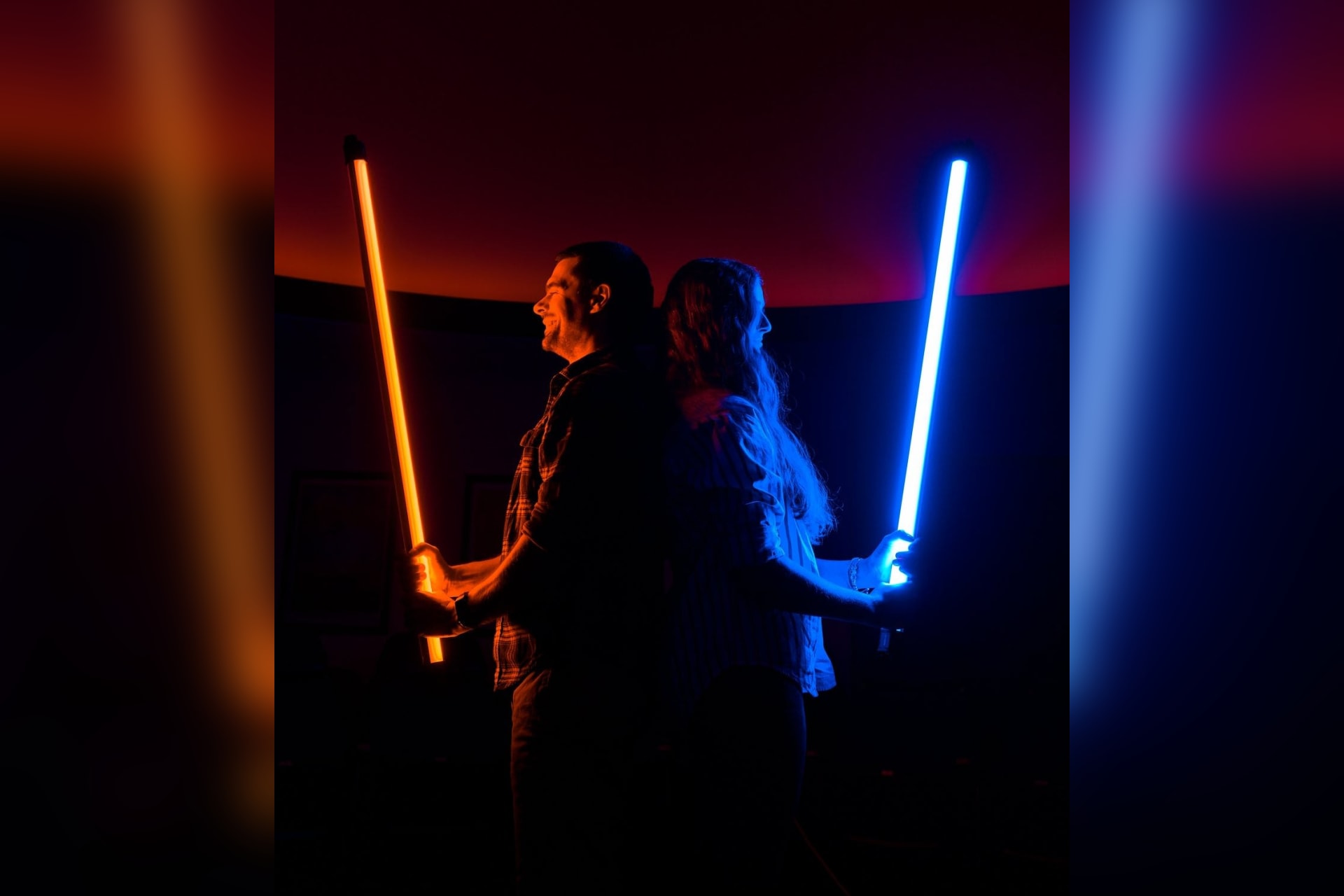
Both Fowler’s missions operate on long timelines. While the twin spacecraft of ESCAPADE, dubbed “Gold” and “Blue,” make the trip to Mars, he’s getting ready to bring the information they’ll be beaming back to West Virginia classrooms.
He hopes students will use the ESCAPADE data to ask some of the same questions he does about Mars, solar winds and science itself.
He hopes their answers will bring them closer to the stars.
Flying the colors

In the spring of 2026, ESCAPADE orbits Earth in a final test phase.
In the fall, Earth and Mars align, and the satellites will use Earth’s gravity to slingshot toward Mars, beginning their yearlong voyage.
Eventually, the data that Gold and Blue beam back to Earth will allow Fowler and others to create computer visualizations that can bring space weather and planetary atmospheric loss into sharper focus.
Fowler said his work involves “analyzing the measurements we make and trying to understand what they are telling us — what is happening at Mars, and why?”
He added, “I find this aspect particularly exciting because I have to remind myself that I might be the first person to see something in the measurements that we don’t yet understand. Then we get to embark on the journey to figure out what it means.”

Like the twin satellites, the ESCAPADE team and the global planetary science community are working in tandem.
“Our goal is to make data available,” Fowler said. “We want to really push collaboration and interaction with other scientists, because that’s how the best science gets done.”