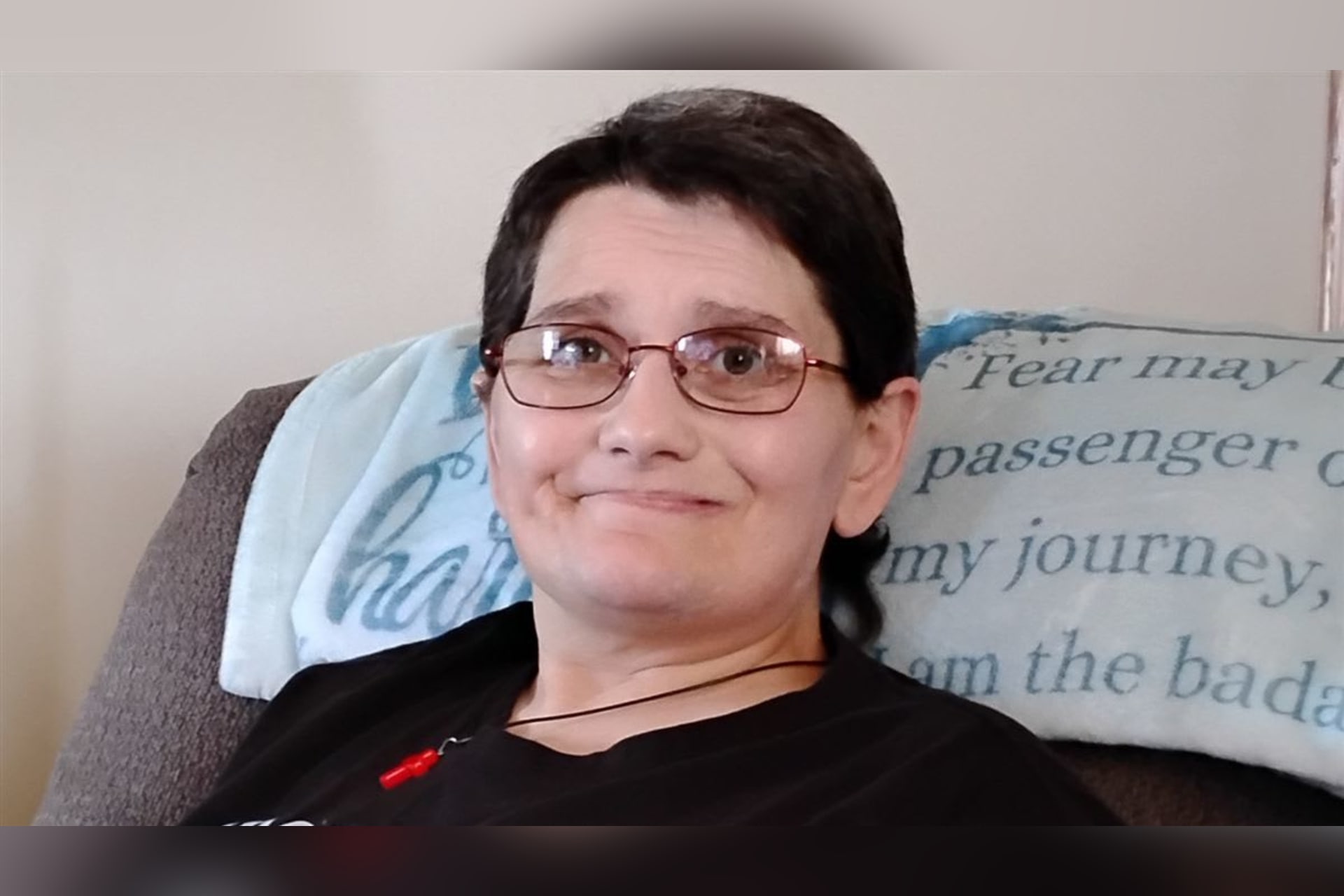
MORGANTOWN, W.Va. – As Jessica Howell headed to work early one morning, she tried desperately to shake a nagging headache. She’d had headaches before, and over-the-counter medication usually managed the pain, but not today.
By the time the 45-year-old Proctor resident arrived at work, her headache had worsened. She became nauseous and dizzy. A few seconds later, she lost consciousness.
Howell was taken by ambulance to WVU Medicine J.W. Ruby Memorial Hospital, where tests revealed an aneurysm, or a weakened spot in a blood vessel wall that ballooned, in one of the largest arteries supplying blood to her brain. The aneurysm had ruptured, leaking blood into her head and rapidly increasing the pressure inside her skull. It was a medical emergency that, if not treated quickly, often leads to brain damage and permanent disability, or worse, death.
Treatment for ruptured brain aneurysms can vary depending on their shape and size and whether a large clot or collection of blood (hematoma) is present. Endovascular treatments are minimally invasive and involve placing a small guiding tube into an artery in the arm or leg. Surgeons then thread tiny, flexible catheters into the neck and brain arteries to place a special device inside or across the neck of the aneurysm to seal it off.
However, Ryan Turner, M.D., Ph.D., a neurosurgeon at the WVU Rockefeller Neuroscience Institute who performed Howell’s surgery, ruled out such a procedure.
“She had a sizable collection of blood around the aneurysm that was causing pressure on the brain,” Turner explained. “We have to relieve that pressure by either taking the clot out or taking the bone off – or both.”
Howell needed a craniectomy, a procedure that involved removing a piece of skull, dissecting down into the fluid-filled space that surrounds the brain to get to the aneurysm, removing the hematoma and placing clips on the aneurysm to prevent it from bleeding again.
The surgery is extremely delicate. “We’re carefully dissecting around this very thin-walled balloon, essentially, to make sure we’re not including normal vessels or normal brain in that area while still trying to protect the aneurysm,” Turner said.
Instead of replacing the piece of her skull at the end of the surgery, Turner and his team left the bone off to allow Howell’s swelling to decrease and her brain to heal. A few months later, Turner placed the bone back on Howell’s head during a second surgery.
Howell spent time recovering in the Neurocritical Care Unit and later moved to the Inpatient Rehabilitation Unit. Both units, located inside Ruby Memorial Hospital, are integrated with the WVU Rockefeller Neuroscience Institute, and they guide patients through a connected recovery track from emergency neurological treatment to intensive, independence-focused rehabilitation.
Howell’s ruptured aneurysm had caused a stroke that resulted in left-sided weakness, blurred vision and swallowing difficulty, so much of her three-month-long rehabilitation was spent on walking and speech therapy.
“The day I was able to walk again helped me feel more normal,” Howell said.
Today, a year into her recovery, she continues to work with an outpatient physical therapist to improve her gait while maintaining an active, independent walking schedule. At home, Howell’s sister assists with exercises designed to strengthen her left arm and leg.
“I tell my sister all the time, I’d never have made it without her and the support system that I have,” she said. “The doctors were amazing, and the nurses were very patient and understanding.”
Howell is hopeful that others can benefit from hearing her story.
“I wouldn’t in a million years have thought that I was having an aneurysm,” she said.
Turner noted that Howell’s main symptom was a telltale sign of a medical problem that required immediate attention.
“The biggest warning sign of an aneurysm rupture is a severe and debilitating headache that’s out of character for what you normally experience,” Turner said. “Many people have headaches or migraines, but this is a different degree of pain and discomfort associated with your headache.”
Howell agreed and added her own advice.
“Don’t let it go,” she said. “Get it checked immediately. All this happening totally flip-flopped my life, but I was blessed with a second chance.”
For more information about WVU Medicine, visit WVUMedicine.org.
Community Bulletin
Hank Ellis Insurance Agency in Buckhannon is urging drivers to ask about an auto insurance rate lock — a way to hold a rate steady as premiums climb. The independent Erie agency, owner-operated since 2006, writes auto, home, life and commercial coverage. Read more →
This story brought to you paywall-free, courtesy of the My Buckhannon team and our community partners