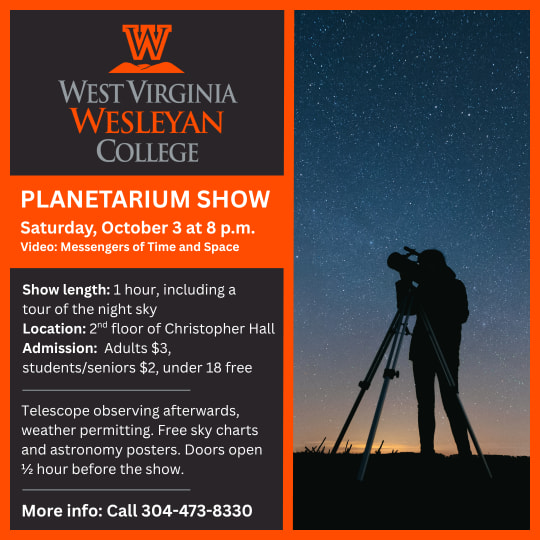
The West Virginia Wesleyan College Planetarium’s October public show looks at how astronomers are learning to study the universe through more than light — and at a night sky that turns out to be changing all the time.
“Messengers of Time and Space” screens at 8 p.m. Saturday, Oct. 3, on the second floor of Christopher Hall on the WVWC campus in Buckhannon.
Produced by NSF NOIRLab and released in 2025, the video looks back at humanity’s long history of watching a changing sky and explains two fast-growing fields. Time-domain astronomy tracks objects that brighten, fade or move. Multi-messenger astronomy combines light with other signals from space — cosmic rays, the elusive particles called neutrinos, and gravitational waves. Its examples range from ‘Oumuamua, the first known visitor to the solar system from another star, to kilonovae, the collisions of neutron stars that send gravitational waves rippling across the universe. The show features the work of the International Gemini Observatory and the NSF–DOE Vera C. Rubin Observatory.
The full monthly program runs about an hour, pairing the video with a guided tour of the current night sky. Weather permitting, telescope observing follows the show, and free sky charts and astronomy posters will be available. Doors open a half-hour before showtime, and seating in the 40-seat facility is first-come, first-served.
Admission is $3 for adults and $2 for students and seniors. Children under 18 attend free. Proceeds support the planetarium’s upkeep and free shows for school and youth groups.
The WVWC Planetarium has offered public astronomy programs since Christopher Hall opened in 1967, when community outreach was part of the building’s original mission; a later Naylor Family gift funded its digital projection system on the same premise. It hosts public shows year-round, typically at 8 p.m. on the first Saturday of each month, and is directed by Dr. Tracey DeLaney, associate professor of physics at the college.
For more information, call 304-473-8330.