Community Bulletin
Since joining Vandalia Health, the former Davis Health System has widened access across central West Virginia. Primary care remains the front door — now at five clinics, including Buckhannon Medical Care, backed by a 190-location network. Read more →
This story brought to you paywall-free, courtesy of the My Buckhannon team and our community partners
The sugar maple harvesting season at WVU Potomac State College is coming to a close, and like the wines of Southern California or the South of France, every production cycle has its season. The 2025-2026 Catamount Syrup Vintage is ready to be capped, corked, labeled and stored.
It’s a long and patient process that began months ago, in the dead of winter, just as campus was reopening after holiday break.
“It’s two months’ worth of work. We normally start in December and then regroup in January, and then we tap the trees and then wait for the maple sap to start running,” said Donna Ballard, professor of horticulture and PSC director of farms.
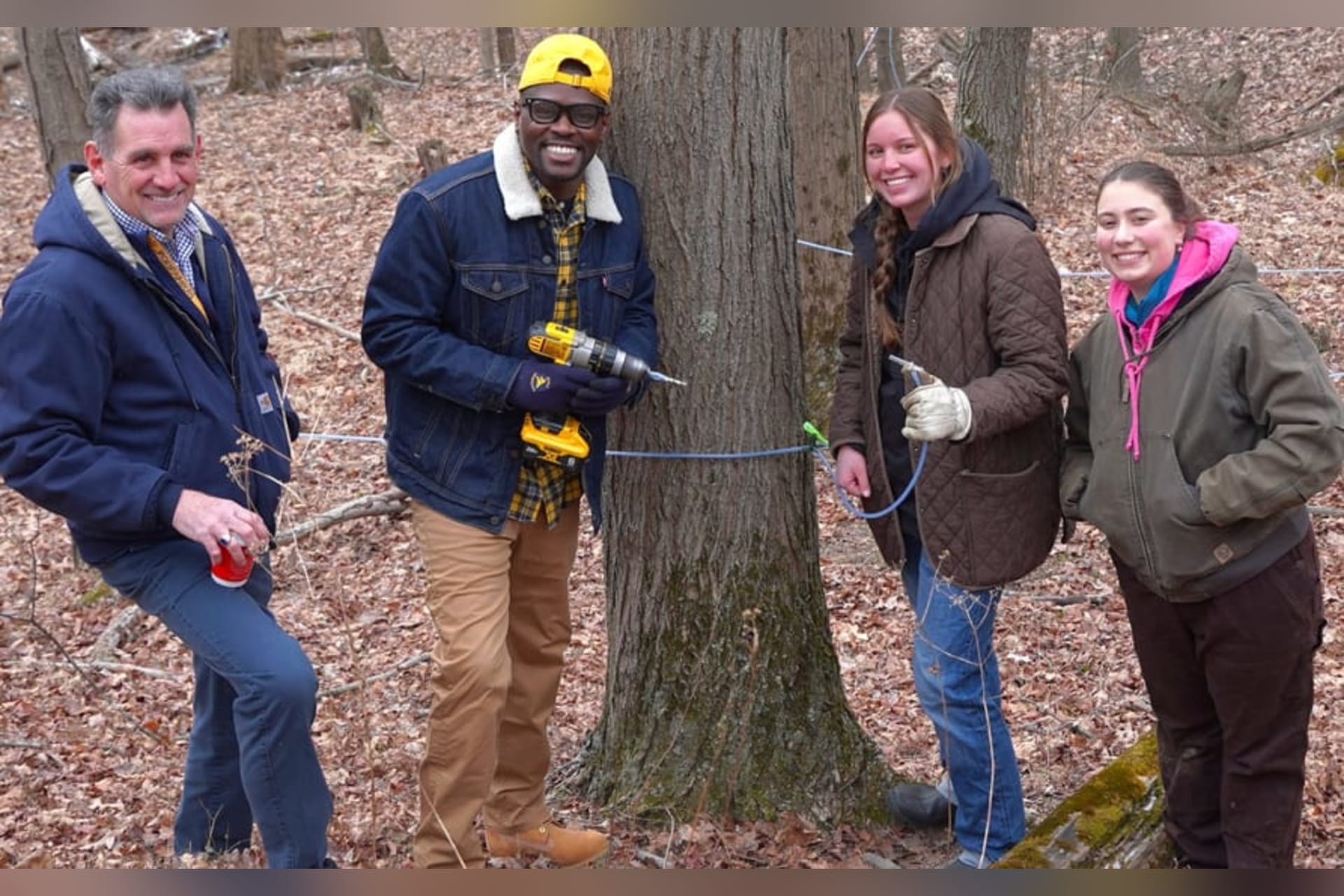
The maple trees on the farm property were tapped in mid-February by agricultural and forestry majors and student volunteers. That tapping involved drilling a small hole in the tree trunk and inserting a spile with a light-blue PVC tube into it. The light blue color is intentional, reportedly fooling predators intent on chewing through the tube to feast on the sticky, sweet sap.
Over the next few weeks, gravity takes over, allowing the maple water to flow naturally from more than 100 viable maple trees on the farm property into a holding tank in the rear of the Sugar Shack. Once the 900-gallon tank is nearly full, staff and students open a valve, allowing the maple water to drip slowly into the indoor evaporator.

The maple water is captured in a reverse osmosis tank, where the water is separated from the sugar. The resulting scent from the building is not unlike baking yeast, pretzels or pizza dough from an oven.
“The machine the maple sugar is in is very much like how beer is distilled, so a lot of people say the smell reminds them of what a brewery or distillery smells like when they walk into it,” said Stephen Collette, a sustainable agricultural entrepreneurship student who works the equipment.
Once the reverse osmosis process and evaporation are complete, what most people know as maple syrup — with its lovely translucent golden color — is what remains in the tanks. The yield is about 10 percent of what went in at the start of the process. In other words, 400 gallons of maple water produce about 40 gallons of pure West Virginia-made maple syrup.
“When it gets to that point, the syrup is in concentrate form, and that is the form most people recognize as maple syrup,” Collette said.
This is a department and process unlike any other taught on a college campus outside the New England states, Ballard said.

“Potomac State is very unique with this. It’s a very unique workshop. It amounts to a very intensive lab experience,” she said.
But when does maple season officially end? That’s up to Mother Nature, Collette says.
“We can keep going until the trees start to bud. Once that happens, we need to stop,” he said, explaining that continuing after budding would dehydrate and starve the tree, making it unusable for the following year.
“The maple trees do have a peak season, and nobody knows when that is for sure until it happens. So when it happens, we get to work,” Ballard said. “Peak season depends on elevation, atmosphere, and weather conditions, and how cold the winter has been.”
This was Collette’s second year tapping the trees and producing the syrup. He came back to school for a degree in Sustainable Agricultural Entrepreneurship after teaching math at a nearby school.

“I really had never done this before until last year. Now this year, I am teaching again because I am teaching other people how to do this,” he said. “I do enjoy teaching this to people. It’s fun.”
“Maple syrup production is listen, learn, and then teach,” Ballard added.
The production of maple syrup is a time-honored tradition, handed down from generation to generation, with modern equipment making it less labor-intensive and more cost-efficient.
“Folks have been making maple syrup for generations. They have made it in kettles in their backyards over an open flame to what we are doing today. The method has stayed the same. The only thing that has changed has been the equipment,” Ballard said.
Does maple syrup from Potomac State College, in the foothills of the ancient Appalachian Mountains, taste different than syrup from places more renowned for its production, like Vermont? According to Ballard, the answer is yes.

“It’s called the Terrior, which is actually French and used first for wine-making grapes. A grape at the same temperature and atmosphere in France will taste different than a grape raised under the same conditions in California. And that is because of the soil contents, the water the plant received, and the climate in which the grapes were raised. The same is true for maple trees and maple syrup. Each region will taste just slightly different,” she said.
And can real connoisseurs of maple syrup tell?
“Oh yes. You have heard of wine snobs, right? There are maple syrup snobs, and they know the difference,” Ballard said.
Is Ballard one of them?
“I will never tell,” she said.

Eventually, the syrup is poured into a 40-gallon steel keg and transported to the commercial kitchen on the Gustafson property, where students process, bottle and label it. Since the product is distributed into pint jars, the college can expect to add an average of 320 pints to its inventory during a typical maple syrup production season.
While only 100 trees are currently used for production, the campus farm has 1,500 maple trees on the property.
“We will add as we go. We are only limited here by our available labor. And that labor is provided by our students. If we decided to add in all 1,500 trees, we would need about 400 student volunteers out here working every day,” Ballard said.
The program was initially started in 2017 by Eddie Hartman of New Creek, WV. When the program was later restarted, current instructors and students had to “learn from scratch,” enlisting the help of regional maple syrup producers for initial expertise.
“Agriculture is what this College was once known for, for producing amazing farmers and people who knew how to get the most out of the land. That hands-on day-to-day learning is something we got away from years ago, and we are just now getting back to it,” Ballard said.