Community Bulletin
A longtime State Farm agent on Buckhannon's Main Street, Kelley Tierney offers home, auto, life and renters insurance — plus State Farm financial services — under the company's "Here For What Matters" approach. Read more →
This story brought to you paywall-free, courtesy of the My Buckhannon team and our community partners
By Jancee Crotts
Close your eyes and envision an Appalachian small town.
You might picture Lewisburg.
Located in the heart of West Virginia’s scenic Greenbrier Valley, the Lewisburg area is known for the State Fair of West Virginia, the Chocolate Festival and a downtown where neighbors still recognize one another by name.
It is also home to West Virginia University student Nate Muhs.

One sunny day, Muhs returned to Lewisburg from Morgantown. He hadn’t been there for long before Lewisburg Mayor Beverly White recognized him and brought him over to catch up with her sister, a former coworker of his at the local restaurant Food & Friends.
Despite Muhs’ pleasure in reconnecting, he wasn’t in town for a social visit. This time, he’d come home to help his community prepare for the unexpected.
A major in electrical engineering at the WVU Benjamin M. Statler College of Engineering and Mineral Resources, Muhs was in Lewisburg representing the WVU Cyber-Resilience Resource Center, a statewide initiative that helps West Virginia businesses, communities and local governments withstand technological threats and disruptions.
“I learned so much about cybersecurity from the CRRC,” Muhs said. “My experience there helped me land an internship at Bechtel Plant Machinery, where I contributed to the security of equipment used by the U.S. Navy. The skills I am building could eventually support organizations with a national or global reach. But it is difficult to imagine anything more meaningful than helping my own hometown remain strong and prepared.”
Muhs was accompanied by four fellow students from the CRRC and by CRRC Director of Center Operations and Outreach Frank Hatten.

Hatten, a Wayne County native and first-generation college graduate, built his career across technology, cybersecurity, risk management and organizational operations before bringing that experience back to West Virginia. He earned his master’s degree from WVU and now teaches cybersecurity in the WVU John Chambers College of Business and Economics in addition to his work for the CRRC.
Hailing from a small West Virginia community himself, Hatten said he knows local organizations are often expected to provide essential services with limited staff and resources.
“My industry experience taught me to look beyond individual devices and consider the big picture,” he said. “At the CRRC, we help communities turn that broader understanding into practical steps that reduce risk.”
He added, “Growing up in a small town taught me that resilience is about people finding a way to keep serving one another, even when resources are limited or circumstances change. Technology is now part of nearly every essential service, so helping communities understand their dependencies and prepare for disruption is a natural extension of that same Appalachian spirit of resiliency.”
At the CRRC, Hatten and his students help West Virginia organizations understand how their people, technologies, vendors and daily operations work together, so organizations can be ready for problems, limit their effects, continue essential services and recover effectively.

“Our fellows gain practical experience beyond the classroom, working alongside experienced professionals on real organizational challenges,” he said. “At the same time, communities receive free assistance that helps them understand what matters most and how to keep serving people when something unexpected happens.”
Small towns depend on emergency services, clean water, reliable communications, accurate financial systems and functioning local government just as much as major cities do, he emphasized.
They also face many of the same risks: equipment failures, vendor outages, severe weather, staffing changes, cyber incidents and communications disruptions.
“Every emergency call that gets answered and every glass of clean water that comes from the tap depends on people and connected systems operating reliably,” Hatten said.
“Resilience means understanding those connections, preparing for disruption, and making sure the community can continue relying on essential services.”

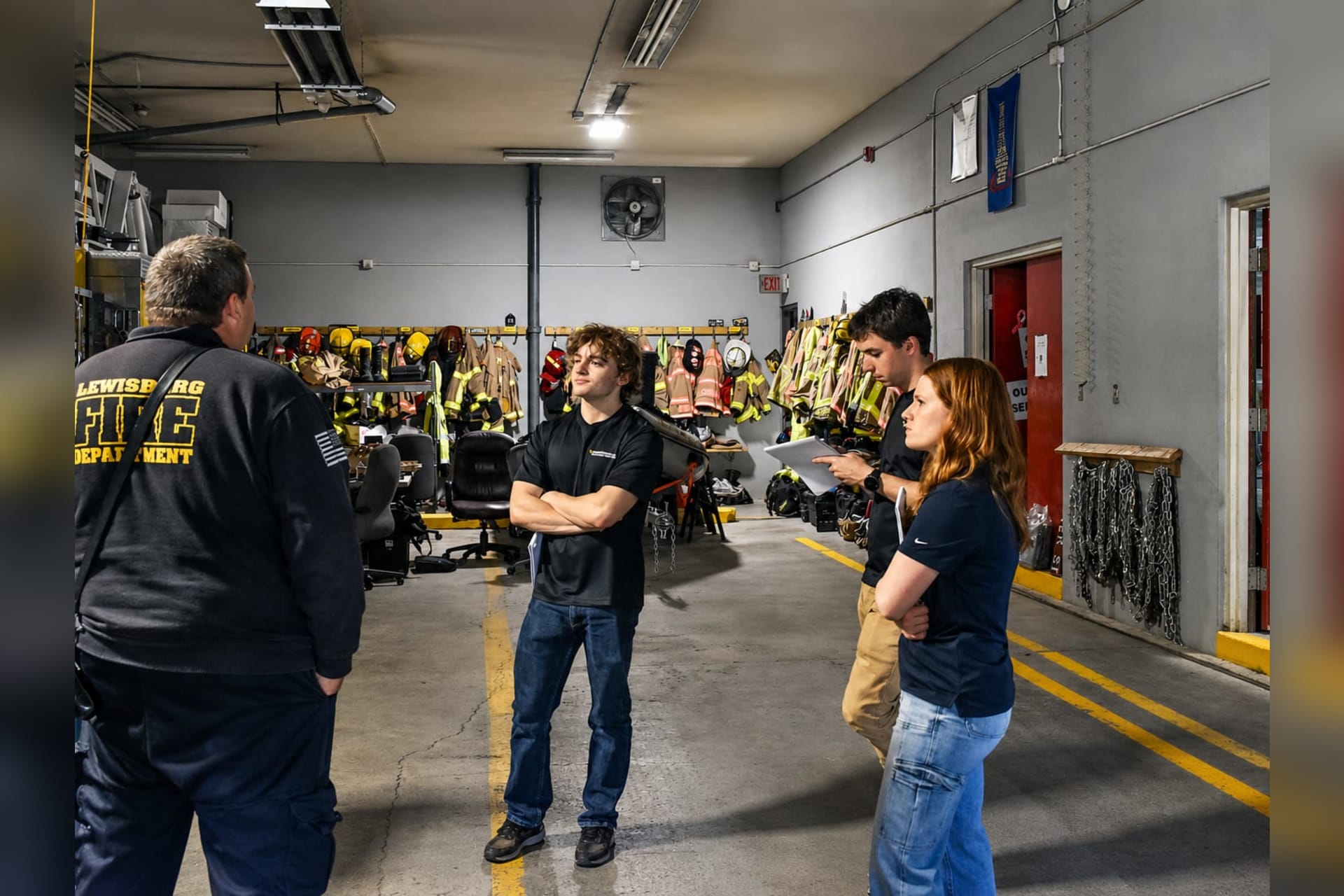
The CRRC team began at City Hall and continued to the fire station, water treatment facility and police station.
“The fellows were not just looking at computers,” Hatten said. “They were learning how technology supports water service, emergency response, public safety, finance, and daily city operations. We think about how those systems depend on one another, where responsibility sits, and how the city could continue serving residents during a disruption.”
At each location, fellows spoke with the people responsible for keeping services running. They asked questions like:
Which services must remain available during an emergency?
How would departments communicate if normal systems or email were unavailable?
Are important records backed up and recoverable?
Who is responsible for restoring critical services?
What manual processes are available if a digital system stops working?
Muhs said, “I met a worker from the water department and realized we used to be neighbors — we both lived near the same turkey farm. I also heard stories about people’s grandchildren and about the decades some employees have spent in public service. In Lewisburg, a lot of the people behind the systems are my family and friends, and that helped me see how the individuals involved with the technologies need to balance changing responsibilities with limited time and resources.”

In his view, conversations like those matter, because resilience depends as much on institutional knowledge, communication and trusted relationships as on technology.
Muhs also recalled how Lewisburg’s city manager described the city’s coordination of its response to a previous water outage and how multiple departments worked together to restore service quickly.
For Hatten, that example reinforced why resilience must be viewed across the entire organization.
“An issue affecting one system or service can quickly extend beyond a single building or department, so understanding those ripple effects helps a community prepare a coordinated response instead of reacting in isolation,” he said.
“Our job is to help communities identify what is most critical, understand where systems and services intersect, and prepare for the moment when normal operations do not go as planned. The strongest organizations are not those that never experience disruption. They are the ones that know how to continue serving people and recover in an organized way.”

Beyond Lewisburg, the CRRC works with West Virginia organizations and communities that may lack dedicated cybersecurity personnel or the resources to conduct comprehensive resilience assessments on their own.
Its fellows assist local governments, water and wastewater systems, nonprofits, small businesses, startups and other organizations that provide important services across the state to “identify critical assets, document operational dependencies, strengthen backups, improve incident response, review vendor relationships, develop continuity plans, and train employees to respond effectively when normal operations are disrupted,” Hatten said.
Launched in 2024 with support from the Appalachian Regional Commission as part of a broader initiative, the CRRC is designed to support organizations across all 55 West Virginia counties while preparing more than 200 students through paid fellowships, internships and experiential projects.
West Virginia organizations receive practical assistance they may not otherwise be able to afford, while students like Muhs develop technical skills, professional judgment and experience communicating with the people responsible for essential services.
By the time Muhs and the CRRC team packed up for the drive back to Morgantown, he was beginning to understand his hometown in a new way, he said.
“I may be from Lewisburg, but I learned a great deal more about my community during the visit. I learned about the people behind the systems — the people who make sure water is safe to drink, emergency calls get answered, and local government keeps moving.”
He added, “They are the ones who protect our communities every day. I am proud the CRRC could do its part to help them prepare, adapt, and keep serving the people who depend on them.”