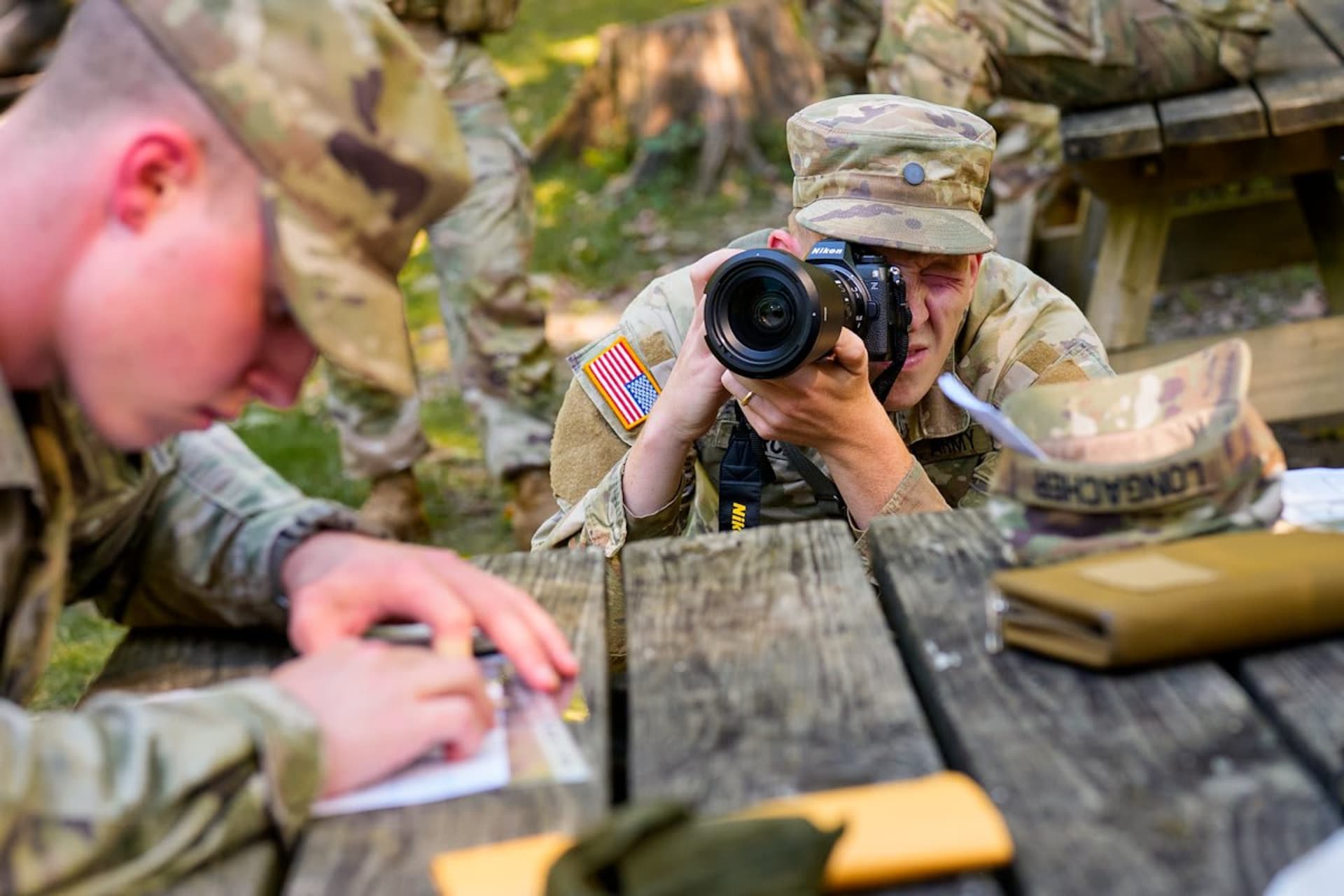
From his shrinking West Virginia hometown, Ayden Norcross assumed his future lay under the hood of other people’s cars or in the crawl space of other people’s homes, as an auto mechanic or HVAC technician, with enough steady pay to continue fueling his passion — filming silly YouTube videos.
But an undergraduate education at West Virginia University, along with the Army Reserve Officers’ Training Corps, encouraged him to think bigger, transforming a hobbyist into a documentarian, a citizen into a soldier and a 145-pound kid from western Mingo County into a young man with a well-stamped passport, a robust multimedia portfolio and 30 pounds of added muscle.
“I never thought I would go anywhere,” he said. “I just sort of had my lot in life.”
The coalfields
Norcross spent his early childhood in Sandusky, Ohio. While his single mother worked, his grandmother would watch him. Then, when he was around 10 years old, his grandmother died in a car accident, and his mother moved the family back to her roots in the town of Williamson, pressed against the Kentucky border.
He wanted to leave. Williamson was built on “black gold” — bituminous coal — in the early 20th century, but when Norcross arrived, its population had dwindled to less than a third of its peak. Many of the town’s 2,500 people worked at the local hospital or in the shrinking mines, and as the jobs left, the opioids snaked in. Drug wholesalers dumped more than 20 million pain pills into the town, which developed a nickname: “Pilliamson.” Men injured in the mines got hooked on the pills, Norcross said, spawning more dangerous addictions to heroin and fentanyl. Crime soon followed.
“Williamson is an interesting place,” he said, “but it’s got a lot of problems. I don’t want to move back there. It’s not a place filled with opportunity.”
But Norcross made his own opportunities. He’d been filming YouTube videos since he was 10 — including raw early attempts like one clip of him throwing a sock down a flight of stairs while screaming. He read the news and watched documentaries, and he latched onto the writing of gonzo journalist Hunter S. Thompson, Stanley Kubrick’s “Full Metal Jacket” and the documentaries of Louis Theroux.
“I love creating. It’s my whole life,” he said.
He briefly returned to Sandusky from Williamson to shadow his uncle, a mechanic. But he still didn’t see his future.
“I just lived in my little town for so long, and I was like, I need to get out of here,” he said. “Being a mechanic, it’s a job, but why not do something that I like to do as my work and build this skill that I enjoy?”
College, he decided, was worth a try. A visit to WVU helped persuade him, including a trip to the Student Recreation Center.
“I saw the pool. I was like, wow, this place is nice,” he said.
Norcross enrolled as a journalism major, joined the Army ROTC — satisfying a lifelong interest in the military — and spent his freshman year in a Living-Learning Community for cadets.
“We had a blast,” he said. “We would help each other out.”
The program demanded early mornings and a structure that made him happy.
Then, after one semester, he left campus.
Basic training
ROTC cadets can serve in the National Guard or Reserve while they’re still in school. So after his first semester, Norcross enlisted in the state National Guard as a public affairs specialist, stepping away from classes for a semester and a summer.
First came roughly nine weeks of basic training.
Then, he spent six months at the Defense Information School in Fort Meade, Maryland, where public affairs troops are trained.
Norcross learned Photoshop, Illustrator and Premiere Pro. He got hands-on experience conducting interviews and designing logos.
By the time he returned to Morgantown, he was “light years ahead,” he said.
His pockets were deeper too. Federal and state tuition assistance, plus scholarships, cover Norcross’ entire education.
“I don’t pay a dime to be here. I get paid,” he said.
Back on campus, he settled into the rhythm of ROTC. Cadets train at 6 a.m. three days a week, and most work out on their own as well. Military science classes cover basics such as map reading, artillery firing and radio operation, and cadets put those lessons into practice in labs often held at Coopers Rock State Forest. A cadet is placed in charge and given a mission, the enemy’s position and 20 minutes to write a plan for 30 to 40 cadets, before presenting it over a model of dirt mounds and toy soldiers.
“It shows how you can think under pressure. It shows leadership ability,” Norcross said.
During a February field training exercise at Camp Dawson in Kingwood, he faced his hardest test while humping a 27-pound M240 machine gun plus a rucksack of roughly 40 pounds over a few miles of rough terrain.
It snowed, sleeted and rained. The cadets slept in a patrol base with no tents while someone stayed awake on guard.
“I was really wet and freezing cold,” he said. “But if you wear too much cold weather gear, you’ll sweat too much and you’ll pass out. If you can do the field training, then having to study for an exam is light work.”
First flight
Norcross now drills one weekend per month with the 153rd Public Affairs Detachment, a unit of about 11 soldiers that covers the West Virginia National Guard.
When he traveled to basic training, it was his first time on a plane, and his first annual training sent him to the Joint Multinational Readiness Center in Hohenfels, Germany, in 2024.
There, he documented Allied Spirit, a NATO exercise that brought together troops including Germans, Dutch and Hungarians. Drones dropped tennis balls on vehicles to simulate strikes, and soldiers posed proudly beside their tanks for his camera.
Norcross had expected stern and humorless Germans.
Instead, “they were the exact same as us,” he said.
He befriended a German public affairs sergeant who doubles as a professional rapper. He ate schnitzel and pretzels on a free day in Regensburg.
Qatar, however, was a new landscape. He covered a pair of Best Warrior competitions, one American and one Qatari, held side by side in partnership with Qatar’s National Service Academy.
“It looked so different. It looked like Mars,” he said.
He was concerned about how American soldiers would be received in a Middle Eastern country, and although the Qatari soldiers were initially wary, by the end, “they were trading patches, and everybody was patting each other on the back, giving hugs, and it was great.”
Recently, he traveled to Peru for a planning conference. A colonel from a Peruvian jungle school introduced the visiting Americans at an Independence Day parade, and townspeople lined up for about an hour to take photos with them. The Peruvians he met spent their days outside, dogs roamed the streets and neighbors raised chickens.
“I was just surprised at how similar Peru was to Williamson, West Virginia,” he said.
Seeing the world makes a person more empathetic, he said, “once you see other people are just like me, you know?”
The kid with the camera
The discipline Norcross acquired in the military followed him into the study hall.
“How you do one thing is how you do a lot of things,” as he put it.
The kid who once filmed a sock tumbling down the stairs is now a WVU senior who has made seven documentaries.
One of those investigates the 1932 murder of Mamie Thurman in Logan County, whose ghost is said to pull cars back up a hill. Norcross and his crew went out to test the legend themselves.
His portfolio from Germany landed him a job shooting marketing photos and video for WVU Dining. After seeing Norcross’ pictures of armored vehicles, his new boss told him, “Somehow you made a tank look sexy.”
“I was hired the next day,” Norcross said.
He also works as a gaffer and second assistant camera on short films in Pittsburgh with Davis Rohrer, a filmmaker and sergeant in his unit.
After graduating, Norcross and his wife will head to Charleston to start a family. He aims to work in marketing.
“The choice I made to take a risk and go to college has paid off tenfold,” he said.
Story by Jonathan Cribbs, WVU Stories.
Community Bulletin
Bundling home and auto can lower your premiums — and at Jen Kesling State Farm in Buckhannon, a full-service agency with a 4.9-star Google rating across 300-plus reviews, a bundled quote is a phone call away. Read more →
This story brought to you paywall-free, courtesy of the My Buckhannon team and our community partners