When Gesa Dinges started her academic career in neurobiology, she didn’t expect to find herself pulled into the world of engineering. But after meeting West Virginia University robotics assistant professor Nick Szczecinski at the University of Cologne during his postdoctoral appointment, she realized that her research questions would benefit from the expertise of disciplines outside of the natural sciences.
“I find that different disciplines have the potential to excel each other forward. Not only are the questions that are asked different but the approach to tackle problems differs based on training and education,” Dinges explains. “Biologists have the tendency to investigate how something functions until the smallest part is understood, using a lot of different methods that all compliment each other to achieve a full picture. Engineers tend to have more of a ‘Wouldn’t it be cool if we could understand how this part works so we can build this other thing with it?’ attitude. It’s two different motivations, both with merit on their own, but together they allow for better understanding of highly complex systems while opening the door for new creations.”
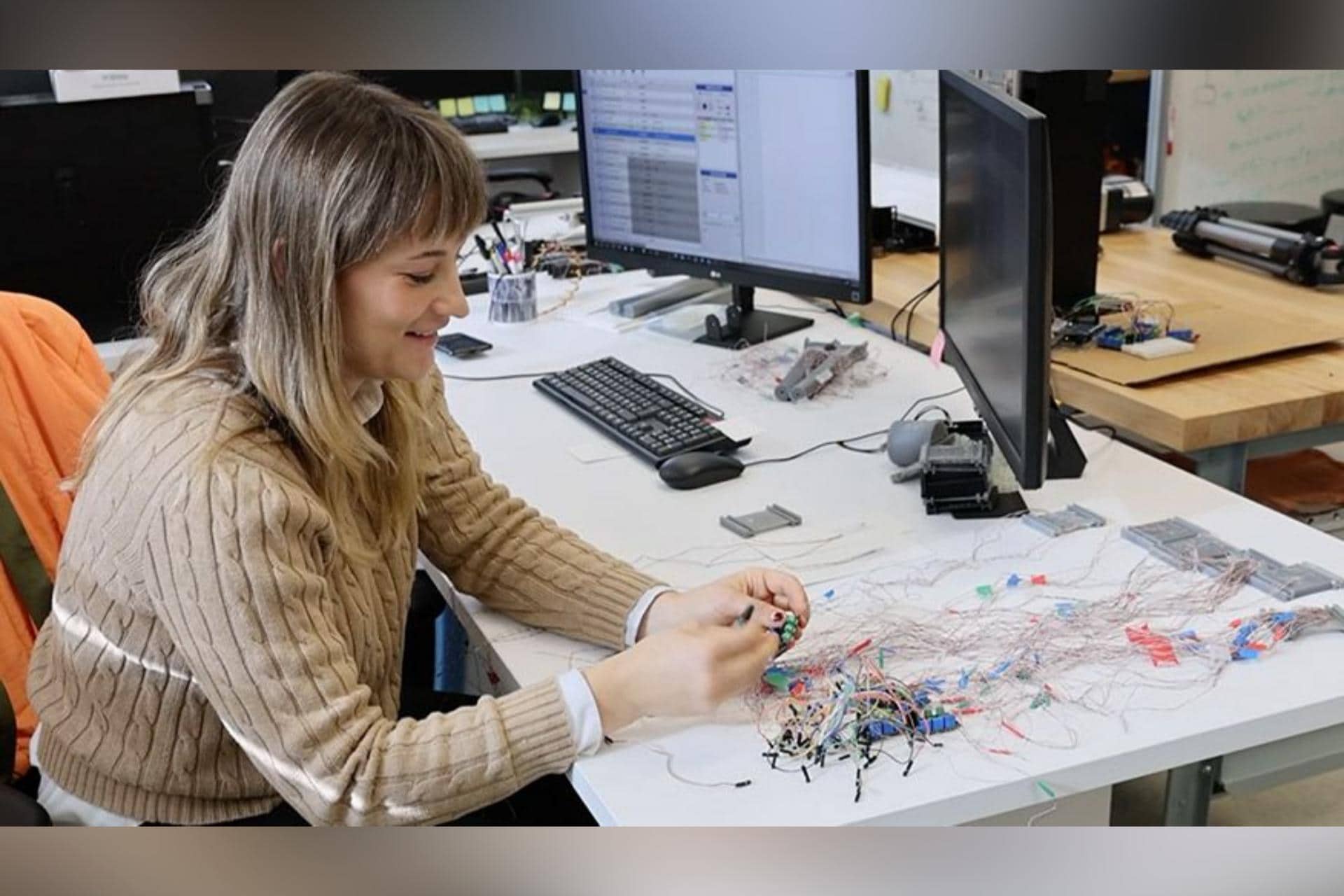
For her master’s thesis, Dinges focused on insects’ locomotion and motor control. Dinges dabbled in classical engineering methods that mirrored the mechanical interface of the sensors, but had still worked primarily with biologists up to that point. When she started her PhD in Germany, she knew she wanted to make her research more applicable and challenge herself in another discipline. As Szczecinski explored research questions on the locomotion of insects from a robotics perspective, Dinges decided she was ready to try something new.
“When I wrote my grant it felt risky, I remember thinking ‘I’m leaning out of the window very far right now, I’m not necessarily qualified to be doing this,” Dinges recalls. “It was thrilling that it was funded — and now seeing our publications and the progress we’ve made is fantastic — but it was definitely not expected. Neither at the beginning nor the end of my PhD was I planning to work with robots or in a mechanical engineering lab.”

Szczecinski, assistant professor in the mechanical, materials and aerospace engineering department at Benjamin M. Statler College of Engineering and Mineral Resources, started the Neuro-Mechanical Intelligence (NeuroMINT) lab at WVU in 2020 with a focus on robotic modeling of animal systems. Dinges wanted to work with Szczecinski and knew the lab held opportunities for her research interests to thrive.
“It makes the ideas you have on how to approach the problem a lot more creative and out of the ‘box’ of one discipline,” Dinges said. “It opens a lot more opportunities on how to investigate something because you’re not just using the tools and methods that are traditionally within one field — you can look at it with a lot of new novel things that might be extremely useful for that discipline.”
Dinges joined the NeuroMINT lab in 2022 as a Walter-Benjamin Postdoctoral Fellow from the German Research Foundation. She’d lived in Canada and the US during her childhood, including in north Pittsburgh, so coming to West Virginia felt familiar. It’s become a home away from home for Dinges — she plays hockey and loves her community in Morgantown.
“Gesa has been tremendously valuable to our research group,” Szczecinski says. “Her scientific background has elevated the quality of our research, and her biological systems models have led to exciting, completely novel solutions to problems that animals and robots both face. She’s a true community builder — she brings together all kinds of people both within and outside the lab in a way that supports everyone and helps them grow. Gesa is a powerful exemplar of WVU’s values, and it’s a privilege to have her in my lab.”

Through a National Science Foundation grant in collaboration with Marshall University, Dinges is now investigating the variability in insect load sensors and how to integrate similar sensory information into insect-like robots here at the Statler College. Recently she’s made progress characterizing how insect’s sensory organs can filter information. At last year’s GAIN conference in San Francisco, Dinges won a Science Slam contest for her research, competing against peers from institutions like Stanford and MIT.
“I won and thought ‘You don’t need a prestigious ivy league name in order to do impressive research’. I specifically came to WVU to work with Dr. Szczecinski, and winning competitions like these further cements that it was the right decision.’”
Dinges hopes to incorporate her unique research approach, which she describes as ‘broad but thorough’ into her future work.
“My work has been very eclectic, allowing me to dive into various experiments and questions,” she says. “I think the important thing is to not fear the unknown, I shifted from neurobiology to robotics and so far it’s been an excellent decision for me intellectually and personally.”