Story by Rachel Brosky, Media Manager – WVU Office of Strategic Communications and Marketing
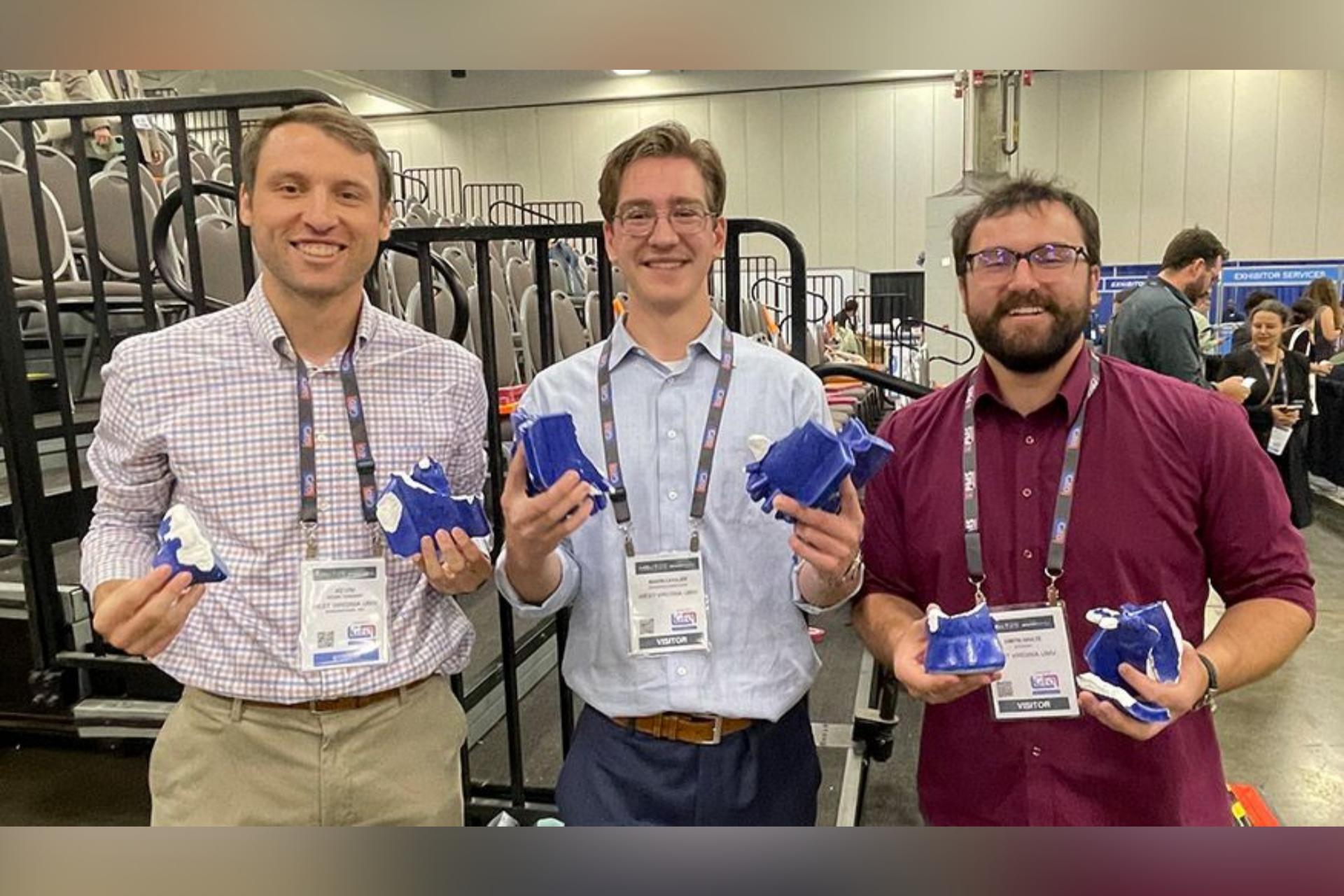
West Virginia University Benjamin M. Statler College of Engineering and Mineral Resources chapters of the Material Advantage and Materials Research Society took home their first win in the 2025 iteration of the Materials Science and Technology Conference’s University Ceramic Mug Contest in Columbus, Ohio.
Hosted annually by the Keramos National Professional Ceramic Engineering Fraternity, the purpose of the University Ceramic Mug Contest is to create friendly competition between engineering students by testing their prowess in making strong, mechanically reliable and aesthetically designed ceramic mugs.
The competing mugs must be made in the current academic year and are judged on appearance and their ability to stay intact when dropped from various heights.

Materials and manufacturing presented significant challenges for participants.
Each mug must be constructed solely with ceramic or glass materials, without any metal, plastic, paint, organics or non-ceramic materials. Students could not use any commercially made parts such as rods or fiber mats. Raw materials such as powders, liquid precursors, fibers and chemicals were permitted to be purchased to aid construction, but any woven textile fiber architecture to reinforce the mugs was not allowed. The mugs also had to be food-safe and contain no acutely toxic materials such as arsenic. They also had to be fired at 1,000 °C or higher, and no additions could be made to the mugs after firing.
The final mugs had to be single, monolithic pieces, no more than 25 centimeters in height and 20 centimeters in diameter, with the year of the competition carved into them and the ability to hold between 350 and 650 milliliters of liquid.
“Opportunities like this one give students a chance to see another side of engineering that they rarely get in their coursework,” said Mason Cavalier, a mechanical engineering major and vice president of the WVU MA/MRS chapter.

“I would say it’s 30% mechanical design, and 70% material design and processing. If the mug you bring in isn’t the correct composition, hasn’t been fired correctly, or has major defects in its structure, you will not do well in the competition.”
Cavalier, along with students from the Mechanical, Materials and Aerospace Engineering department — Dimitri Shultz, Kevin Tennant, Davis Warmuth, Matthew Kraska, Izzy Farinash and chemical engineering major Colton Balog — created three mugs for this year’s competition, with the winning design surviving a drop of 10 feet 4 inches.
Shultz, Cavalier and Tennant entered the designs alongside 42 mugs from other universities. WVU MA/MRS has scored within the top three competing universities since 2022, but this is the first year they took home the top prize.
Unlike previous years, WVU had no MA/MRS members experienced in ceramic casting, which made the month-and-a-half creation timeline more intimidating. Despite the pressure, the students came up with their winning designs using a previous mold and fine-tuning the composition and firing temperature for the mugs.

With some help from the WVU College of Creative Arts and Media’s Ceramics adviser Robert “Boomer” Moore, they were able to fire the mugs in time to travel to Columbus.
“My favorite part of the competition was seeing how many people were excited and engaged in this type of competition,” Cavalier said. “At least in my experience, there aren’t a lot of students that are interested in these types of material heavy events, so to see a large group of people like that was amazing.”
For more information on MA/MRS, visit materialadvantage.orgs.wvu.edu.